


Panerai automatic watches require movement-specific turns-per-day (TPD) and winding-direction settings. Independent watch-winder references commonly suggest approximately 650–950 TPD for selected Panerai calibres, but the correct program depends on the movement rather than the Luminor, Submersible, or Radiomir collection name.
Older OP-series movements demonstrate important differences. Calibre OP III is commonly listed at approximately 800 TPD clockwise, while OP IV, OP VI, and OP VII are generally associated with approximately 650 TPD bidirectional. The automatic P.9000 family frequently appears in independent databases with recommendations around 800–950 TPD bidirectional.
Modern movements require separate consideration. The P.900 uses a bidirectional rotor and provides three days of power reserve, while the P.9010 uses two barrels to achieve a similar running duration. Neither specification alone determines an exact external TPD requirement.
Many Panerai watches are manually wound. Calibres P.6000, P.5000, and P.3000 cannot receive energy from conventional rotating watch winders.
For Panerai owners, accurate movement identification is more important than following a generic brand-wide setting.
Why Panerai Watch Winder Settings Vary Between Movements
Panerai's mechanical identity has always been closely associated with functional design, substantial cases, and extended power reserves.
The Luminor, Radiomir, and Submersible collections share recognizable elements of the brand's design language, but their internal movements vary considerably.
Some contain relatively compact automatic calibres.
Others use larger movements with two barrels, specialized complications, or extended power reserves.
Many retain manually wound constructions that reflect Panerai's historical approach to watchmaking.
This distinction is important because a conventional watch winder works only with a compatible automatic movement.
An automatic movement contains an oscillating weight that responds to motion. As the rotor moves, its winding mechanism transfers energy to the mainspring.
A watch winder supplies controlled external rotations to help operate this system.
However, not every Panerai automatic movement converts external motion into stored energy in the same way.
Older calibres derived from established Swiss movement architectures may have different winding-direction requirements from Panerai's more recent manufacture movements.
A Luminor powered by OP III should therefore not automatically receive the same program as a Luminor Marina using P.9010.
Similarly, two movements offering three days of power reserve do not necessarily require identical external rotation programs.
The correct setting follows the calibre's winding architecture, not the watch's appearance or stated running duration.
Panerai TPD Settings and Rotation Direction by Calibre
Independent winding-reference databases contain settings for numerous historical Panerai movements.
These references can help identify useful starting programs, but they should not be mistaken for universal manufacturer-issued instructions.
The distinction is especially important with modern P-series calibres, for which some third-party databases provide incomplete or conflicting information.
Panerai Watch Winder Settings Chart
| Panerai calibre | Winding type | Independent TPD reference | External rotation direction |
|---|---|---|---|
| OP III | Automatic | Approx. 800 | Clockwise |
| OP IV | Automatic | Approx. 650 | Bidirectional |
| OP VI | Automatic | Approx. 650 | Bidirectional |
| OP VII | Automatic | Approx. 650 | Bidirectional |
| P.9000 | Automatic | Approx. 800–950 | Bidirectional |
| P.9001 | Automatic | Approx. 800–950 | Bidirectional |
| P.9002 | Automatic | Approx. 800–950 | Bidirectional |
| P.9010 | Automatic | Approx. 650 in some references | Verify exact external program |
| P.900 | Automatic | No consistently verified exact TPD | Bidirectional internal rotor; verify external program |
| P.900/GMT12H | Automatic GMT | Verify | Bidirectional internal rotor; verify external program |
| P.4001/S | Automatic micro-rotor | Verify | Verify external program |
| P.9010/AC | Automatic annual calendar | Verify | Verify external program |
| P.6000 | Manual | Not applicable | No conventional winder |
| P.5000 | Manual | Not applicable | No conventional winder |
| P.3000 | Manual | Not applicable | No conventional winder |
Numerical TPD entries are independent third-party recommendations, not official Panerai settings. Internal rotor construction and the direction selected on an external watch winder are not automatically interchangeable. Verify the exact reference before programming.
The most important difference is not always numerical.
Consider OP III and OP IV.
The former is commonly associated with clockwise winding at approximately 800 TPD.
The latter appears with bidirectional recommendations around 650 TPD.
Using an unsuitable direction can reduce the amount of effective winding even when the device performs its programmed rotations correctly.
Modern P-series movements introduce another challenge.
The P.900 and P.9010 both provide approximately three days of autonomy, but that does not establish that both should operate at 650 TPD.
For a fuller explanation of how TPD relates to effective winding, consult the watch TPD guide.
Understanding Panerai OP-Series Winding Requirements
Before Panerai developed its broader range of manufacture movements, many watches used calibres derived from established Swiss movement platforms.
These movements remain relevant for collectors of older Luminor, Luminor Marina, and other historical references.
They also explain why general recommendations for modern Panerai watches can be misleading.
OP III: The 800 TPD Clockwise Reference
Independent winding databases commonly list Panerai OP III at approximately 800 TPD clockwise.
This is a significant difference from the bidirectional 650 TPD setting often used as a generic starting point for automatic watches.
The OP III is associated with the ETA/Valjoux 7750 movement architecture, adapted for Panerai's specifications and applications.
The underlying automatic winding design is associated with single-direction effective winding.
Consequently, the correct external direction deserves particular attention.
An owner selecting bidirectional rotation without checking the movement may deliver fewer useful winding cycles than expected.
However, the clockwise recommendation should still be confirmed against the exact watch and the external device's operating convention.
The direction of an internal rotor, viewed from the movement, is not necessarily described from the same perspective as the rotation of a complete watch inside a winder.
OP IV, OP VI, and OP VII
Other OP-series movements are commonly listed with bidirectional external winding recommendations.
Independent references generally suggest approximately 650 TPD for OP IV, OP VI, and OP VII.
These values provide useful preliminary guidance for watches positively identified as containing the relevant calibre.
They should not be generalized across every historical Panerai.
The movement's exact designation, production period, and technical construction remain important.
For an older watch with an uncertain service history, confirming the calibre through its documentation or a qualified watchmaker is preferable to relying only on the model name.
P.900: Three-Day Automatic Winding
The P.900 is one of Panerai's modern compact automatic movements.
It appears in selected Submersible and Luminor references.
Panerai specifies a movement thickness of approximately 4.2 mm, a frequency of 28,800 vibrations per hour, and three days of power reserve.
The movement uses one barrel and a bidirectional oscillating weight.
Its relatively compact construction makes it suitable for watches where case proportions are an important consideration.
What TPD Does the Panerai P.900 Require?
Although the manufacturer's technical specifications confirm bidirectional internal winding, they do not by themselves establish an exact external TPD figure.
Some independent guides propose starting in the region of 650–800 TPD for modern Panerai automatic movements.
However, the recommendation must be verified for the specific P.900 configuration and winding device.
It would be inaccurate to present one number as a universal official requirement.
A programmable device with adjustable daily rotations and selectable direction is therefore preferable to a fixed-program winder.
The objective is to provide enough effective winding to maintain the movement's reserve.
Does a Three-Day Reserve Make the Winder Unnecessary?
For many owners, it reduces the need.
A sufficiently wound P.900 can operate for approximately 72 hours without additional energy.
Someone who wears a Submersible on Friday and removes it for the weekend may find that the watch remains running when worn again.
The outcome depends on how much energy was stored when the watch was removed.
If the watch is worn only occasionally, a compatible winder may become more useful.
The owner can maintain its running state without repeatedly restarting and setting the watch.
However, power reserve should not be used to calculate a universal TPD setting.
The duration of stored energy and the efficiency of the winding mechanism are different characteristics.
P.9010: Why Two Barrels Do Not Determine TPD
The P.9010 is another important contemporary Panerai automatic movement.
It appears in selected Luminor Marina references.
The movement operates at 28,800 vibrations per hour and provides approximately three days of power reserve.
Unlike the P.900, it uses two barrels.
Panerai also incorporates an hour-hand adjustment system that allows the hour indication to be changed independently in appropriate configurations.
This makes the movement particularly practical for travel.
P.900 Versus P.9010
| Characteristic | P.900 | P.9010 |
|---|---|---|
| Winding | Automatic | Automatic |
| Power reserve | 3 days | 3 days |
| Barrels | One | Two |
| Frequency | 28,800 vph | 28,800 vph |
| Movement thickness | Approx. 4.2 mm | Approx. 6.0 mm |
| External TPD | Verify | Verify |
The most important observation is that both movements provide similar autonomy through different constructions.
A longer or shorter mainspring arrangement does not directly reveal the number of external rotations required to maintain energy.
The correct winding program must account for the rotor mechanism and its efficiency.
Why Independent P.9010 Recommendations Differ
Some independent databases suggest approximately 650 TPD for P.9010.
Other broader guides place modern Panerai automatic movements within a higher numerical range.
This difference should not be resolved by automatically selecting the highest number.
The owner should identify the calibre and confirm the external winding recommendation before using the device regularly.
A watch that maintains adequate power under a verified moderate program gains no clear benefit from unnecessary additional rotation.
P.900/GMT12H: Automatic Winding and Travel-Time Functions
Panerai also offers the automatic P.900/GMT12H movement.
Representative references include selected Luminor GMT watches.
The movement incorporates a second time-zone indication and a date.
Like the standard P.900, it provides approximately three days of power reserve through a bidirectional oscillating weight and one barrel.
The additional GMT function does not independently determine TPD.
The rotor still transfers energy to the movement's mainspring.
The complications operate using that stored energy.
A collector should therefore avoid increasing TPD simply because the watch displays two time zones.
Why a GMT Watch May Benefit From Continuous Running
Consider an owner who uses a Luminor GMT primarily when traveling.
When the watch remains unused beyond its available reserve, it stops and must be reset.
A compatible watch winder can reduce that inconvenience.
However, someone who wears the GMT frequently may receive sufficient winding through daily activity and have little reason to keep it on an external device.
The convenience depends on the wearing schedule.
Movement-specific programming remains essential regardless of how often the GMT function is used.
Panerai Micro-Rotor Movements: P.4001/S
The P.4001/S represents a different automatic winding architecture.
Instead of a conventional centrally mounted full-size rotor, the movement uses a micro-rotor integrated into the mechanism.
This arrangement helps expose more of the movement's construction and supports Panerai's approach to specialized mechanical design.
The P.4001/S is associated with approximately three days of power reserve.
It also incorporates additional indications, including GMT and power-reserve-related functions in representative configurations.
Does a Micro-Rotor Need More TPD?
Not automatically.
The physical size of the oscillating weight does not establish a universal external winding requirement.
Winding efficiency depends on rotor inertia, mechanical transmission, gear ratios, and the movement's overall construction.
Some micro-rotor movements may have different effective winding characteristics from central-rotor calibres, but it would be inaccurate to assign a higher TPD setting without reliable data.
For P.4001/S, the exact external program should be confirmed independently.
A compatible winder can provide controlled motion, but that motion must produce effective winding within the movement.
Using the Power Reserve Indicator
Where a Panerai model includes a power reserve display, the indication can help assess whether the external winding program is maintaining stored energy.
If the display declines consistently while the watch remains on the winder, the program may be inadequate.
However, that observation does not prove that TPD alone is responsible.
The device's direction, operating schedule, initial reserve, and mechanical condition should also be evaluated.
A power reserve indicator is a useful diagnostic aid, not a substitute for movement-specific guidance.
P.9010/AC: Annual Calendar Winding Considerations
Panerai's P.9010/AC adds an annual calendar complication to an automatic movement.
The calibre provides approximately three days of power reserve through two barrels.
Its displays include date, day, and month indications.
The annual calendar mechanism accounts for different month lengths but still requires a correction at the appropriate point in the annual cycle.
This makes maintaining the movement particularly convenient for an owner who wears the watch intermittently.
Does an Annual Calendar Require Higher TPD?
Not automatically.
The calendar complication is driven by the movement's stored energy.
Its presence does not determine which external rotation direction should be used or how many rotations are necessary.
The winding program should be selected according to the actual automatic calibre.
For P.9010/AC, a reliable movement-specific external recommendation is preferable to assuming that the basic P.9010's settings apply unchanged.
Although the calibres share part of their designation, the annual calendar is a more complicated configuration.
The owner should also follow Panerai's instructions when restoring calendar indications after the watch has stopped.
A watch winder maintains energy; it does not replace correct calendar setting.
Panerai's Eight-Day Watches: Why Power Reserve Can Be Misleading
One of Panerai's most recognizable technical characteristics is the extended power reserve.
The brand produces manually wound movements offering several days of autonomy.
The P.5000 is a particularly important example.
It is a manually wound movement with approximately eight days of power reserve.
This long running time can be mistaken for an indication that the watch needs special automatic winding.
In reality, the opposite is true.
The P.5000 does not contain the conventional automatic rotor needed for a rotating watch winder to replenish its mainspring.
Its energy must be supplied through manual winding.
A watch winder cannot replace that procedure.
P.6000: Three Days Without an Automatic Rotor
The P.6000 is another hand-wound Panerai movement.
It provides approximately three days of reserve.
The movement is used in selected Radiomir and Luminor references.
Despite offering the same approximate reserve as several automatic P-series calibres, it does not wind through wrist movement.
This illustrates why power reserve cannot establish whether a watch is suitable for a winder.
Two Panerai movements can both provide 72 hours of running time while requiring completely different winding methods.
P.3000 and Other Manual Movements
Panerai's P.3000 is also manually wound.
Like the P.5000 and P.6000, it belongs in passive storage rather than an active automatic winding position.
Collectors should confirm the movement before assigning a watch to a rotor.
A large collection of mechanical Panerai watches does not necessarily require an equally large number of winding modules.
Only compatible automatic movements benefit from conventional external rotation.
How to Set Up a Panerai Watch Winder
The correct setup should begin with movement identification.
Find the exact reference number and determine whether the watch contains an automatic calibre.
Do not assume that all Luminor or Radiomir watches use automatic winding.
If the movement is manually wound, follow Panerai's crown-winding instructions and use passive storage.
For automatic watches, locate reliable information about the required external direction and daily rotations.
Where a movement-specific reference is unavailable, avoid treating a generic setting as manufacturer-approved.
Initial Winding Before Using the Device
If the watch has stopped, restart it according to Panerai's instructions.
The objective is to establish adequate initial energy before evaluating the external winding program.
A watch winder should generally maintain reserve rather than act as a rapid charging device for an entirely depleted movement.
After setting the time and date, correctly secure the crown.
For Luminor watches, the crown-protecting lever should be returned to its proper position.
For Radiomir models with screw-down crowns, ensure that the crown is secured as instructed.
Selecting Direction and TPD
Choose a program verified for the exact calibre.
A historical OP III should not automatically receive a bidirectional program intended for another Panerai movement.
Similarly, modern P-series movements should not automatically inherit the settings of the older OP family.
A programmable winder allows the owner to control rotation direction and daily turns independently.
Observing the Results
After mounting the watch, check that the holder is secure and that the case has adequate clearance.
Allow the device to operate through its normal rotation and rest intervals.
Observe the watch over several days.
If it stops or loses reserve, investigate the initial winding condition, direction, actual rotation count, and mechanical performance.
Increasing TPD should follow this assessment rather than replace it.
Physical Compatibility: Large Panerai Cases and Straps
Panerai watches can present significant physical challenges for compact watch winders.
A 44 mm Submersible or Luminor may require more compartment space than a slim dress watch.
The case's crown-protecting bridge adds another consideration.
Even if the watch fits inside the opening, it must have sufficient clearance throughout the rotation cycle.
The crown guard should never contact the compartment wall.
Rubber straps, leather straps, and large bracelets also require different holders.
A rigid cushion designed for a smaller watch may place unnecessary pressure on a thick rubber strap.
A holder that is too small may allow a substantial Panerai case to shift during rotation.
Compressible cushions and generous compartment spacing are especially useful.
The correct electronic program is only one part of compatibility.
Standalone Winder or Watch Winder Safe for Panerai?
A standalone programmable winder may be sufficient for a single automatic Panerai.
The decision changes when a collector owns several automatic and manually wound references.
Consider a collection containing a Luminor Marina P.9010, Submersible P.900, Luminor GMT P.900/GMT12H, Radiomir P.6000, and an eight-day P.5000 model.
Three movements are automatic.
Two are manually wound.
The collection therefore needs no more than three active winding positions, and potentially fewer depending on wearing frequency.
Passive compartments remain necessary for the manual watches.
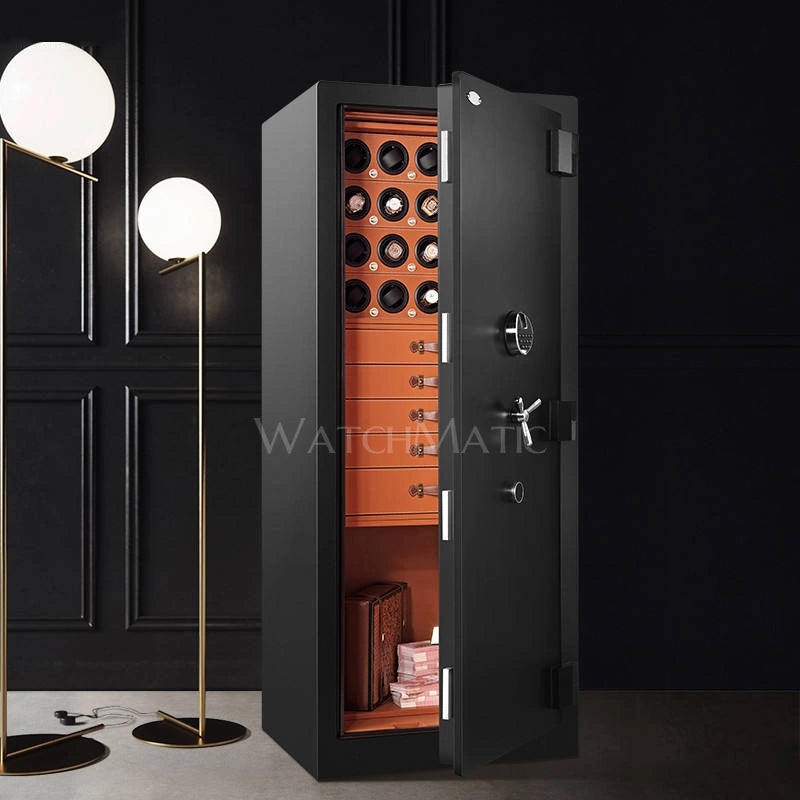
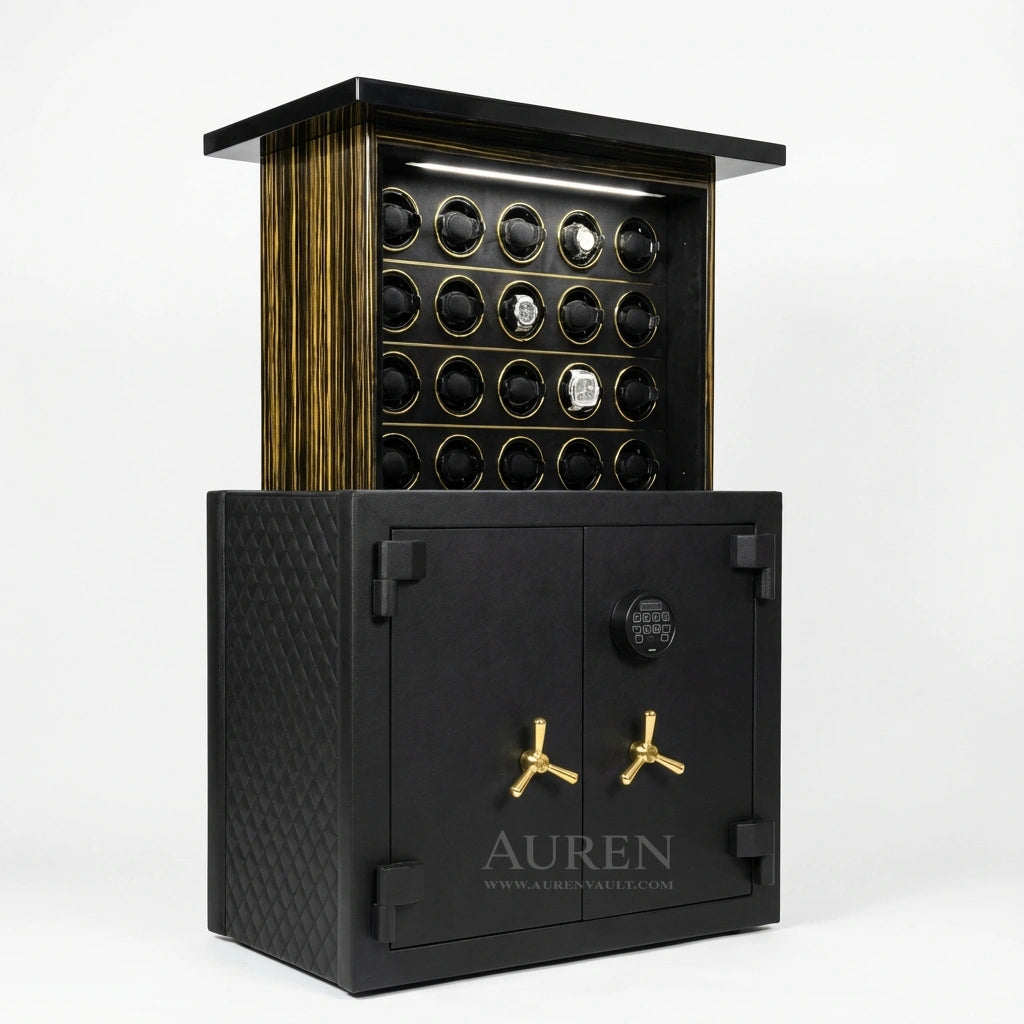
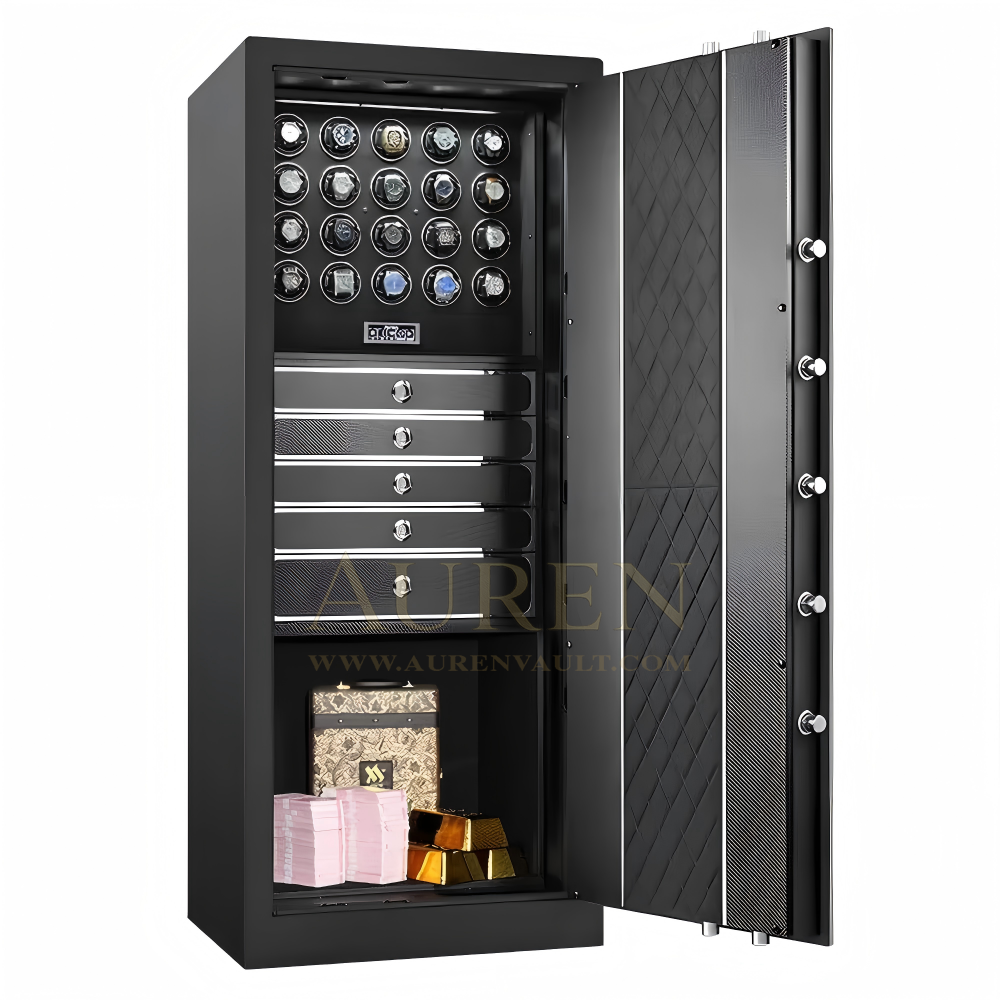
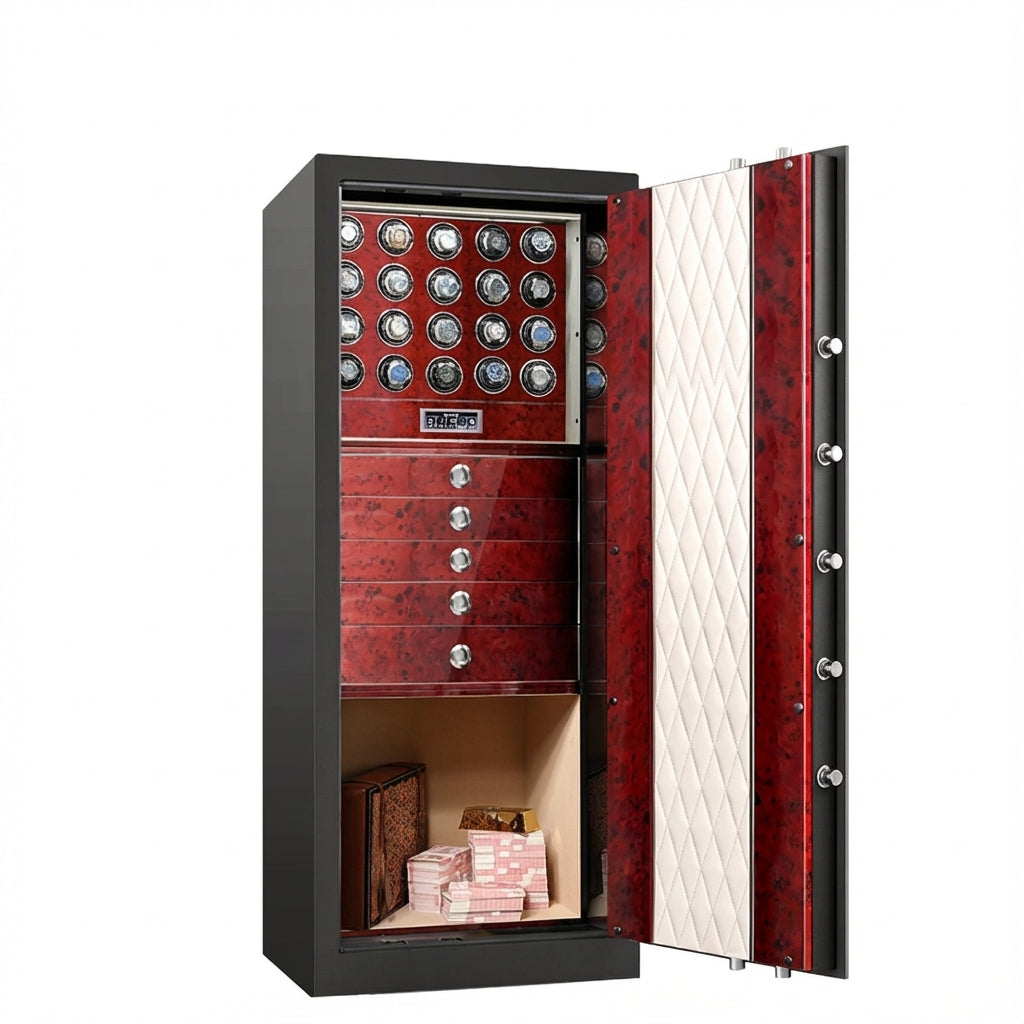
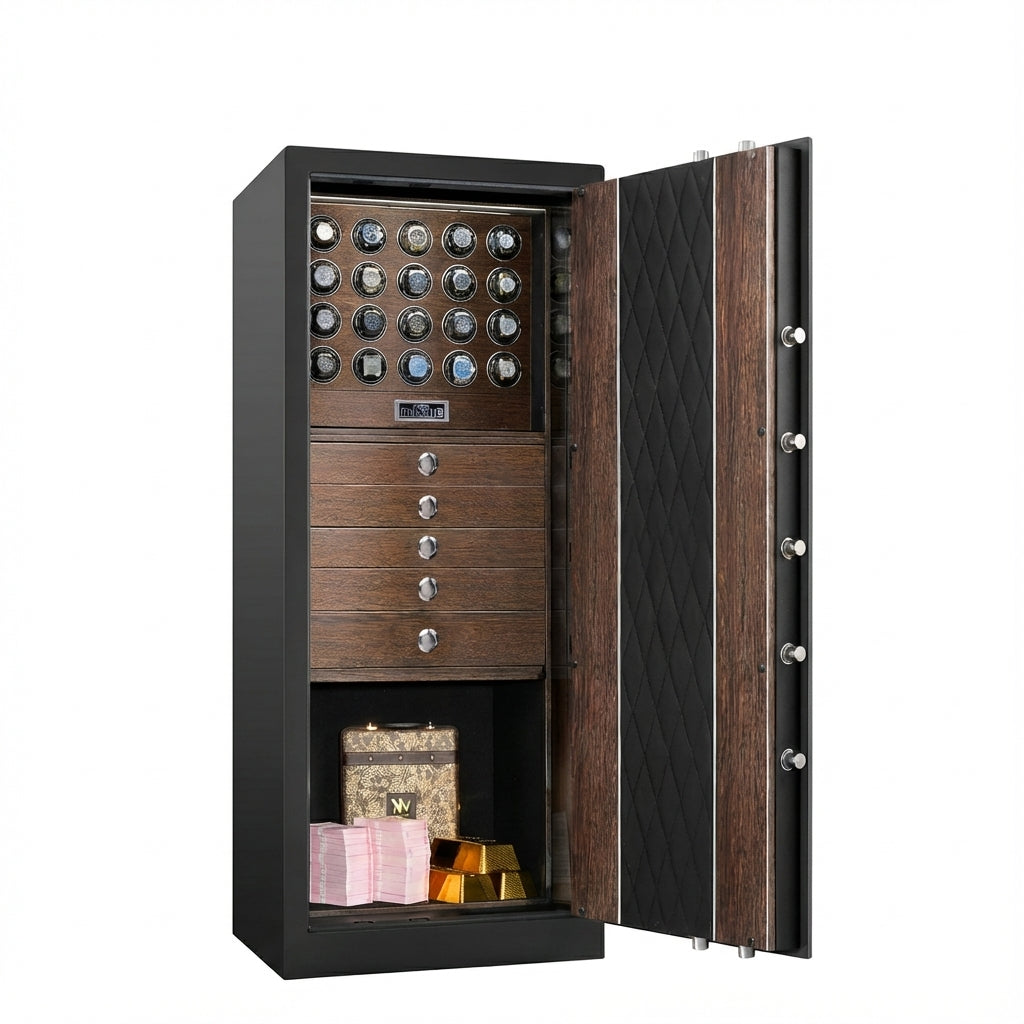
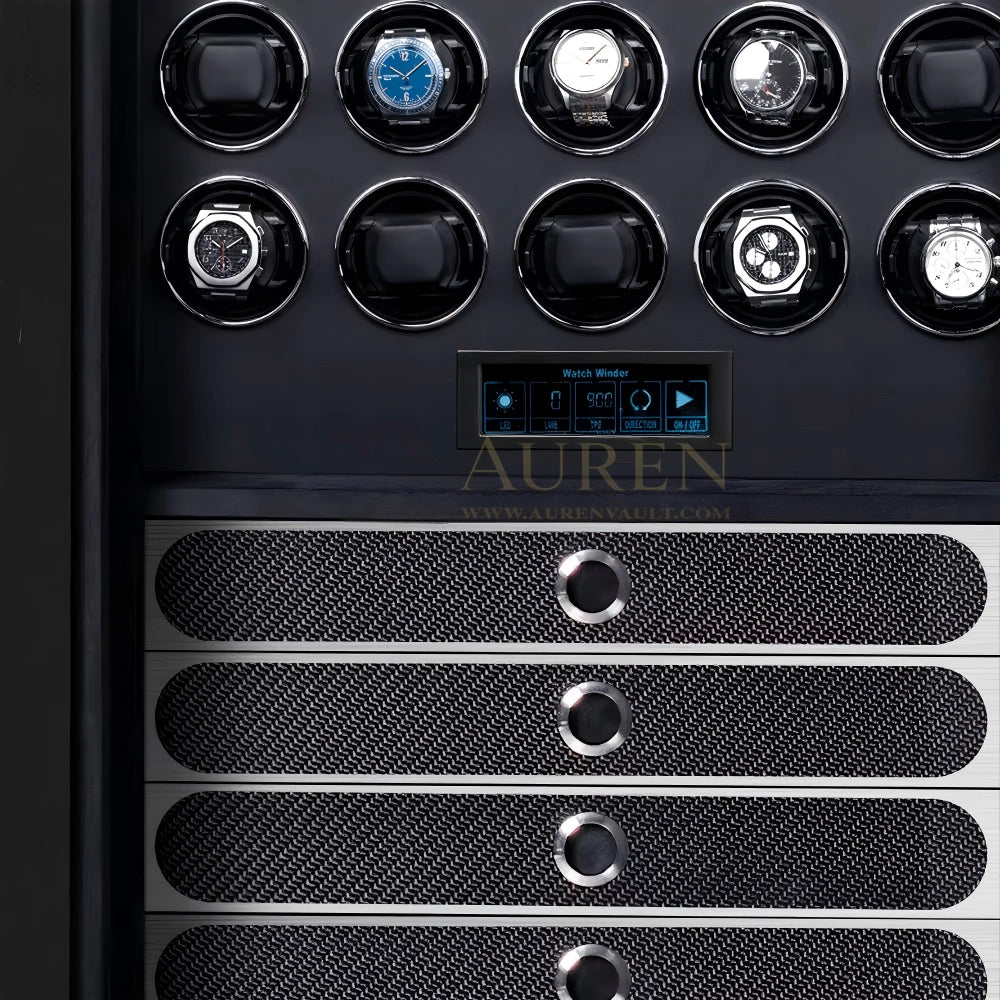
A watch winder safe combines enclosed storage with automatic winding modules.
For larger mixed collections, independent rotor programming and adjustable holders can provide greater flexibility than simply maximizing the number of winding positions.
The protective properties of the enclosure should be evaluated separately from its winding capabilities.
A lockable cabinet does not automatically establish certified resistance to burglary or fire.
The watch winder safe guide explains the differences between integrated storage and conventional watch winders.
For a large collection with unusual case dimensions or a high proportion of manually wound Panerai watches, custom watch safe configurations may provide a more appropriate balance of active and passive storage.
Long-Term Storage and Mechanical Care
A watch winder can maintain the running state of a compatible automatic Panerai.
It does not improve the underlying accuracy of the movement or eliminate the need for servicing.
Long-term care should also account for case materials, straps, crowns, and environmental conditions.
Panerai watches used for diving or water activities should be cleaned and dried in accordance with the manufacturer's instructions before storage.
Leather straps should not be enclosed while persistently damp.
The watch should rest on a suitable support without excessive pressure on the strap or crown-protecting assembly.
High humidity and substantial temperature fluctuations can create unfavorable storage conditions.
An enclosed watch safe does not automatically provide active humidity regulation.
For extended periods of non-use, passive storage may be appropriate when consistent with Panerai's maintenance recommendations.
The watch storage guide provides additional context for protecting mechanical watches over time.
Frequently Asked Questions About Panerai TPD
What is the recommended TPD for Panerai watches?
There is no universal setting. Independent databases commonly list approximately 650 TPD for selected OP calibres and 800–950 TPD for certain P.9000-family movements. Other calibres require separate verification.
What is the Panerai OP III winding direction?
Independent winding references commonly list OP III at approximately 800 TPD clockwise. The exact watch and external winder's direction convention should be confirmed.
Can I use 650 TPD for Panerai P.900?
Approximately 650 TPD appears in some general recommendations for modern Panerai movements, but a universal manufacturer-issued external setting for P.900 has not been established here. Verify the program for the exact calibre and device.
What is the recommended TPD for Panerai P.9010?
Some independent references suggest approximately 650 TPD, while broader Panerai tables contain higher recommendations for other P-series calibres. Confirm the exact P.9010 external program rather than assuming it shares all P.9000 settings.
Does the P.9000 movement wind bidirectionally?
Independent winding references commonly recommend bidirectional external rotation for the P.9000 family, with settings around 800–950 TPD. The exact movement version should still be confirmed.
Does a Panerai Luminor Marina need a watch winder?
Not necessarily. Automatic references can benefit from a compatible winder when worn infrequently. Hand-wound Luminor references cannot receive energy from conventional external rotation.
Can a Panerai Submersible use a watch winder?
Yes, if it contains an automatic movement. The winder must support the exact calibre and provide adequate clearance for the substantial case and crown-protecting bridge.
Does a Panerai GMT require more TPD?
Not automatically. A GMT indication does not independently determine winding requirements. The movement's automatic winding architecture remains the relevant factor.
Can a Panerai micro-rotor use a conventional winder?
Yes, when the movement is automatic and the external device is compatible. However, a micro-rotor does not establish a universal TPD requirement.
Do Panerai eight-day watches need a winder?
Not when they use manually wound movements such as P.5000. An eight-day reserve describes how long the movement can run after winding, not whether it winds automatically.
Can I put a P.6000 on a watch winder?
A conventional rotating winder will not replenish the P.6000's mainspring. It is manually wound and should receive energy through the crown.
Can high TPD damage a Panerai?
Modern automatic movements normally have mechanisms that manage mainspring tension. Nevertheless, unnecessary rotation provides no additional benefit once sufficient reserve is maintained. Use a verified program rather than the highest available setting.
Why does my Panerai stop on a winder?
Possible causes include insufficient initial reserve, an ineffective rotation direction, inadequate daily rotations, winder malfunction, or a mechanical condition requiring servicing.
Is a winder useful for a Panerai annual calendar?
It can reduce repeated adjustment of calendar indications when the watch is worn intermittently. However, its TPD requirement remains dependent on the specific automatic calibre.
Is a watch winder safe worthwhile for Panerai?
It may be appropriate for collectors who want enclosed storage for several automatic and manually wound watches. The arrangement should prioritize appropriate programming, case clearance, passive compartments, and documented security specifications.
Related Reading: Panerai Winding and Secure Storage
Movement compatibility is only one part of selecting the appropriate winding equipment.
Collectors comparing device design and everyday convenience can explore Best Watch Winder for Panerai Watches, which examines practical winder selection for different Panerai references.
For larger collections, Watch Safes with Built-In Watch Winders: Are They Worth It? discusses the advantages and limitations of combining automatic winding with enclosed storage.
Environmental care is equally important. Why Humidity Can Damage Luxury Watches explains why stable storage conditions deserve attention even when the movement is correctly maintained.
Final Perspective: Panerai TPD Begins With Movement Identification
Panerai's movement architecture makes a universal watch-winder recommendation unreliable.
Older OP-series calibres may require different external directions, while the P.9000 family has its own independently published winding references.
Modern P.900 and P.9010 movements provide approximately three days of reserve, but that similarity does not establish identical TPD settings.
Manual movements such as P.6000, P.5000, and P.3000 require no conventional automatic winding.
For collectors, the correct approach is to identify the calibre, verify the external program, and choose a device that physically supports the watch without unnecessary pressure.
A large case or extended power reserve does not automatically require more rotations.
For owners managing a mixed collection, Auren Vault offers integrated winding and watch storage configurations designed to accommodate different movement types and storage requirements.
The best Panerai TPD setting is the one supported by the watch's actual automatic winding system and the owner's wearing routine—not a generic number assigned to the brand as a whole.