


The best watch winder for Panerai watches is a programmable model that matches the movement's winding direction, provides adjustable turns per day (TPD), and securely accommodates Panerai's distinctive case shapes and substantial straps.
Many Panerai automatic movements can operate with moderate daily winding programs, but settings vary by calibre. Independent references list approximately 650–950 TPD for certain automatic Panerai movements, with either clockwise or bidirectional rotation depending on the mechanism. These figures are not universal manufacturer-approved settings.
Movement identification is particularly important because Panerai produces both automatic and hand-wound watches. Models equipped with calibres such as P.900 or P.9010 can benefit from a compatible winder, while manually wound P.6000 and P.5000 movements cannot.
For a single automatic Panerai, reliable programming and proper cushion fit are the primary considerations. Owners of larger collections may benefit from independently controlled winding modules combined with secure storage.
Ultimately, the right watch winder should support the specific movement, accommodate the watch's physical dimensions, and fit the owner's wearing routine.
Why Choosing a Panerai Watch Winder Is Not as Simple as It Looks
Panerai watches are immediately recognizable through their cushion-shaped cases, highly legible dials, and distinctive crown designs.
Yet two watches with nearly identical external appearances can have fundamentally different winding requirements.
Consider a modern Luminor Marina equipped with the automatic P.9010 movement and a Luminor Base Logo powered by the hand-wound P.6000.
Both share the visual language associated with Panerai. Both are mechanical watches with approximately three days of power reserve.
Only one, however, can be wound through the rotation of an automatic watch winder.
The difference lies inside the movement.
An automatic movement contains a rotor that responds to changes in the watch's position. As the rotor moves, energy is transferred through the winding mechanism to the mainspring.
A hand-wound movement relies on the winding crown instead.
This distinction matters because a watch winder rotates the entire watch. It does not turn the crown or directly wind the mainspring.
Consequently, placing a manually wound Panerai on a rotating watch holder will not replenish its power reserve.
For collectors who own several Panerai references, the first purchasing decision should therefore concern movement compatibility rather than winding capacity.
Which Panerai Watches Actually Need a Watch Winder?
Panerai's Luminor, Submersible, and Radiomir collections contain a variety of movement configurations.
Some are powered by conventional automatic rotors, others use more compact winding systems, and many retain the hand-wound architecture closely associated with the brand.
The following examples illustrate the differences.
Panerai Movement Compatibility Guide
| Panerai model or movement | Calibre | Winding type | Power reserve | Winder suitability |
|---|---|---|---|---|
| Luminor Marina PAM01707 | P.9010 | Automatic | 3 days | Optional, compatible |
| Submersible PAM01595 | P.900 | Automatic | 3 days | Optional, compatible |
| Luminor GMT PAM01460 | P.900/GMT12H | Automatic | 3 days | Optional, compatible |
| Radiomir Officine PAM01350 | P.6000 | Hand-wound | 3 days | Not required |
| Luminor Base Logo PAM01086 | P.6000 | Hand-wound | 3 days | Not required |
| Panerai watches using P.5000 | P.5000 | Hand-wound | 8 days | Not required |
| Panerai watches using P.4001/S | P.4001/S | Automatic micro-rotor | 3 days | Optional; verify settings |
The table uses representative model specifications and calibre characteristics. Panerai may use different movements across production years, references, and special editions.
Luminor Marina: A Natural Candidate for Automatic Winding
The Luminor Marina is among Panerai's most recognizable collections, but its familiar appearance should not be mistaken for a single mechanical specification.
The PAM01707 uses calibre P.9010, an automatic movement with two barrels and a three-day power reserve.
This movement receives winding energy through an oscillating weight, allowing the watch to replenish its stored energy during ordinary wrist movement.
When the watch remains unworn, a compatible winder can help maintain that reserve.
For an owner who alternates between a Luminor Marina and several other watches, keeping the movement running can reduce the need to reset the time and other indications.
A winder is less essential when the watch is worn consistently throughout the week.
The practical value depends on how often the watch is left stationary, not on the prestige of the movement.
Submersible: Automatic Winding and Everyday Utility
Panerai's Submersible collection is closely associated with diving-inspired design, robust cases, and substantial rubber straps.
Many contemporary references use automatic movements.
The Submersible PAM01595, for example, contains the P.900 calibre, which provides approximately three days of power reserve.
Panerai describes the P.900 as using a bidirectional oscillating weight.
This makes the movement mechanically suitable for automatic winding, although the exact external TPD program should still be confirmed.
The case and strap introduce another consideration.
A Submersible's substantial dimensions and pronounced crown-protecting bridge may require more space inside a winding enclosure than a smaller dress watch.
A device that offers excellent rotation control but insufficient physical clearance is not an appropriate choice.
Radiomir: Why the Collection Name Is Not Enough
The Radiomir family demonstrates why Panerai cannot be assigned one universal watch winder setting.
Certain Radiomir references are manually wound.
The Radiomir Officine PAM01350 uses the hand-wound P.6000 calibre and therefore does not benefit from a conventional watch winder.
Other Radiomir models use automatic movements, including references equipped with specialized calibres and complications.
For these watches, automatic winding may be useful.
Collectors should identify the movement from the manufacturer's specifications or the watch's documentation before selecting a winding program.
The same principle applies to vintage and discontinued references, where movement specifications may differ substantially from those found in contemporary collections.
Best Panerai Watch Winder Settings: TPD and Direction
A watch winder's operating program is determined primarily by two variables: turns per day and winding direction.
Turns per day (TPD) represents the number of rotations performed by the external winding device over a 24-hour period.
Winding direction determines whether those rotations occur clockwise, counterclockwise, or in both directions.
These variables must be matched to the winding mechanism of the individual calibre.
Panerai Watch Winder Settings by Calibre
| Panerai calibre | Published TPD reference | Rotation direction | Guidance |
|---|---|---|---|
| OP III | 800 | Clockwise | Independent database recommendation |
| OP IV | 650 | Bidirectional | Independent database recommendation |
| OP VI / OP VII | 650 | Bidirectional | Independent database recommendation |
| P.9000 / P.9001 / P.9002 | 800–950 | Bidirectional | Common third-party reference range |
| P.9010 | Approximately 650 in some databases | Bidirectional references exist | Verify the exact calibre and winder program |
| P.900 | No verified official TPD figure | Bidirectional rotor | Confirm external winding program |
| P.4001/S | No verified official TPD figure | Bidirectional micro-rotor | Confirm external winding program |
| P.6000 / P.5000 | Not applicable | Hand-wound | Do not use an automatic winder |
TPD figures come from independent winding databases and should not be interpreted as official Panerai prescriptions. Some P-series settings remain unpublished or differ between sources.
For a collector, this table is most useful as a starting point for identifying the right questions.
It should not replace the operating instructions for the specific watch.
Why Panerai Does Not Have One Universal TPD Setting
A three-day power reserve does not establish how many rotations an automatic watch needs each day.
Power reserve describes how long a sufficiently wound movement can operate without additional energy.
Winding efficiency describes how effectively rotor movement replenishes that energy.
The two characteristics are related, but they are not interchangeable.
For example, the P.900 and P.9010 both offer approximately three days of power reserve, yet they are different mechanical designs.
Likewise, older OP-series movements do not necessarily share the same winding behavior as Panerai's more recent automatic calibres.
The external winder also matters.
Some manufacturers calculate TPD using the combined total of clockwise and counterclockwise rotations. Others use different programming conventions for alternating-direction modes.
As a result, entering the same numerical setting on two different winders does not always guarantee identical winding performance.
The watch TPD reference guide is a useful reference point for this broader aspect of watch winder configuration.
What About 650, 800, or 950 TPD?
These numbers frequently appear in independent Panerai winding charts.
However, they should not be treated as interchangeable recommendations.
Approximately 650 TPD is listed for certain OP calibres and appears in some recommendations for modern P-series movements.
Other automatic movements, including the P.9000 family, are listed by independent databases with programs around 800–950 TPD.
The difference illustrates the importance of identifying the specific movement.
For a watch without a verified winding program, the appropriate approach is to confirm direction and rotation requirements with Panerai, a qualified watchmaker, or a reliable movement-specific reference.
Selecting the highest available setting as a precaution is not a substitute for identifying the correct program.
Why Panerai's Rotor Design Matters
Panerai automatic watches are not all built around the same winding architecture.
The P.900, P.9010, and P.4001/S demonstrate how different mechanical layouts can achieve the same basic objective: maintaining energy in the mainspring through automatic rotor movement.
Understanding these differences helps explain why adjustable winding programs are preferable to fixed-speed devices.
P.900: A Compact Automatic Calibre
The P.900 is a relatively slim automatic movement within Panerai's modern range.
It uses a bidirectional oscillating weight and a single barrel to provide approximately 72 hours of power reserve.
Its architecture allows the movement to receive energy from rotor activity in both winding directions.
For a watch winder, the practical requirement is a compatible bidirectional program with an appropriate daily rotation count.
However, the fact that a movement winds bidirectionally does not establish its precise TPD requirement.
Rotor efficiency, winding transmission, and external winder programming must still be considered.
P.9010: Three-Day Reserve With Two Barrels
The P.9010 takes a different approach.
Panerai specifies an automatic movement with two barrels and a three-day power reserve.
The calibre also incorporates features such as independent adjustment of the hour hand, depending on the watch configuration.
For owners who travel frequently, this can make setting a new local time more convenient.
A watch winder supports the movement's continued operation between wears, but it does not operate the time-setting mechanism.
That remains a separate function controlled through the crown.
A reliable winder should therefore provide the correct winding routine without requiring the owner to interact with the watch unnecessarily.
P.4001/S: The Micro-Rotor Difference
Certain Panerai movements use an off-center micro-rotor rather than a conventional centrally mounted winding weight.
The P.4001/S is an example.
Its compact winding system is integrated into the movement architecture and uses bidirectional rotor activity to wind two barrels.
This arrangement allows the movement to retain automatic winding while making room for a more open view of its mechanical construction.
From a watch winder perspective, the distinction is mechanical rather than cosmetic.
The external device still rotates the complete watch, while the movement's internal winding system converts that motion into stored energy.
A micro-rotor does not automatically require a higher TPD setting, nor should its compact dimensions be interpreted as evidence of reduced winding capability.
The appropriate program must be established for the specific calibre.
How to Set Up a Watch Winder for a Panerai
A properly configured watch winder should maintain the watch's operating reserve without unnecessary rotation.
The setup process begins before the watch is placed inside the winder.
First, confirm the reference and calibre. A Luminor Marina equipped with an automatic movement can use a winder, while a visually similar Luminor Base Logo powered by a manual-winding movement cannot.
If the automatic watch has stopped, follow the manufacturer's instructions for initially winding it through the crown.
For applicable P.900 watches, Panerai's operating instructions recommend partial manual winding before normal use when the watch has stopped.
The watch should then be secured in a correctly sized holder.
A suitable setup includes:
-
A verified winding direction for the specific calibre.
-
An appropriate daily rotation program.
-
A stable holder that does not overstretch the strap.
-
Proper rest intervals and adequate clearance around the case.
Once programmed, the watch can be observed over several days to determine whether the selected configuration maintains its operating reserve.
A watch that repeatedly stops may indicate an unsuitable program, inadequate initial winding, a winder problem, or a mechanical issue requiring inspection.
Simply increasing TPD indefinitely is not an appropriate solution.
Check the Crown-Protecting Bridge Before Winding
The Luminor's crown-protecting bridge is one of Panerai's most recognizable design features.
It is also relevant when preparing the watch for storage.
After any manual winding or time adjustment, the crown should be returned to its correct position and the protecting lever secured according to the watch's operating instructions.
The watch should not be mounted with the crown-protecting mechanism left open.
This is particularly important when the watch sits close to the edge of a winding compartment.
The crown guard must have sufficient clearance throughout the rotation cycle.
On Radiomir models with screw-down crowns, the crown should likewise be correctly secured after adjustment.
These are straightforward handling precautions, but they matter more than adding unnecessary features to the winding program.
The Overlooked Problem: Panerai Case Size and Strap Fit
A technically compatible watch winder can still be unsuitable for a Panerai if its holder is poorly designed.
Panerai watches are frequently associated with substantial cases and wide straps.
Contemporary examples include 42 mm and 44 mm Submersible models, while other references extend to larger dimensions.
The crown-protecting bridge on many Luminor and Submersible watches also increases the space required around the case.
A compact winding compartment may accommodate the case diameter but leave insufficient clearance for its crown guard or strap.
Rubber Straps and Large Watch Cushions
Many Panerai sports watches use rubber or caoutchouc straps.
These materials are flexible, but they should not be stretched unnecessarily to fit a rigid cushion.
A holder that is too large may force the strap into a configuration tighter than its normal wearing position.
One that is too small may fail to secure the watch, allowing it to shift during rotation.
An adjustable or interchangeable cushion is preferable.
The ideal holder supports the watch securely while minimizing unnecessary tension.
Leather Straps and Long-Term Storage
Panerai also offers numerous watches with leather straps.
Leather requires a different approach to support and storage than steel bracelets or rubber straps.
A winder cushion should not create sharp bends or excessive compression.
When watches are stored for extended periods, a stable environment and suitable supports are often more important than keeping the movement running.
This distinction is especially relevant for owners who rotate between leather and rubber straps throughout the year.
Why Rotor Capacity Is Not the Same as Watch Compatibility
A watch winder advertised as holding six watches may not comfortably accommodate six large Panerai cases.
Spacing between adjacent modules can be as important as the number of available winding positions.
Before purchasing a multi-watch unit, the owner should consider the case dimensions, crown-guard clearance, strap length, and the space needed to remove each watch safely.
These requirements become even more important when several large watches are mounted side by side.
Should a Panerai Stay on a Watch Winder Every Day?
Not necessarily.
An automatic Panerai is designed to replenish its power reserve through normal wrist movement.
A watch winder can maintain that reserve when the watch is not being worn, but continuous operation is not essential to mechanical watch ownership.
Panerai's three-day automatic movements provide considerable flexibility between wears.
An owner who removes a fully wound watch on Friday evening may find that it is still running when worn again within its available power-reserve window.
For that wearing pattern, a winder may offer limited additional convenience.
The benefit becomes greater when the owner alternates between several watches over longer periods.
Automatic GMT and calendar references may be particularly convenient to keep running, since resetting multiple indications can take additional time.
However, long power reserve should not be confused with automatic winding compatibility.
A manually wound P.5000 offers eight days of power reserve, yet it receives no benefit from a conventional automatic watch winder.
The difference between winding method and energy capacity remains fundamental.
Watch Winder vs. Watch Winder Safe for Panerai Collections
When choosing storage for Panerai watches, winding functionality is only one part of the decision.
A standalone winder is primarily a convenience device.
It keeps compatible automatic watches running and may provide an accessible display arrangement.
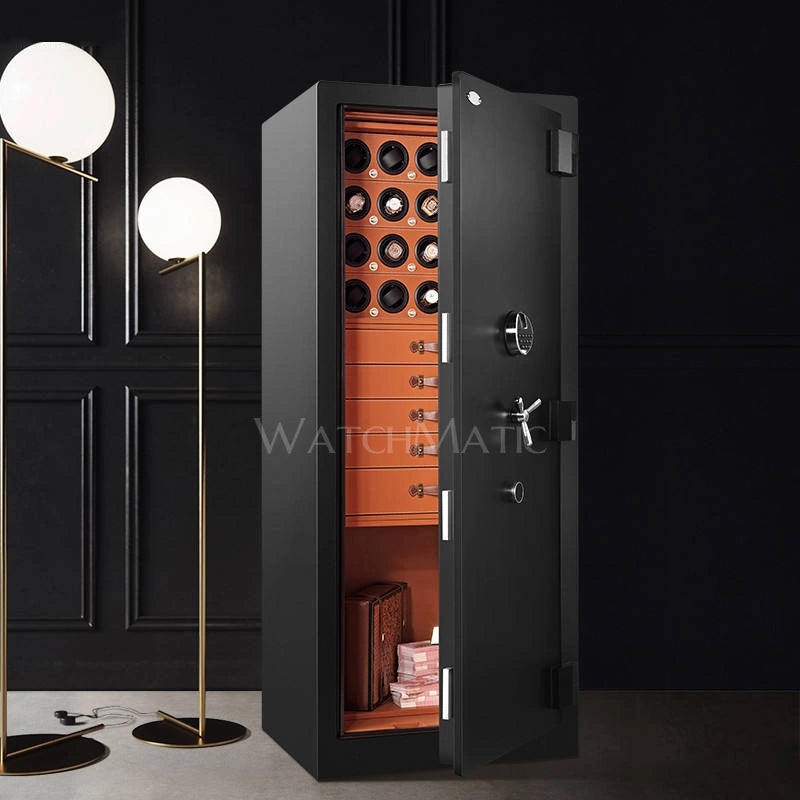
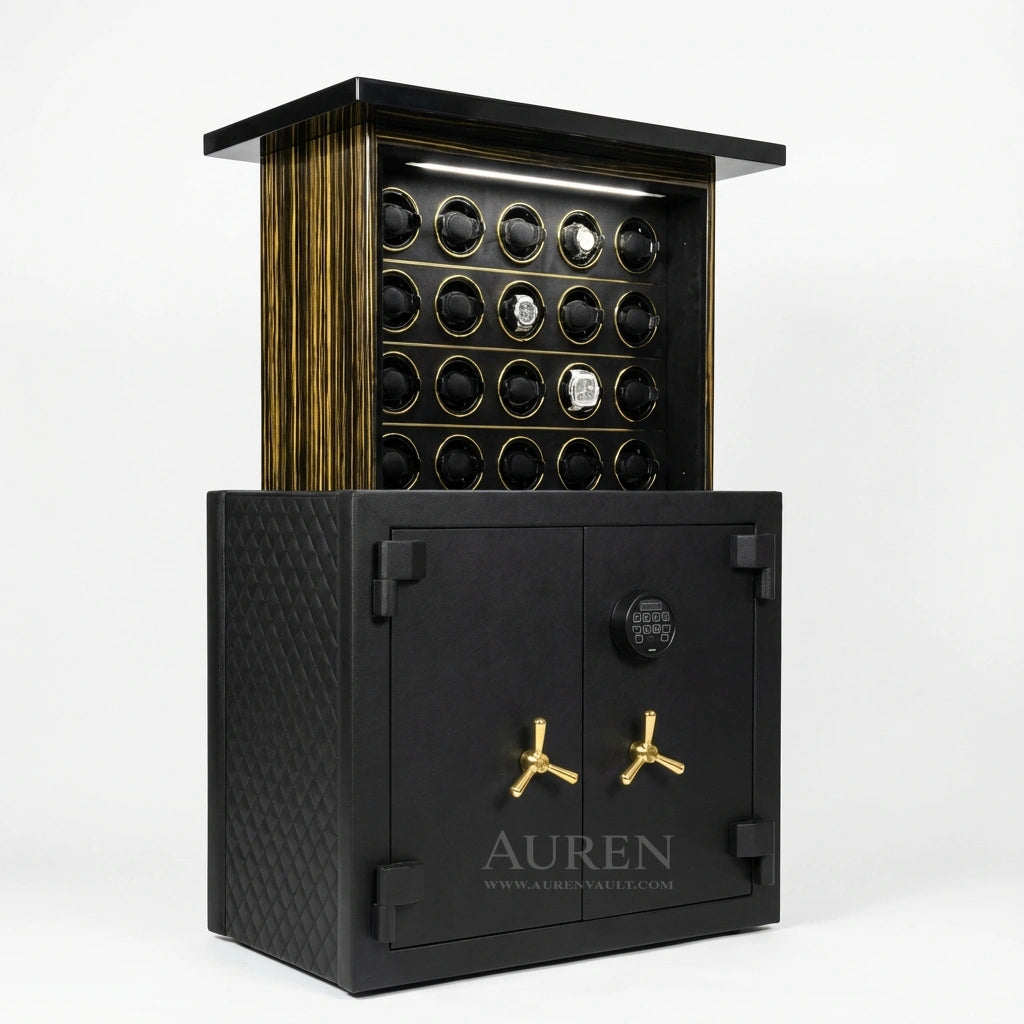
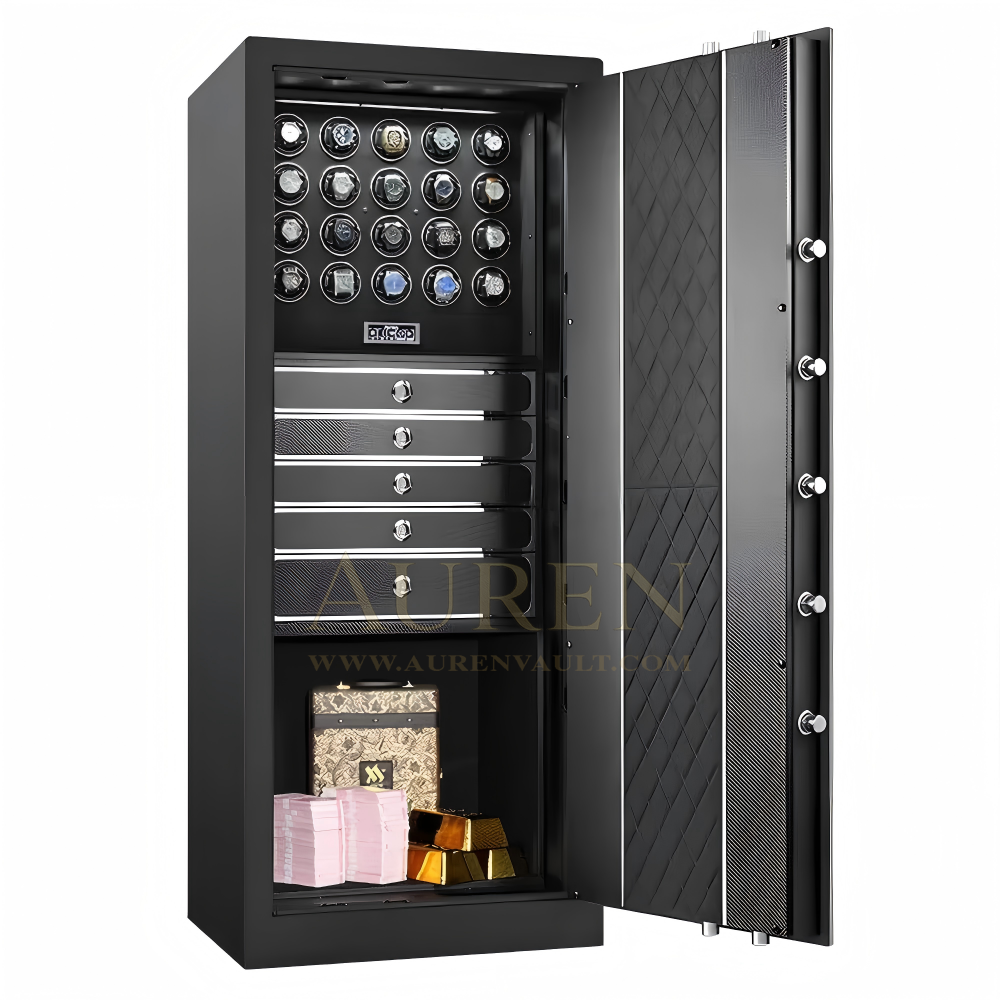
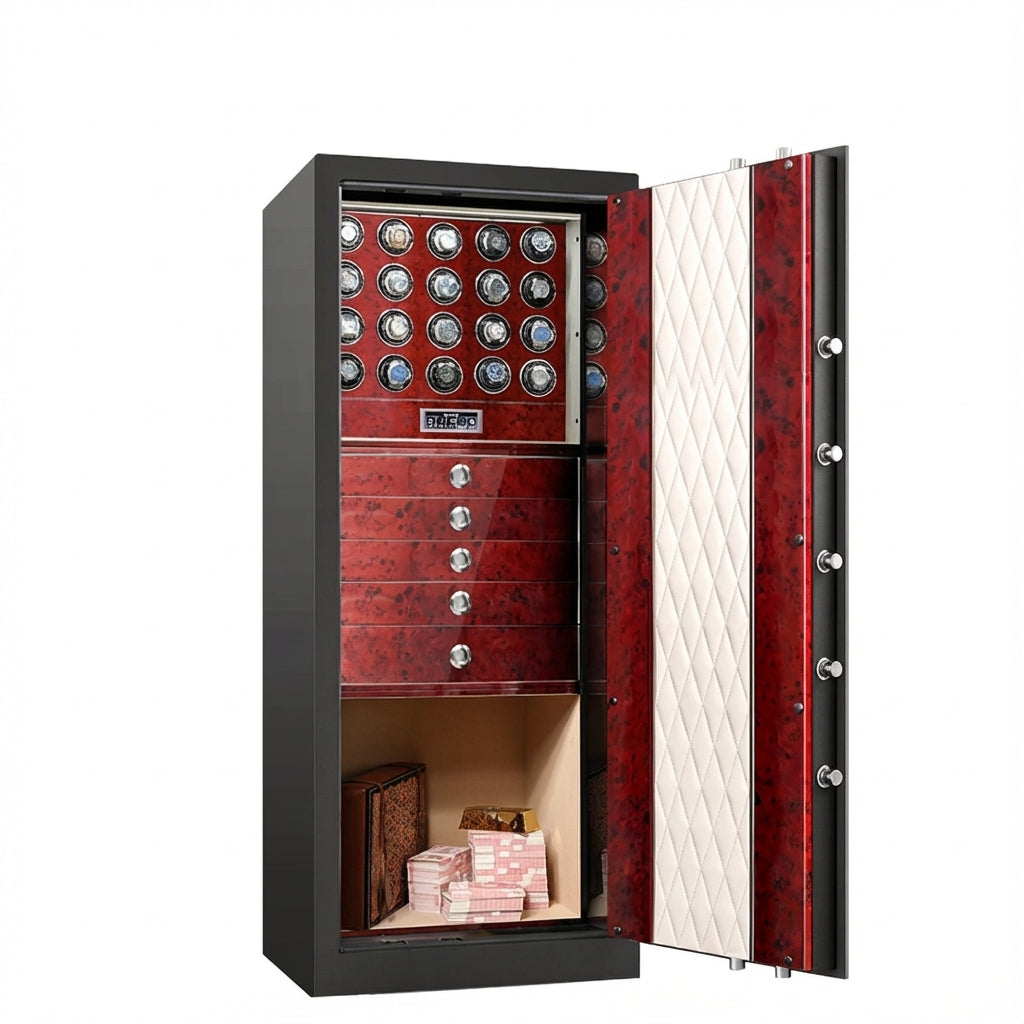
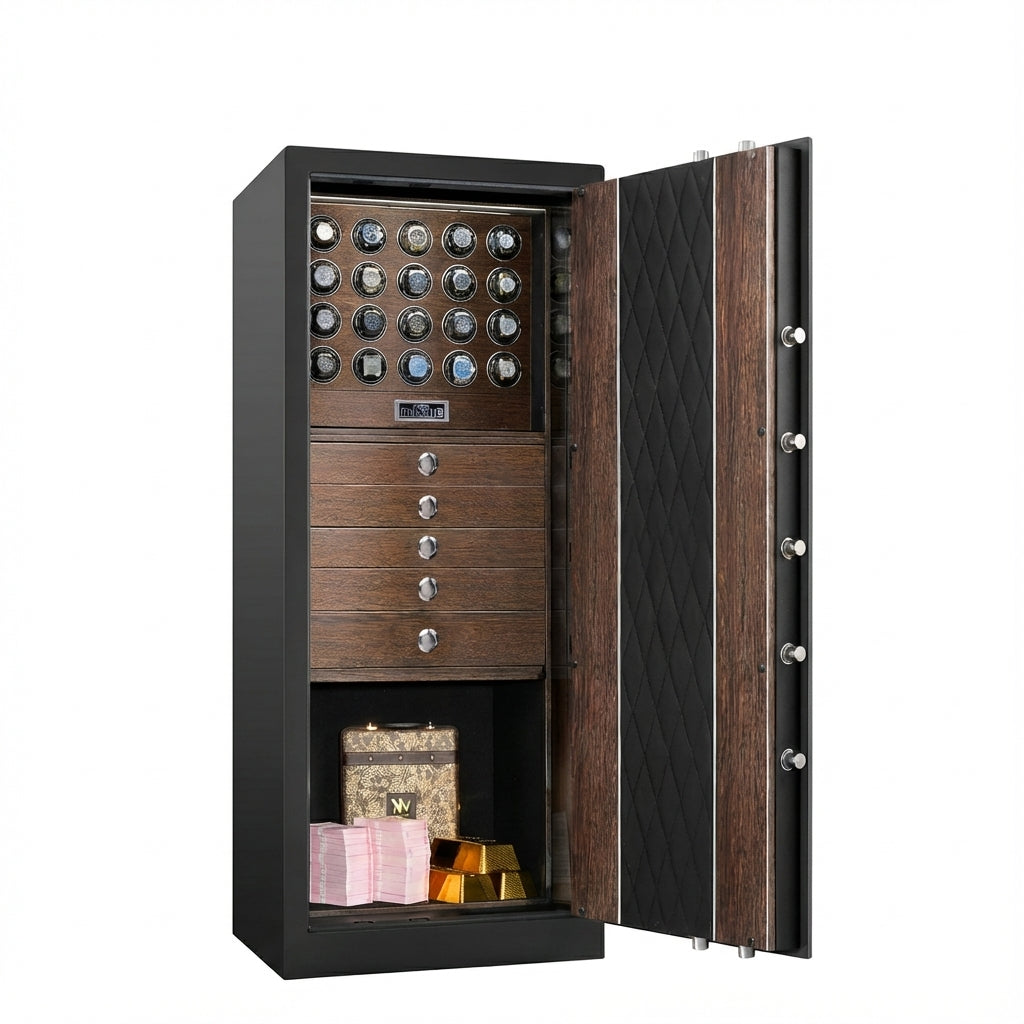
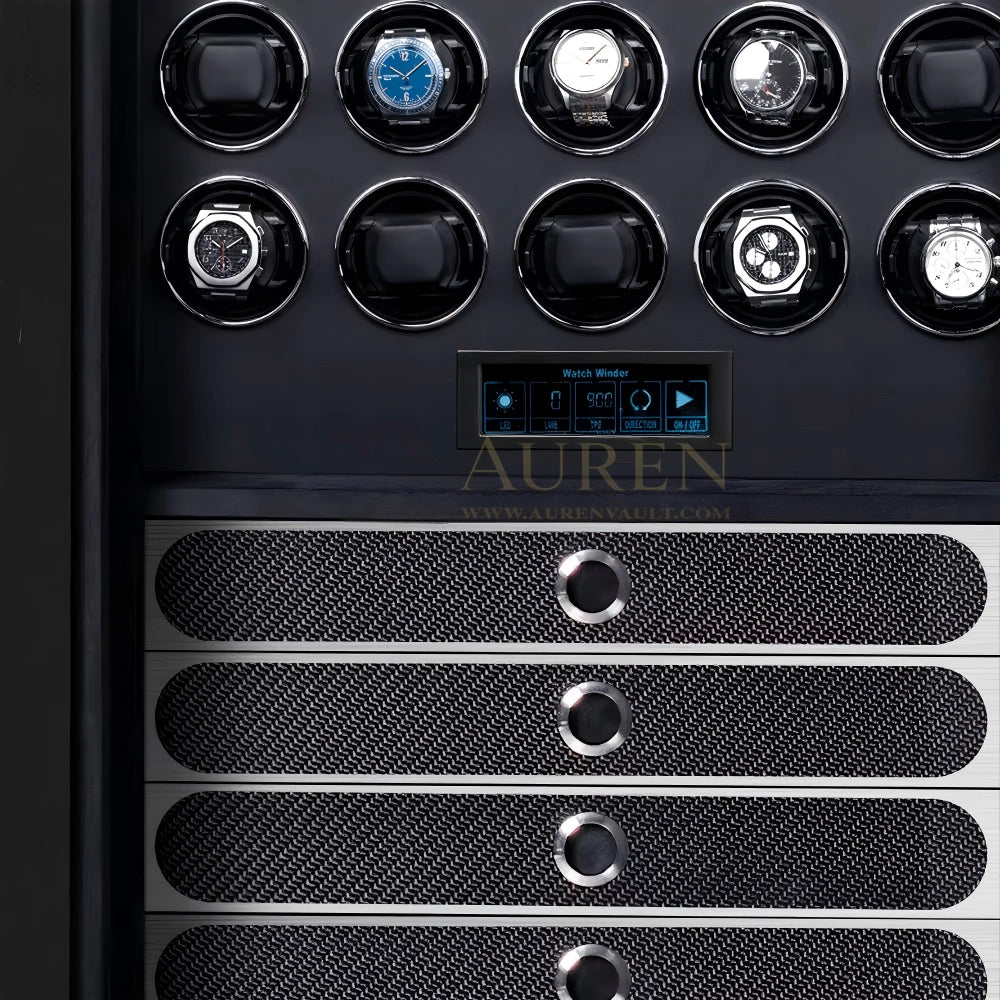
A watch winder safe serves a broader purpose by incorporating winding modules within a lockable storage enclosure.
For owners of substantial collections, this can help reduce the need to transfer watches between separate winding and secure storage locations.
Which Storage Arrangement Makes More Sense?
| Collection requirement | Preferred approach | Main consideration |
|---|---|---|
| One frequently worn automatic Panerai | Standalone programmable winder or no winder | Convenience and movement compatibility |
| Several automatic Luminor and Submersible watches | Multi-watch winder with independent controls | TPD flexibility and case clearance |
| Mixed automatic and hand-wound Panerai collection | Combined winding and passive storage | Efficient allocation of storage positions |
| Valuable collection requiring enclosed protection | Appropriately specified watch winder safe | Security, installation and winding compatibility |
| Long-term storage of mostly hand-wound watches | Protective passive watch storage | Physical support and environmental stability |
A collector considering a secure winding arrangement can examine integrated watch winder safes to understand how winding modules and enclosed storage can work together.
The watch winder safe guide is another relevant reference when comparing the two storage approaches.
Importantly, a lockable cabinet should not automatically be assumed to offer a particular burglary-resistance or fire-protection rating.
These characteristics depend on the construction, documented specifications, and testing applicable to the individual safe.
Planning a Storage Layout for a Mixed Panerai Collection
Consider an owner with two automatic Luminor Marina watches, a Submersible, a hand-wound Radiomir, and two Luminor Base Logo references.
That is a six-watch collection, but only three watches need automatic winding positions.
Selecting a cabinet with six active rotors may therefore be unnecessary.
A more efficient configuration could combine three individually controlled winding modules with three passive watch holders.
This creates a practical distinction between watches that benefit from automatic winding and those that require protected storage alone.
The complete range of watch safes for organized collections provides a broader starting point for considering storage capacity.
As the collection expands, larger luxury watch safe configurations may become more appropriate, particularly when the owner also needs storage for additional straps, accessories, and manually wound timepieces.
When Customization Becomes Important
Panerai collections can create unusual storage requirements because of their relatively large cases and varied strap designs.
A fixed interior may offer enough positions in theory but insufficient clearance in practice.
For example, a cabinet intended for twelve smaller dress watches may not comfortably hold twelve large sports watches with substantial crown guards.
A more considered design can accommodate spacing, holder dimensions, independent winding modules, and passive storage compartments.
These requirements may be addressed through bespoke watch safe configurations, subject to the options supported by the selected design.
For collectors planning a private dressing room or dedicated watch storage space, the cabinet's dimensions, installation access, power supply, and day-to-day usability should be considered alongside its exterior appearance.
A successful configuration should make the collection easier to manage rather than simply providing the highest possible slot count.
Does a Watch Winder Improve the Long-Term Condition of a Panerai?
A watch winder is sometimes presented as essential equipment for preserving a mechanical movement.
That claim deserves qualification.
An automatic watch winder helps maintain the movement's power reserve. It does not replace servicing, restore degraded lubricants, or correct mechanical problems.
Nor is there a universal requirement to keep every automatic mechanical watch running continuously.
The decision depends on the watch's design, the frequency of wear, and the manufacturer's maintenance recommendations.
For a frequently rotated automatic collection, a winder can reduce repeated resetting and improve everyday convenience.
For watches kept unused over extended periods, suitable storage conditions may matter more.
The watch storage guide is relevant to these broader considerations, including the relationship between mechanical care and secure storage.
A watch with a properly maintained movement and an appropriate storage environment does not become inherently better protected simply because it remains in motion.
The purpose of a winder is operational convenience—not mechanical preservation by default.
Frequently Asked Questions About Panerai Watch Winders
What is the best TPD setting for Panerai watches?
There is no universal TPD setting for every Panerai. Independent references list approximately 650 TPD for some OP calibres and 800–950 TPD for certain P.9000-family movements. Other modern calibres require individual verification. Always confirm the movement before programming a winder.
Does a Panerai Luminor need a watch winder?
Only automatic Luminor references can benefit from one. A Luminor Marina with calibre P.9010 is compatible with automatic winding, while a Luminor Base Logo powered by the hand-wound P.6000 is not.
What watch winder direction is best for Panerai?
It depends on the calibre. Certain older OP movements are listed as clockwise-only, while others support bidirectional winding. Modern calibres such as the P.900 use bidirectional internal rotor systems, but external winder settings should still be verified.
Can a Panerai Submersible use a watch winder?
Yes, if the reference contains an automatic movement. Many contemporary Submersible watches use the P.900 calibre or related automatic movements. The winder must provide appropriate programming and sufficient clearance for the watch's case, crown guard, and strap.
Do Panerai 8 Days watches need watch winders?
Not if they contain manually wound movements such as the P.5000. An eight-day power reserve describes how long the watch can operate when wound; it does not mean the watch winds automatically.
Can a watch winder overwind a Panerai?
Modern automatic Panerai movements incorporate mechanisms intended to manage mainspring winding. Nevertheless, unnecessary rotation provides no practical advantage. A compatible winder should use suitable daily cycles rather than operating continuously at maximum speed.
How should a Panerai with a rubber strap fit in a watch winder?
The cushion should hold the watch securely without excessively stretching the strap. Large cases and crown-protecting bridges also require sufficient clearance during rotation.
Is a watch winder safe worthwhile for Panerai watches?
It may be useful for a collector who needs both automatic winding and secure enclosed storage. The decision should account for the number of automatic movements, total collection capacity, physical case dimensions, and the actual security specifications of the safe.
Related Reading: Watch Winder Guides for Other Luxury Watches
Different Swiss watch manufacturers use distinct winding systems, making movement-specific guidance particularly valuable when building a mixed collection.
Best Watch Winder for Vacheron Constantin Watches
Compare winding requirements and storage considerations for Vacheron Constantin automatic movements.
Best Watch Winder for Richard Mille Watches
Understand how specialized rotor architecture influences winder compatibility, programming, and physical fit.
Watch Safes With Built-In Watch Winders: Are They Worth It?
Explore when combining automatic winding and secure storage makes more sense than using separate equipment.
Final Thoughts: Choose the Winder Around the Movement and the Watch
Panerai's distinctive design language can make its watches appear mechanically similar, but their winding requirements vary considerably.
An automatic Luminor Marina, a hand-wound Radiomir, and a Submersible equipped with calibre P.900 may share the same design heritage while requiring different approaches to daily operation.
For an individual automatic watch, movement compatibility, appropriate TPD settings, and a correctly fitted holder should guide the decision.
For larger collections, those priorities extend to winding capacity, passive storage, case clearance, and security.
As a luxury watch storage specialist, Auren Vault approaches integrated winding and collection organization as complementary functions that should reflect the watches being stored.
The most suitable watch winder is not necessarily the one with the greatest number of rotations or the largest enclosure.
It is the one that respects the movement's requirements, accommodates the watch securely, and simplifies ownership without introducing unnecessary complexity.