

The best watch winder for MB&F watches is a programmable unit that matches the specific automatic movement's winding requirements while providing enough physical clearance for the watch's unconventional case architecture.
Automatic MB&F creations include the Legacy Machine FlyingT, with approximately 100 hours of power reserve, the HM7 Aquapod, with 72 hours, and the HM8 Mark 2, with 42 hours. Their winding systems can potentially be maintained by compatible external watch winders.
However, many MB&F Machines are manually wound. The LM101, LM Perpetual, LM Sequential EVO, and HM11 Architect do not benefit from conventional rotating winders.
The HM11 is especially important: although it is wound by rotating its case, this is a manual mechanism requiring relative rotation between the case and movement—not rotation of the complete watch inside a conventional winder.
No single verified TPD program applies to every automatic MB&F creation. Movement-specific settings and physical compatibility must be established individually.
For collectors, a suitable storage system may require specially sized winding compartments and protected stationary positions rather than conventional identical watch holders.
MB&F's Unconventional Machines Require Unconventional Winder Planning
MB&F describes its creations as Horological Machines and Legacy Machines.
The distinction reflects different design philosophies, but it does not directly determine how a movement is wound.
Some Machines use conventional automatic winding principles within extremely unconventional cases.
Others are manually wound despite having complex three-dimensional movements and elaborate moving components.
The Legacy Machine FlyingT uses automatic winding.
The HM8 Mark 2 combines a mechanical automatic movement with an optical system that projects its time display through sapphire prisms.
The LM Sequential EVO, despite incorporating two fully integrated chronographs, is manually wound.
The HM11 Architect has an even more unusual arrangement: the owner winds it by turning the case relative to the stationary movement structure through its designated mechanism.
These differences mean that a conventional watch winder cannot be chosen from a general description such as mechanical MB&F watch.
An automatic winder rotates the complete watch, creating relative motion in an internal oscillating rotor.
A movement without a self-winding rotor cannot receive energy through that method.
For MB&F collectors, the key questions are therefore whether the movement is automatic, what external winding program it requires, and whether the watch can be mounted safely.
The last point can be especially difficult because many MB&F cases are taller, wider, or more unusual than conventional wristwatches.
Which MB&F Watches Can Use a Conventional Winder?
The following examples illustrate the manufacture's mechanical diversity.
| MB&F Machine | Movement type | Power reserve | Conventional winder suitable? |
|---|---|---|---|
| Legacy Machine FlyingT | Automatic, vertically arranged movement | 100 hours | Yes, with compatible program and holder |
| HM7 Aquapod | Automatic, three-dimensional movement | 72 hours | Yes, with suitable clearance |
| HM8 Mark 2 | Automatic, Girard-Perregaux-based movement | 42 hours | Yes, with compatible holder |
| LM101 | Manual winding | 45 hours | No |
| LM Perpetual | Manual winding | 72 hours | No |
| LM Perpetual EVO | Manual winding | 72 hours | No |
| LM Sequential EVO | Manual winding | 72 hours | No |
| LM Sequential Flyback EVO | Manual winding | 72 hours | No |
| HM11 Architect / Art Deco | Manual winding through case rotation | 96 hours | No |
These specifications apply to the documented Machines listed.
MB&F has produced numerous editions and mechanical variations, so the exact reference should be checked before choosing a winding program or mounting system.
The important conclusion is that complexity does not establish automatic winding.
A Machine containing several hundred components may still be manually wound.
Likewise, a watch featuring a large rotating tourbillon may or may not contain an automatic rotor.
MB&F Watch Winder Settings: TPD and Direction
Two specifications determine how a conventional watch winder maintains an automatic movement.
Turns per day (TPD) describes the number of rotations delivered during a programmed 24-hour period.
Rotation direction determines whether the watch turns clockwise, counterclockwise, or alternates between both.
The appropriate values depend on the automatic winding mechanism.
For MB&F, there is no verified universal TPD chart covering the different Machines.
It would therefore be inappropriate to assign every automatic MB&F the same 650 or 800 TPD program without movement-specific confirmation.
Programming Requirements by Machine
| MB&F Machine | TPD approach | Direction |
|---|---|---|
| LM FlyingT | Confirm the automatic vertical movement's requirements | Verify |
| HM7 Aquapod | Confirm the three-dimensional automatic movement's program | Verify |
| HM8 Mark 2 | Confirm the Girard-Perregaux-based movement's external winding requirements | Verify |
| LM101 | Not applicable | Manual winding |
| LM Perpetual / Perpetual EVO | Not applicable | Manual winding |
| LM Sequential EVO / Flyback EVO | Not applicable | Manual winding |
| HM11 Architect | Not applicable | Special manual winding mechanism |
A programmable winder is preferable because it can accommodate the confirmed settings for a specific Machine.
However, electronic flexibility alone is insufficient.
The chosen device must also be physically compatible with the watch.
Why 650 TPD Is Not an MB&F Universal Setting
Many conventional automatic calibres are associated with daily winding programs around 650–800 TPD.
MB&F uses different automatic architectures, including a vertically arranged FlyingT movement, the HM7's three-dimensional construction, and the Girard-Perregaux-based HM8.
Their winding requirements should not be inferred from one another.
A winder with adjustable TPD and direction provides flexibility.
For more information on how rotation count and movement efficiency interact, see the watch TPD guide.
Does a Three-Dimensional Movement Require More TPD?
Not automatically.
Three-dimensional movement architecture affects the arrangement of components within the watch.
It does not establish a universal amount of external rotation needed to maintain power.
The correct program depends on the actual winding rotor, gearing, and energy transfer.
A large sapphire dome or vertically oriented tourbillon should not be treated as evidence that the watch needs unusually high TPD.
The movement's documented winding characteristics remain the deciding factor.
Legacy Machine FlyingT: An Automatic MB&F With 100 Hours of Reserve
The Legacy Machine FlyingT is among MB&F's most recognizable automatic creations.
Introduced in 2019, it uses a highly vertical movement architecture with a central flying tourbillon.
The hours and minutes are displayed on an inclined subdial positioned to face the wearer.
The automatic movement incorporates a sun-shaped rotor and provides approximately 100 hours of power reserve.
This makes the FlyingT suitable for compatible automatic winding.
However, its physical construction requires particular care.
Why the FlyingT's Reserve Changes the Ownership Decision
A sufficiently wound FlyingT can continue operating for more than four days without additional winding.
For an owner who wears the watch frequently, this may provide enough flexibility without a winder.
A collector who rotates between several timepieces may prefer to keep it operating between wears.
The benefit is reduced repeated restarting.
The watch does not mechanically need continuous external winding simply because it contains a tourbillon.
Its automatic rotor provides the capability, but its use remains optional.
The Flying Tourbillon Is Not the Winding Rotor
The flying tourbillon and automatic rotor perform different functions.
The tourbillon is part of the regulating system.
The rotor transfers mechanical energy to the mainspring.
The presence of a large, visibly rotating tourbillon does not establish how many external rotations the watch needs.
For the FlyingT, a suitable winder should be programmed according to the automatic winding mechanism, not the motion of its tourbillon.
The 20 mm Case Height Creates a Serious Fit Requirement
The FlyingT measures approximately 38.5 mm across and 20 mm high in documented versions.
Its height is partly attributable to the prominent sapphire dome protecting the vertical movement architecture.
A conventional shallow winding compartment may not provide adequate clearance.
Before purchasing a winder, the owner should check the space available when the watch is mounted and rotating.
The sapphire dome should never contact the enclosure.
The holder must support the watch without compressing its case or placing pressure on its decorative elements.
For diamond-set FlyingT versions, the mounting arrangement deserves particular attention.
The correct solution may require a winding compartment designed for taller watches.
HM7 Aquapod: Automatic Winding Inside an Unusual Case
The HM7 Aquapod demonstrates MB&F's exploration of organic mechanical design.
Its three-dimensional architecture is inspired by aquatic forms.
A flying tourbillon occupies the upper part of the movement, while the automatic winding rotor sits beneath the construction.
The movement provides approximately 72 hours of power reserve.
This makes the HM7 a legitimate automatic-winder candidate.
However, its exterior is unusually large.
Documented versions measure approximately 53.8 mm in diameter and 21.3 mm high.
Why the HM7's Rotor Location Matters
The HM7's winding rotor is positioned beneath the movement.
Its location is unusual visually, but the underlying function remains automatic winding.
An appropriately programmed external winder can potentially maintain the movement's energy.
However, rotor location alone does not establish the correct TPD.
The complete winding mechanism must be considered.
A generic program chosen from another MB&F Machine should not be applied automatically.
A 53.8 mm Case Needs More Than a Standard Holder
The HM7's substantial diameter is a central storage consideration.
Even a device described as suitable for large watches may not provide enough clearance.
The watch's bezel, sapphire dome, crown, and strap attachment points must remain clear of surrounding surfaces throughout rotation.
The holder must also accommodate the watch's weight and shape.
A compact winder designed around conventional 40–42 mm cases may be unsuitable.
For the HM7, physical verification should occur before selecting a device.
A programmable motor does not make an undersized compartment compatible.
Why the Aquapod Does Not Need Continuous Rotation
Its 72-hour reserve allows a sufficiently wound HM7 to operate for approximately three days without additional movement.
A winder is therefore mainly useful when the watch is part of a longer rotation.
It should operate through controlled cycles and rest periods.
Continuous uninterrupted rotation is unnecessary.
The objective is to maintain the movement's energy, not keep its visible mechanical features moving for display.
HM8 Mark 2: Automatic Winding and Optical Time Display
The HM8 Mark 2 takes inspiration from automotive design.
Its case combines sculpted bodywork with a mechanical movement and optical time-display system.
A Girard-Perregaux-based automatic movement powers the watch.
The hours and minutes are shown through discs, with the information projected and magnified through sapphire prisms.
The movement incorporates a 22K gold automatic rotor and provides approximately 42 hours of reserve.
The HM8 Mark 2 therefore can benefit from a compatible watch winder.
Why the Display Does Not Change the Winding Requirement
The optical system changes how the time is presented to the wearer.
It does not independently determine external winding direction.
The winder maintains the movement's mainspring energy.
It does not operate the optical prisms or adjust the projected display.
The correct program should follow the automatic movement.
The unusual display architecture is a reason to examine physical clearance, not automatically increase TPD.
The HM8 Mark 2's Unconventional Case
Documented HM8 Mark 2 references measure approximately 47 × 41.5 × 19 mm.
Their cases incorporate sculpted components, a complex sapphire crystal, and an unusual crown arrangement.
These features make physical mounting more demanding than it is for a conventional round dress watch.
The winder must support the watch securely without pressure on the bodywork, crystal, or crown.
A rigid holder that is suitable for a standard bracelet may not be appropriate.
The owner should confirm the entire rotating clearance envelope, not merely the case width.
What About the Girard-Perregaux-Based Movement?
The use of a Girard-Perregaux base provides useful information about the movement's origin.
However, MB&F has developed additional display architecture around that base.
The appropriate winding program should therefore be confirmed for the complete HM8 Mark 2 movement configuration.
A generic recommendation associated with an unrelated Girard-Perregaux watch should not automatically be transferred.
LM101: A Manually Wound Machine With 45 Hours of Reserve
The Legacy Machine 101 is one of MB&F's most recognizable hand-wound watches.
Its large suspended balance wheel is visible above the dial.
The movement was developed in-house with finishing specifications associated with independent watchmaker Kari Voutilainen.
It offers approximately 45 hours of reserve.
Despite the visibly moving balance, the LM101 is manually wound.
It does not contain a conventional automatic winding rotor.
A rotating watch winder cannot replenish the mainspring.
Why the Flying Balance Wheel Does Not Mean Automatic Winding
The balance wheel is part of the regulating system.
Its oscillation controls the movement's timekeeping.
It does not function as an automatic rotor.
This distinction is important for collectors who may see a visibly moving component and assume the watch is self-winding.
An LM101 should be wound through its designated crown.
When unused, it can be stored in a protected stationary compartment.
LM Perpetual: A Complicated Calendar Without Automatic Winding
The Legacy Machine Perpetual uses a manually wound movement developed with Stephen McDonnell.
It incorporates an innovative mechanical processor for its perpetual-calendar system.
The movement provides approximately 72 hours of reserve.
Its complexity makes repeated calendar adjustments an important consideration.
However, conventional automatic winding cannot maintain the movement.
Why a Perpetual Calendar Does Not Automatically Need a Winder
A perpetual calendar may be easier to manage when it remains running.
But continuous operation is possible through an external winder only when the movement is automatic.
The LM Perpetual is manually wound.
Its mainspring must be replenished through the designated manual mechanism.
A rotating device will not replace that operation.
The appropriate approach is to follow the manufacturer's winding and setting instructions.
The LM Perpetual EVO uses the same basic principle.
Its more robust case architecture does not change its manual-winding status.
Storage for Complicated Calendars
A manually wound perpetual calendar should be stored securely, with minimal unnecessary handling.
A stationary compartment is more appropriate than a rotating module.
The owner should observe any setting restrictions described in the watch's operating instructions.
A winder cannot correct calendar misalignment or compensate for inappropriate adjustment.
LM Sequential EVO: Two Chronographs, No Automatic Rotor
The LM Sequential EVO is one of MB&F's most technically ambitious creations.
Developed with Stephen McDonnell, it incorporates two chronographs and the distinctive Twinverter control system.
The movement contains hundreds of components and offers approximately 72 hours of reserve.
Despite this complexity, it is manually wound.
The same applies to the LM Sequential Flyback EVO.
Why Chronograph Complexity Does Not Establish Winder Compatibility
A chronograph measures elapsed time.
Its complication does not determine whether the movement is automatic.
A manually wound chronograph receives energy through the crown.
Rotating the complete watch will not wind it unless the movement includes a separate automatic winding mechanism.
The LM Sequential EVO therefore belongs in passive storage when not being worn.
An expensive winding device provides no additional mechanical benefit for its mainspring.
HM11 Architect: Why Rotating the Entire Watch Is Not the Same as Winding Its Case
The HM11 Architect deserves special attention because its winding method is unusually easy to misunderstand.
Its mechanical movement offers approximately 96 hours of reserve.
The watch features a flying tourbillon beneath a dome-like sapphire structure, with several surrounding display chambers.
To wind the movement, the owner rotates the watch's case clockwise relative to its underlying structure through the designated mechanism.
This is a manual winding system.
It is not conventional automatic winding.
Why a Standard Watch Winder Cannot Replace the HM11's Mechanism
A conventional watch winder rotates the complete watch together.
The holder, case, and attached strap move as one assembly.
That is fundamentally different from rotating the HM11's case relative to the internal winding structure.
A conventional winder therefore should not be expected to wind an HM11.
The fact that both actions involve rotation does not make them mechanically equivalent.
The HM11 must be operated according to its original instructions.
This is one of the clearest examples of why unusual winding systems should not be interpreted from appearance alone.
Protecting the HM11's Architectural Case
The HM11 has a substantial three-dimensional exterior.
Documented references measure approximately 42 mm in diameter and 23 mm high.
Its multiple sapphire elements, unusual crown, and surrounding display chambers make a standard watch cushion potentially unsuitable.
Because no automatic winding is required, the more appropriate solution is a carefully fitted stationary compartment.
The case should be supported without pressure on its protruding components.
For an unconventional piece of haute horlogerie, secure passive storage may be more useful than any conventional winder.
What Matters Most When Choosing an MB&F Winder?
MB&F presents a different purchasing challenge from brands whose watches have relatively conventional cases.
Movement programming remains essential, but physical compatibility may be the more difficult requirement.
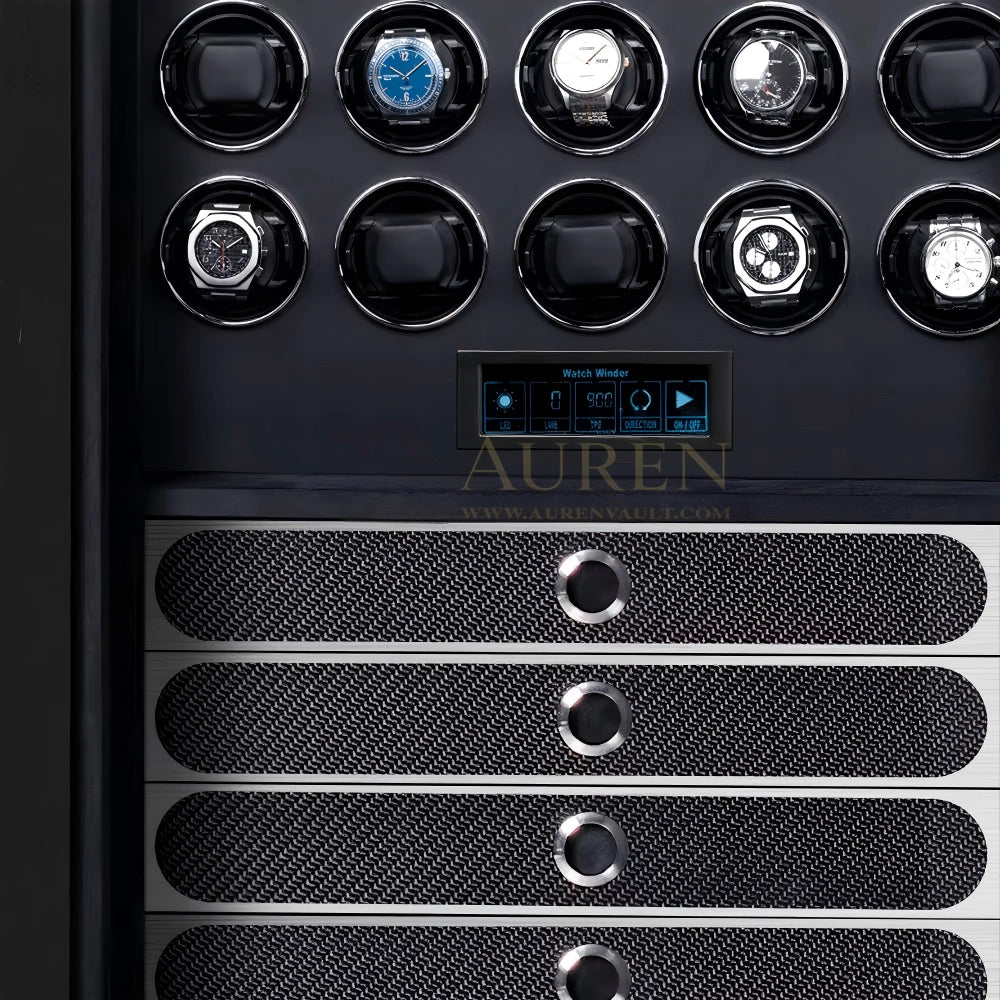
A suitable device should provide adjustable TPD, selectable rotation direction, and controlled rest cycles.
However, it must also offer sufficient height, width, depth, and a holder suitable for the Machine.
Clearance Is More Important Than a Generic Size Rating
A manufacturer may describe a winder as suitable for large watches.
That does not establish compatibility with an HM7 Aquapod or a FlyingT.
The full dimensions must be considered.
A watch that fits inside the enclosure while stationary may still contact its surfaces during rotation.
The case, crystal, crown, strap, and any unusual components must remain clear throughout the movement cycle.
When the fit cannot be verified, a conventional winder should not be assumed safe.
Independent Control for Several Automatic Machines
A collector who owns a FlyingT, HM7, and HM8 Mark 2 may require three different programs.
Independent modules allow each movement to receive suitable settings.
A cabinet that forces every watch onto one fixed program may be unnecessarily restrictive.
The holder dimensions may also need to differ considerably.
Secure Storage for a Mixed MB&F Collection
A collector may own several automatic Machines alongside manually wound Legacy Machines.
This makes a combination of active and passive storage particularly relevant.
| MB&F ownership situation | Appropriate approach |
|---|---|
| One LM FlyingT | Verify an appropriately sized, programmable winder |
| HM7 Aquapod | Confirm unusually large case clearance |
| HM8 Mark 2 | Compatible winder with nonstandard case support |
| LM101 / LM Perpetual / LM Sequential | Protected stationary storage |
| HM11 Architect | Protected stationary storage; use manual winding mechanism |
| Large mixed collection | Custom arrangement of active and passive compartments |
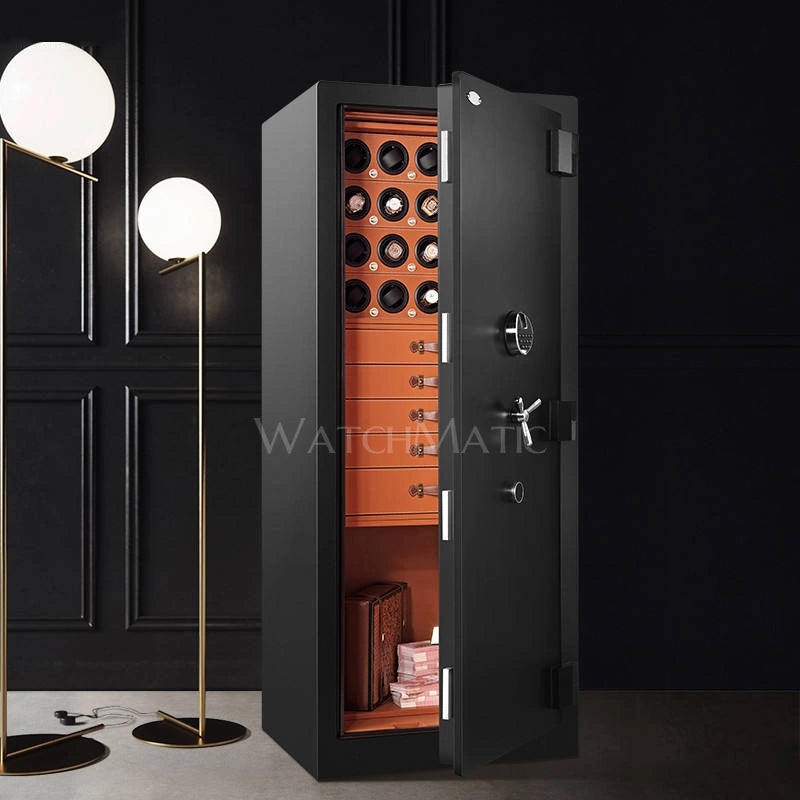
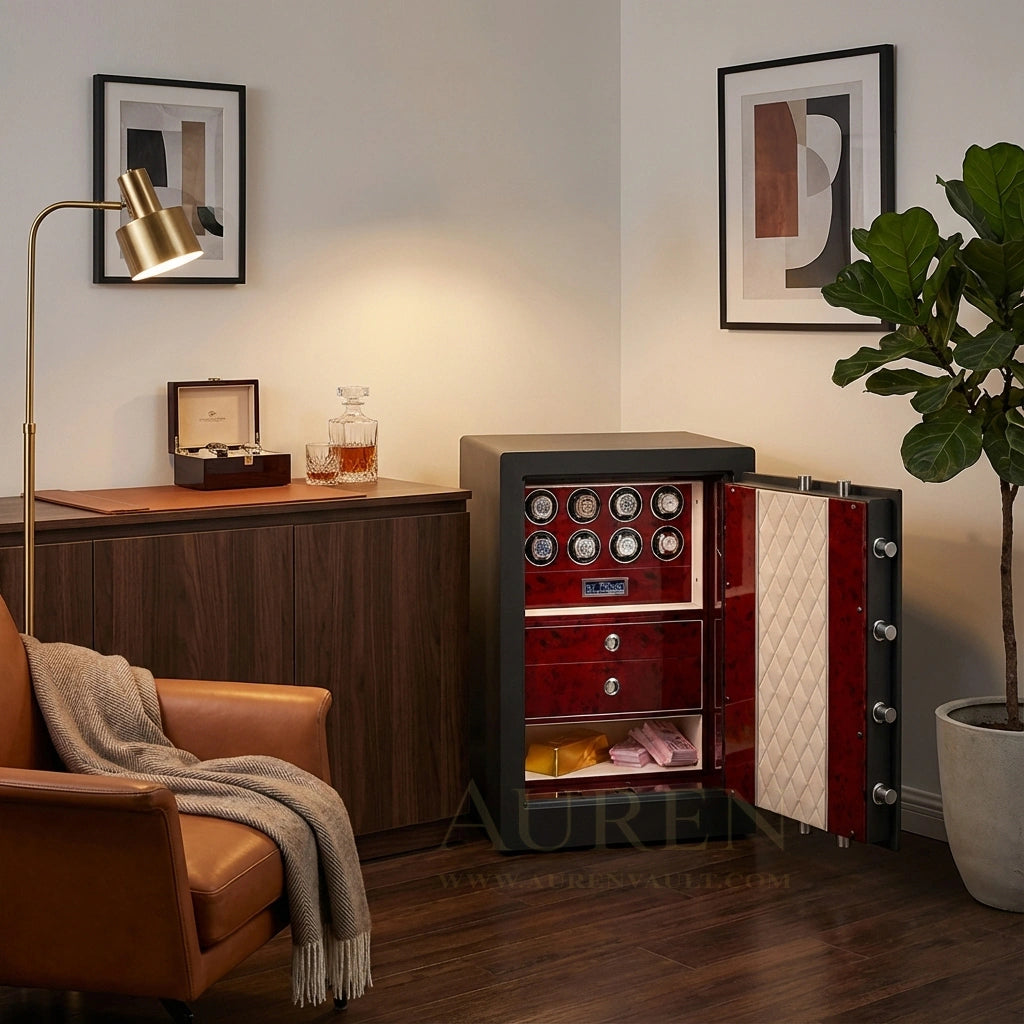
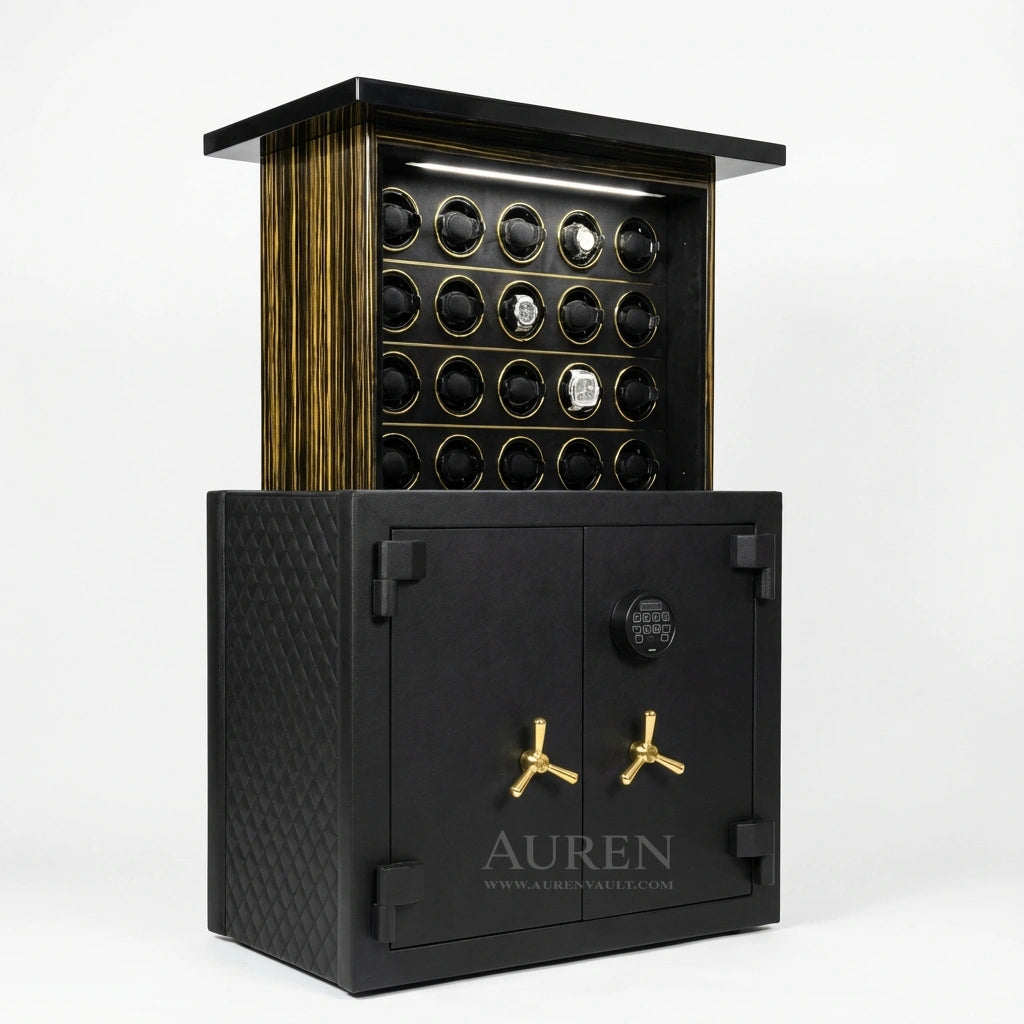
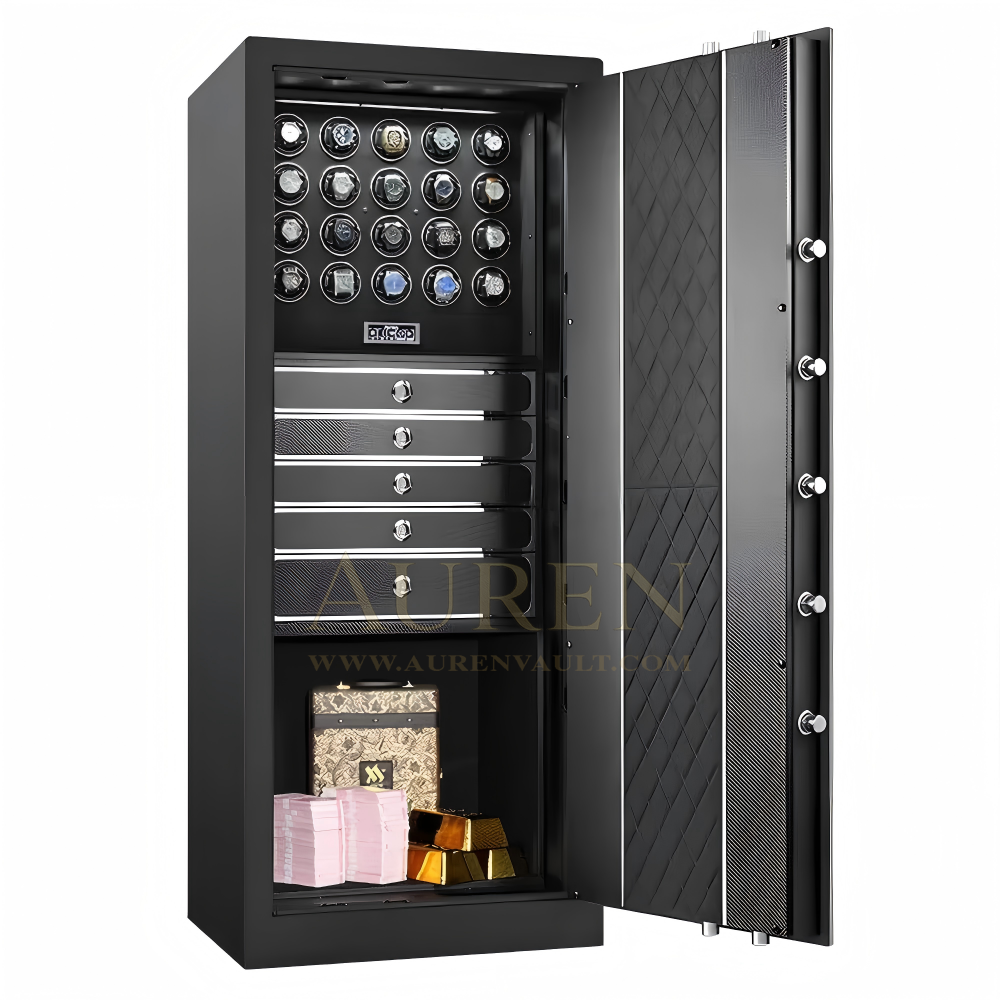
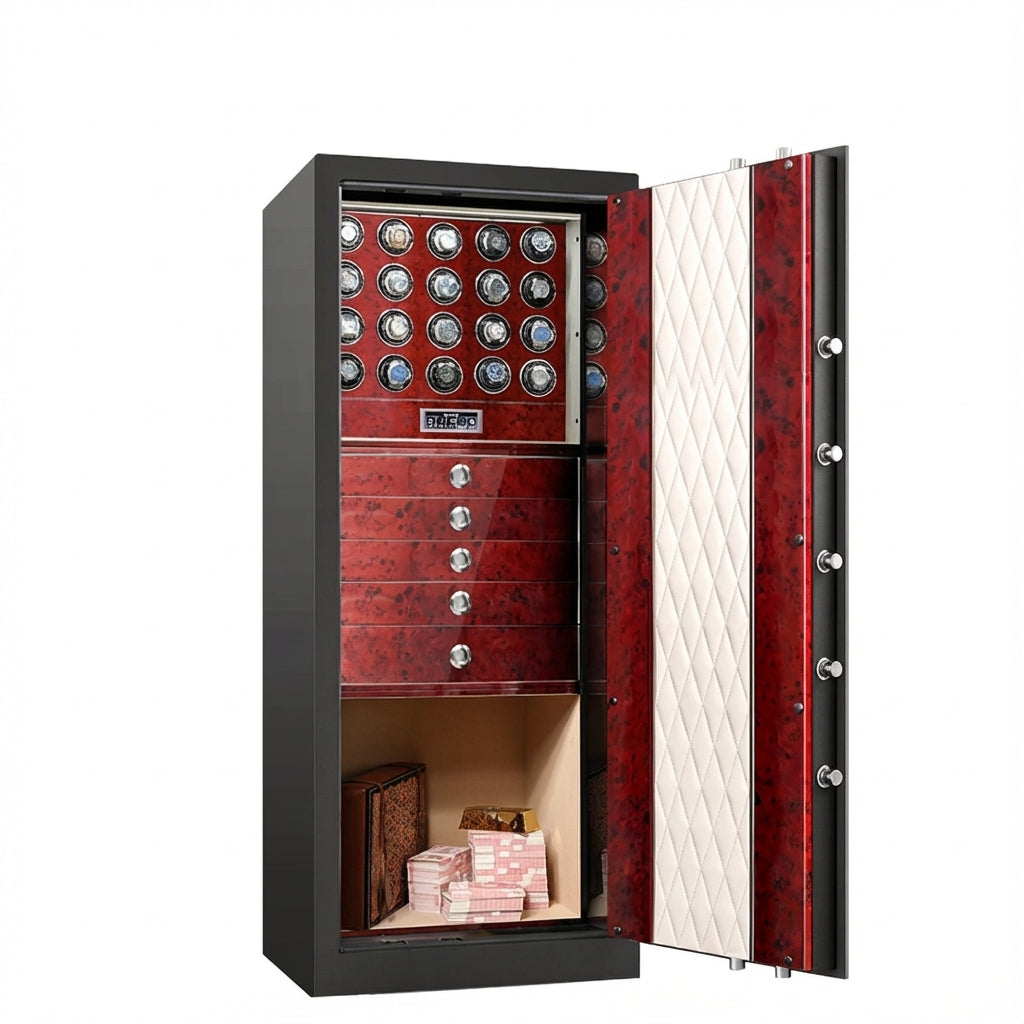
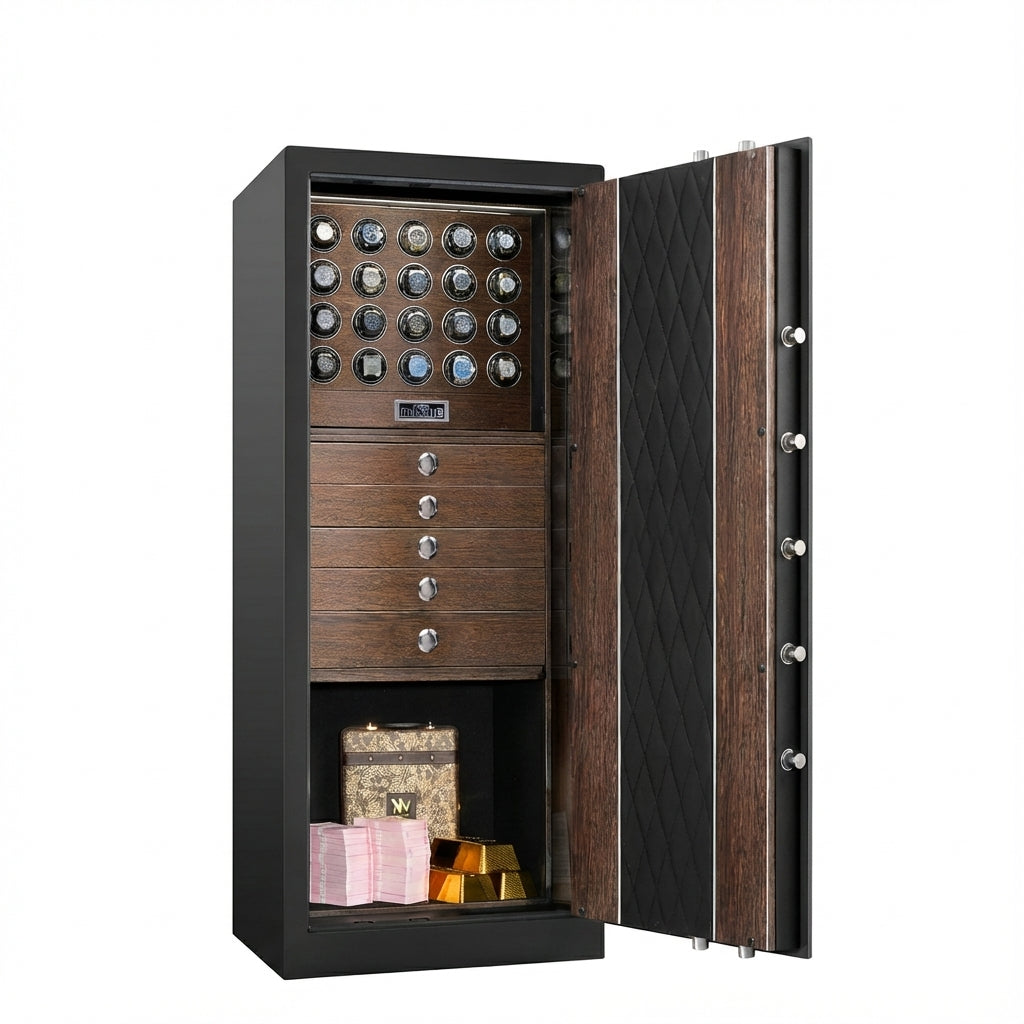
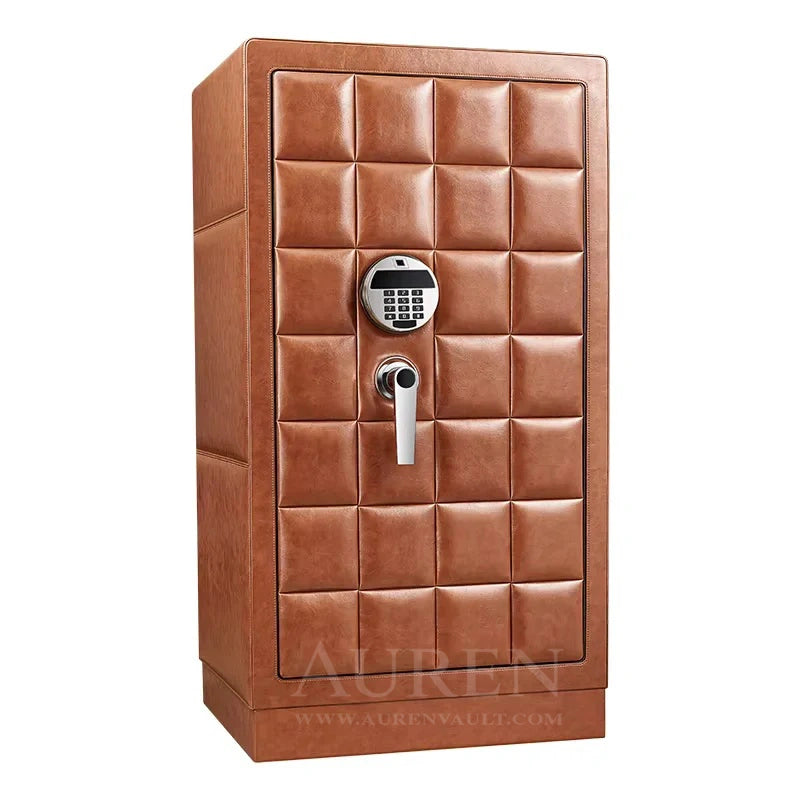
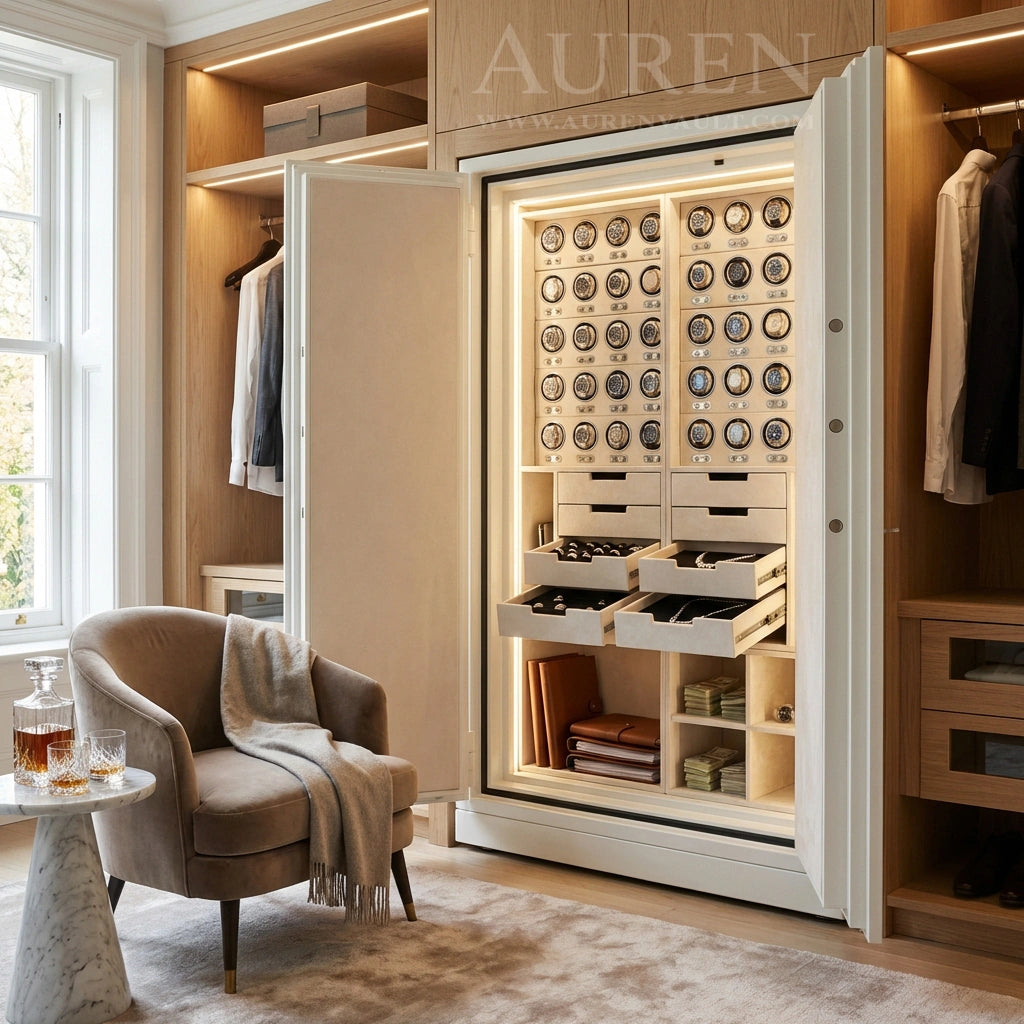
A watch winder safe can combine automatic winding positions with enclosed storage.
However, standard winding modules may not accommodate every MB&F Machine.
That compatibility must be checked before selecting the configuration.
The watch winder safe guide explains how integrated winding capacity and storage requirements interact.
For larger collections, luxury watch safes offer additional storage options.
The wider selection of watch safes can help collectors evaluate different capacities.
Because MB&F watches have such varied dimensions, custom watch safe configurations may be especially relevant.
The objective is to create appropriate positions for each Machine rather than force every watch into a conventional rotating compartment.
A locking safe should not automatically be assumed to offer certified burglary or fire resistance; those characteristics require separate verification.
How to Set Up an Automatic MB&F on a Winder
Begin by identifying the exact Machine and its movement.
Confirm that the movement is automatic.
If it is manually wound, conventional external rotation provides no winding benefit.
For an automatic Machine, obtain the verified TPD and direction.
If the watch has stopped, restart it according to the manufacturer's operating instructions.
Next, examine the intended holder.
Confirm that the case and all external components have adequate clearance during a complete rotation.
Do not force a nonstandard case onto an ordinary rigid cushion.
Select the movement-specific program and allow the device to complete its normal operating and resting cycles.
Observe whether the watch maintains its reserve.
If it stops or the physical mounting is unstable, review the setup rather than increasing TPD automatically.
For unusually complicated or valuable Machines, manufacturer guidance may be necessary.
Frequently Asked Questions About MB&F Watch Winders
What is the best watch winder for MB&F watches?
A fully programmable winder with movement-specific settings and a holder suitable for the exact case is the best general option for automatic MB&F Machines.
How many TPD does an automatic MB&F need?
There is no verified universal program. The correct TPD and direction should be confirmed for the specific Machine.
Is the MB&F LM FlyingT automatic?
Yes. It incorporates an automatic movement with approximately 100 hours of power reserve.
Can the HM7 Aquapod use a watch winder?
Yes, because its movement is automatic. However, its approximately 53.8 mm case diameter and considerable height make physical compatibility important.
Does the HM8 Mark 2 need a winder?
Not necessarily. Its automatic movement can receive winding through normal wear. A compatible winder is optional and useful during longer periods without use.
Is the HM8 Mark 2 based on a Girard-Perregaux movement?
Yes. MB&F describes it as using a Girard-Perregaux base movement with an additional proprietary display architecture.
Can an MB&F tourbillon use a winder?
Only when the movement is automatic. A tourbillon complication does not establish winding type.
Can the LM101 use a watch winder?
No. The LM101 is manually wound.
Does the LM Perpetual need a winder?
No. Its perpetual-calendar movement is manually wound despite its mechanical complexity.
Is the LM Sequential EVO automatic?
No. Both the Sequential EVO and Sequential Flyback EVO are manually wound.
Can rotating the HM11 on a conventional winder wind it?
No. The HM11 requires relative rotation of its case through a designated manual winding mechanism. Rotating the complete watch as one assembly is not equivalent.
Does the FlyingT's 100-hour reserve require 1,000 TPD?
No. Power reserve and daily external rotations are different measurements.
Are ordinary watch winder cushions suitable for MB&F?
Not necessarily. Several MB&F Machines have unusually tall, wide, or asymmetrical cases requiring individually verified holders and clearance.
Is a watch winder safe appropriate for MB&F collectors?
It can be useful if its winding modules and stationary compartments are physically compatible with the watches. For unusual Machines, a tailored configuration may be more appropriate.
Related Reading
Collectors interested in innovative independent watchmaking and storage may also find these guides useful:
-
Best Watch Winder for Richard Mille Watches — Unusual case constructions and movement-specific winding.
-
Best Watch Winder for Jaeger-LeCoultre Watches — Automatic and manually wound complications.
-
Watch Safes with Built-In Watch Winders — Balancing active winding with secure stationary storage.
Final Thoughts: MB&F Needs More Than a Generic Luxury Winder
MB&F demonstrates why movement type and case geometry must be evaluated together.
The LM FlyingT, HM7 Aquapod, and HM8 Mark 2 are automatic and can benefit from compatible winding.
The LM101, LM Perpetual, LM Sequential EVO, and HM11 Architect do not use conventional automatic winding.
Their elaborate mechanical architecture does not change that distinction.
For automatic Machines, a suitable winder must reproduce the correct program while providing sufficient clearance for the watch's unusual exterior.
For manually wound Machines, protected stationary storage is more appropriate.
At Auren Vault, the focus is on integrating precision winding, refined organization, and considered protection for distinctive timepiece collections.
Ultimately, the best MB&F watch winder is the one that is genuinely compatible with the Machine—both mechanically and physically.