

The best watch winder for Louis Vuitton watches is a programmable model that supports the specific automatic calibre, offers adjustable turns per day (TPD), allows the correct rotation direction, and securely holds the watch without placing unnecessary pressure on its bracelet or strap.
Modern Louis Vuitton automatic watches include the Tambour and Escale collections powered by the LFT023 micro-rotor movement, which provides approximately 50 hours of power reserve. More complicated models, such as the Tambour Spin Time Air, Escale Worldtime, and Escale Twin Zone, incorporate different automatic movements with their own winding requirements.
Approximately 650–800 TPD is a general range often investigated for conventional automatic watches, but it is not a verified universal setting for Louis Vuitton calibres. Micro-rotor movements and specialized complications require movement-specific guidance.
Not every Louis Vuitton watch needs a winder. Manually wound high-watchmaking pieces, quartz watches, and Tambour Horizon connected watches do not benefit from conventional automatic winding.
The right choice begins with the exact movement, followed by secure physical support and the owner's wearing habits.
Why Louis Vuitton Watch Winder Compatibility Depends on the Movement
Louis Vuitton's watchmaking has evolved considerably beyond the original Tambour collection.
Through La Fabrique du Temps Louis Vuitton, the Maison develops mechanical movements that range from relatively understated automatic calibres to sophisticated world-time displays, jumping-hour complications, and minute repeaters.
This diversity makes movement identification particularly important.
A modern Tambour Automatic and an Escale Automatic may share the LFT023 movement, while the Tambour Spin Time Air uses a separate automatic architecture.
The Escale Worldtime introduces a jumping-hour world-time mechanism, and the Escale Minute Repeater uses a manually wound movement.
These watches have different relationships with a watch winder despite belonging to the same manufacturer.
An automatic movement relies on an oscillating weight, commonly called a rotor, to transfer energy to the mainspring.
When the owner moves their wrist, the rotor moves and contributes to winding the watch.
Once the watch is removed, it continues operating until its stored power is exhausted.
A watch winder recreates some of the necessary motion through programmed rotation.
Its primary purpose is to maintain operating continuity between wears.
It does not improve the movement's inherent accuracy, repair mechanical problems, or replace regular servicing.
For someone who wears a single Tambour Automatic daily, a winder may be unnecessary.
For a collector who rotates between a Tambour, Escale, and other mechanical watches, maintaining the movements can be more convenient.
The correct winding program must nevertheless follow the calibre rather than the visual design of the watch.
Which Louis Vuitton Watches Can Use a Watch Winder?
Louis Vuitton produces automatic, manually wound, quartz, and connected timepieces.
The distinction determines whether conventional winding is relevant.
| Louis Vuitton watch | Representative calibre | Movement type | Power reserve | Winder compatibility |
|---|---|---|---|---|
| Tambour Automatic 40 mm | LFT023 | Automatic micro-rotor | 50 hours | Yes |
| Escale Automatic | LFT023 | Automatic micro-rotor | 50 hours | Yes |
| Tambour Spin Time Air | ST13.01 | Automatic | 45 hours | Yes |
| Escale Worldtime, modern reference | LFT VO12.01 | Automatic worldtimer | 62 hours | Yes |
| Escale Twin Zone | LFT VO15.01 | Automatic dual time | 68 hours | Yes |
| Tambour Twenty Chronograph | LV277 | Automatic chronograph | 50 hours | Yes |
| Escale Minute Repeater | LFT SO13.01 | Manual winding | 80 hours | No |
| Tambour Galactique | LFT AU14.02 | Manual winding | 100 hours | No |
| Tambour Horizon | Electronic | Connected watch | Not applicable | No |
| Selected quartz watches | Quartz | Battery-powered | Not applicable | No |
These specifications refer to representative models and documented movement configurations.
Louis Vuitton has produced different generations of Tambour, Escale, and other watches. The precise reference should always be confirmed before selecting a winding program.
Why the Collection Name Is Not Enough
The Tambour name has been associated with mechanical chronographs, contemporary micro-rotor automatics, complicated watches, and connected technology.
Those products cannot share one universal winding recommendation.
Even watches containing automatic movements can have different winding mechanisms.
A modern LFT023 and an LV277 chronograph should not automatically receive identical settings.
The same principle applies to the Escale collection.
A time-only Escale Automatic can benefit from a compatible winder, while the manually wound Escale Minute Repeater cannot.
For collectors, the practical sequence is straightforward:
Identify the reference, confirm the calibre, establish whether it is automatic, and then select the appropriate winding program.
Louis Vuitton Watch Winder Settings: TPD and Rotation Direction
Two parameters determine how a watch winder operates.
Turns per day (TPD) describes the number of rotations delivered by the device during a programmed 24-hour period.
Rotation direction determines whether those movements occur clockwise, counterclockwise, or alternately in both directions.
These settings must work together.
A movement may wind effectively through both directions or primarily through one direction.
Consequently, a high TPD setting may provide inadequate winding if the device operates in an ineffective direction.
This is especially important when dealing with movement architectures that differ from conventional centrally mounted automatic rotors.
Louis Vuitton Winder Settings by Calibre
| Calibre | TPD recommendation | Rotation direction |
|---|---|---|
| LFT023 | Verify the micro-rotor's specific winding requirements | Confirm for the exact reference |
| ST13.01 | Use calibre-specific guidance | Verify before programming |
| LFT VO12.01 | Confirm the worldtimer movement's requirements | Calibre-specific |
| LFT VO15.01 | Verify the automatic dual-time movement | Calibre-specific |
| LV277 | Use movement-specific guidance for the automatic chronograph | Confirm effective direction |
| LFT SO13.01 | Not applicable | Manual winding only |
| LFT AU14.02 | Not applicable | Manual winding only |
| Tambour Horizon | Not applicable | Electronic charging |
A universally verified Louis Vuitton TPD chart is not established here.
For automatic calibres without a documented external-winder program, it is more accurate to recommend a fully programmable device than to prescribe 650 or 800 TPD as an official setting.
Is 650 TPD Enough for a Louis Vuitton Automatic?
It may be sufficient for some automatic movements, but that number should not be treated as universal.
Approximately 650–800 TPD is a commonly discussed range for many conventional automatic watches.
However, Louis Vuitton uses several specialized movement architectures.
The LFT023 contains a micro-rotor, while other Louis Vuitton calibres incorporate different winding arrangements.
Their rotor construction and winding efficiency should be confirmed before selecting the program.
A watch winder should maintain sufficient power through appropriate movement and rest periods.
The objective is reliable operation, not maximizing the number of rotations.
For a more detailed explanation of TPD and rotation direction, see the watch TPD guide.
Does a Longer Power Reserve Mean Higher TPD?
Not necessarily.
Power reserve measures how long a sufficiently wound movement can operate without receiving additional energy.
TPD measures the number of rotations performed by the external winding device.
A 68-hour Escale Twin Zone does not automatically require more rotations than a 50-hour Tambour Automatic.
Winding efficiency depends on the movement's rotor mechanism, gearing, and how effectively motion transfers energy to the mainspring.
The correct program should therefore be determined by the calibre rather than the power-reserve figure alone.
Best Watch Winder for Louis Vuitton Tambour Automatic: LFT023
The contemporary Tambour Automatic represents an important direction in Louis Vuitton's mechanical watchmaking.
Its 40 mm case combines a refined sports-watch profile with an integrated metal bracelet.
The watch uses the LFT023, a self-winding movement developed for Louis Vuitton with a 22K rose-gold micro-rotor.
It provides approximately 50 hours of power reserve and operates at 28,800 vibrations per hour.
The movement is chronometer-certified under ISO 3159 standards.
For collectors, this combination creates a distinctive automatic watch that can benefit from compatible winding when it is not worn regularly.
How the LFT023 Micro-Rotor Differs From a Conventional Rotor
A conventional automatic movement typically has a centrally mounted oscillating weight that rotates over a substantial part of the movement.
A micro-rotor uses a smaller winding mass integrated into the movement's architecture.
This allows the movement to maintain a relatively slim profile.
The Tambour Automatic's case measures approximately 8.3 mm thick in selected 40 mm references, contributing to its understated proportions.
However, a micro-rotor should not automatically be assumed to have identical winding requirements to a conventional rotor.
Its effective winding performance depends on the complete mechanism.
A watch winder can be suitable, but its direction and TPD should be verified specifically for the LFT023.
When a Tambour Automatic Owner Benefits From a Winder
Imagine someone who wears the Tambour during the working week but chooses another watch for weekends.
With approximately 50 hours of reserve, a sufficiently wound Tambour may continue operating into the weekend.
If left unworn longer, the movement eventually stops.
A compatible winder can maintain the watch's operation and make it ready for use whenever selected.
For someone who wears the Tambour almost every day, the benefit is smaller.
The watch's normal automatic winding system may already provide adequate energy.
The Integrated Bracelet Requires Careful Support
The modern Tambour's integrated bracelet is part of its distinctive design.
A bracelet fitted closely to the owner's wrist may not accommodate an oversized rigid cushion comfortably.
Forcing the clasp closed around an unsuitable holder can create unnecessary pressure on the bracelet.
A compressible cushion provides more flexibility.
The watch should remain secure throughout rotation without stretching the bracelet or allowing the case to shift.
The holder must also provide adequate clearance so that the case does not contact the winding compartment.
For a carefully finished luxury sports watch, stable support matters as much as programming compatibility.
Louis Vuitton Escale Automatic: The Same Calibre, Different Physical Requirements
The contemporary Escale Automatic also uses the LFT023 movement.
This provides a useful example of how two watches can share mechanical requirements while having different physical storage needs.
The Escale's design draws inspiration from Louis Vuitton's historic trunks.
Its refined lugs, case finishing, and strap configurations create a more traditional dress-watch character than the integrated-bracelet Tambour.
Selected automatic Escale references use a 39 mm case, while other configurations have different dimensions.
The LFT023 still provides approximately 50 hours of power reserve.
Does the Escale Need a Different TPD From the Tambour?
When both watches use the same LFT023 movement configuration, their winding requirements should be closely related.
However, the precise watch reference should still be checked.
The main practical difference may be the watch holder.
An Escale fitted with a leather strap should not be stretched around an oversized support.
A soft cushion allows the strap to retain a more natural curvature.
A Tambour with an integrated bracelet may need a holder designed for a closely fitted metal bracelet.
The movement determines the program.
The case and strap determine the physical support requirements.
Is a Winder Necessary for a Dress Watch?
No.
A mechanical dress watch can be stored without active winding.
Allowing the movement to stop when its power reserve is exhausted is normal.
A winder is useful when the owner prefers to have the watch immediately ready or regularly alternates between several timepieces.
For someone who wears an Escale only on special occasions, passive storage may be entirely appropriate.
Tambour Spin Time Air: Why a Jumping-Hour Display Makes Winding Convenient
The Tambour Spin Time Air is one of Louis Vuitton's most distinctive contemporary complications.
Selected automatic references use the ST13.01 calibre, with approximately 45 hours of power reserve.
Instead of a conventional hour hand, the watch uses rotating cubes to display the current hour.
The unusual mechanism is both a technical achievement and a defining visual feature.
Why the Spin Time Air Can Benefit From Continuous Operation
When an automatic watch stops, its indications must be restored after restarting.
For a simple three-hand model, the process is relatively straightforward.
A jumping-hour complication introduces a different display arrangement.
Keeping the movement running may reduce the frequency with which the owner needs to restore the displayed time.
This is especially useful for collectors who wear the Spin Time Air intermittently.
However, a watch winder cannot correct a watch that has been set incorrectly.
It supplies energy through the automatic winding system.
The jumping-hour mechanism and its settings remain separate from the external winder.
Does the Complication Require More TPD?
Not automatically.
A complicated hour display does not independently establish a higher external winding requirement.
The correct rotation program depends on the ST13.01's automatic winding architecture.
A programmable winder should be selected according to verified calibre-specific information.
The owner should not choose the highest available TPD simply because the watch contains an unusual complication.
Escale Worldtime and Twin Zone: The Value of Maintaining Travel Complications
Louis Vuitton's Escale travel watches provide particularly strong examples of why winding convenience can matter.
The modern Escale Worldtime incorporates an automatic LFT VO12.01 movement.
It provides approximately 62 hours of power reserve and includes a world-time display with jumping hours and day/night indications.
The Escale Twin Zone uses the automatic LFT VO15.01, providing approximately 68 hours of power reserve.
Its dual-time display allows the owner to follow local time and home time, with additional day/night information.
These are more involved displays than conventional hours and minutes.
Why a Worldtimer Is Worth Keeping Running
A collector who uses an Escale Worldtime for international travel may prefer not to restart the watch repeatedly.
When the movement stops, the relevant time and world-time indications must be restored.
A compatible winder can maintain operating continuity between wears.
However, it cannot automatically detect a change in the owner's location.
The watch must still be adjusted when the intended displayed time zone changes.
A winder maintains energy, not geographic information.
The Twin Zone's 68-Hour Reserve
A sufficiently wound Escale Twin Zone can continue operating for approximately 68 hours without additional winding.
This provides useful flexibility for an owner who changes watches during the week.
A winder becomes more valuable when the watch regularly remains unused beyond its available reserve.
The longer reserve does not establish a higher TPD requirement.
The appropriate program should follow the LFT VO15.01 movement.
Protecting Precious-Metal Cases and Refined Straps
Escale travel watches may incorporate precious-metal cases, carefully finished lugs, and refined leather straps.
A suitable winding holder should prevent unnecessary contact with hard surfaces.
The strap should be secured without excessive tension.
The compartment should provide enough clearance for the case throughout rotation.
For valuable watches, the quality of physical support is a more meaningful purchase criterion than decorative lighting or an elaborate display mechanism.
Tambour Twenty: Winding an Automatic Chronograph
The Tambour Twenty was introduced in 2022 as a limited-edition celebration of the original Tambour design.
It uses the LV277 automatic chronograph movement, derived from the Zenith El Primero architecture.
The movement operates at 36,000 vibrations per hour and offers approximately 50 hours of power reserve.
This is a different mechanical platform from the LFT023 micro-rotor.
Why the LV277 Should Have Its Own Winding Program
A chronograph movement should not automatically be assigned the same TPD and direction as a time-only automatic.
The LV277's high-frequency movement and automatic winding system require their own compatibility assessment.
The fact that the watch operates at 36,000 vibrations per hour does not establish a particular number of external rotations.
Balance frequency and winding TPD measure different things.
A programmable winder allows the correct program to be selected once the movement's requirements have been confirmed.
A Winder Does Not Operate the Chronograph
The winder rotates the watch to maintain energy.
It does not start, stop, or reset the chronograph.
Those functions remain controlled by the watch's pushers.
For an owner who wears the Tambour Twenty occasionally, the primary benefit is preserving ordinary timekeeping between uses.
When a Louis Vuitton Watch Should Not Be Placed on a Winder
Louis Vuitton's high-watchmaking range includes manually wound movements.
The Escale Minute Repeater is an important example.
It uses the manually wound LFT SO13.01, with approximately 80 hours of power reserve.
The movement combines a minute repeater with jumping hours and retrograde minutes.
Despite its mechanical complexity, it cannot receive winding energy through a conventional rotating winder because it lacks an automatic winding rotor.
The Tambour Galactique with calibre LFT AU14.02 is another manually wound example.
Its 100-hour reserve does not change that distinction.
Likewise, the Tambour Horizon is an electronic connected watch and requires appropriate electronic charging rather than mechanical rotation.
A premium winder is not useful simply because the watch is expensive or complicated.
The movement must actually support automatic winding.
What Makes a Watch Winder Suitable for Louis Vuitton?
The best winding system should be evaluated through its compatibility, physical support, and consistency of operation.
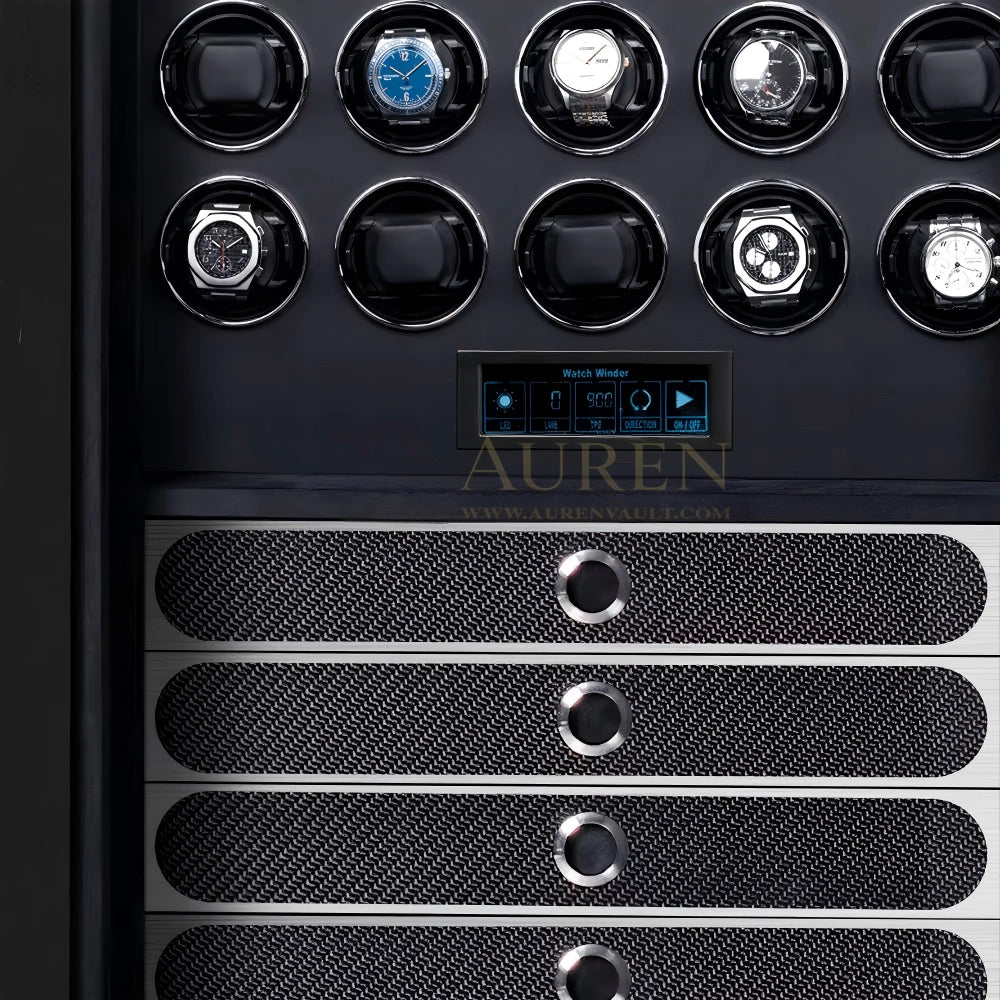
Adjustable TPD and Rotation Direction
A suitable winder should offer clockwise, counterclockwise, and bidirectional programs with adjustable TPD.
For a collection containing several Louis Vuitton automatic calibres, independent programming is particularly valuable.
The LFT023, ST13.01, and LV277 should not automatically share the same program.
Controlled Rest Periods
Automatic watches do not require uninterrupted rotation.
A quality device distributes its scheduled rotations through operating intervals and pauses.
The objective is to maintain adequate energy without unnecessary continuous activity.
Reliable and Quiet Motors
A watch winder placed in a bedroom, dressing room, or private office should operate discreetly.
Smooth motor operation and consistent programming are more useful than an exceptionally high advertised maximum TPD.
Physical Support for Different Case Designs
A Tambour with an integrated bracelet, an Escale with a leather strap, and a Spin Time Air with a larger case may require different holders.
Adjustable, softly supported cushions are preferable to rigid supports that fit only one watch circumference.
The watch should remain stable without placing unnecessary pressure on its bracelet, strap, crown, or case.
Standalone Watch Winder or Watch Winder Safe for Louis Vuitton?
A standalone winder provides convenient maintenance of an automatic movement's operating state.
For someone who owns a single Tambour Automatic, this may be sufficient.
A larger collection introduces other priorities.
Valuable watches may need enclosed storage, organization, and additional physical security.
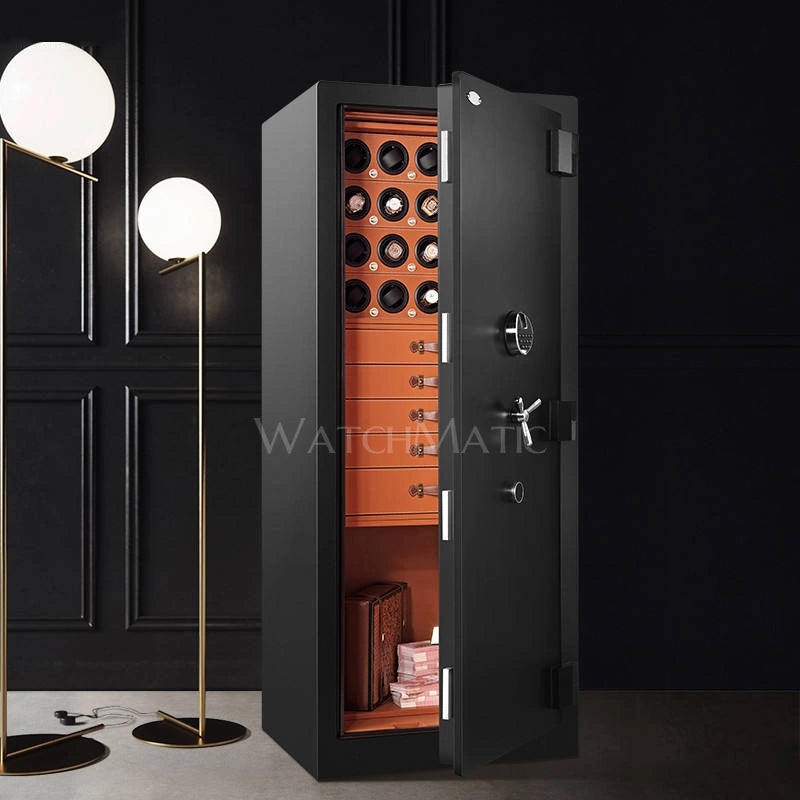
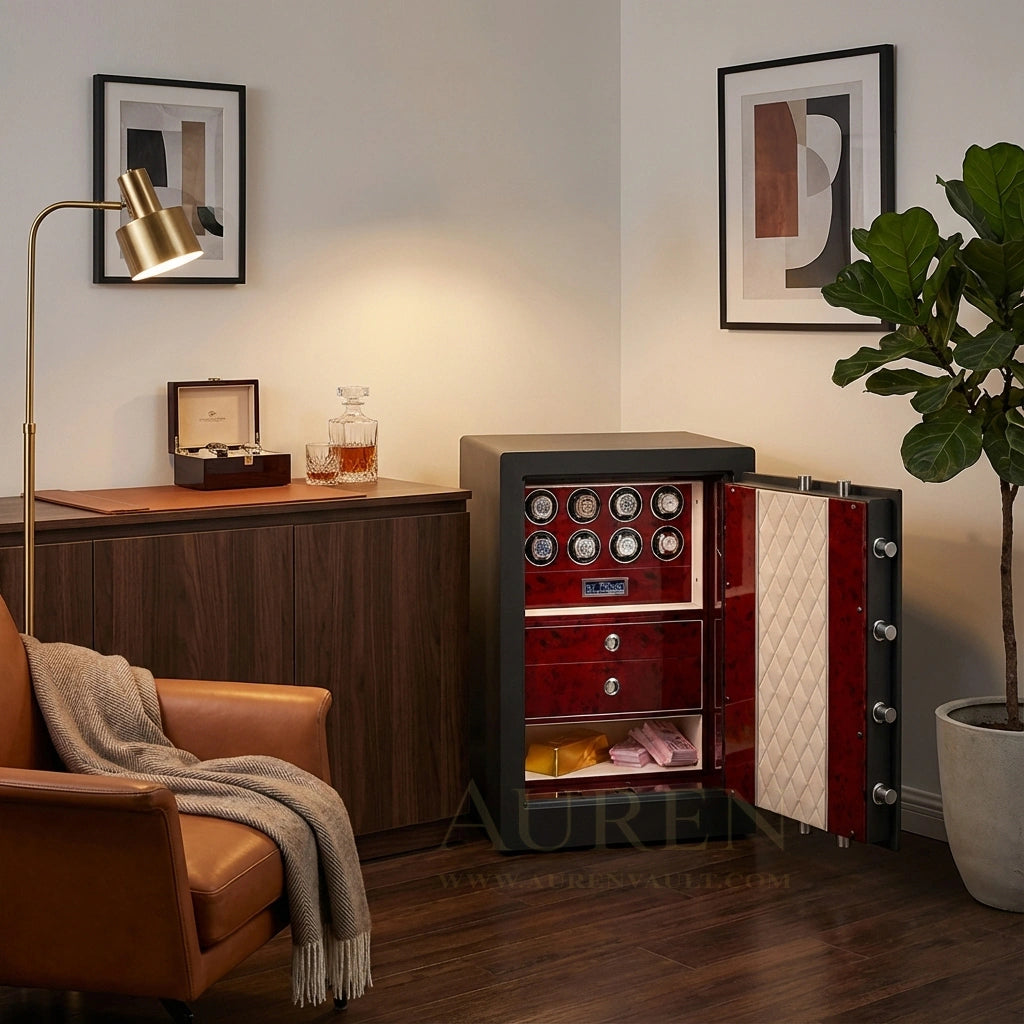
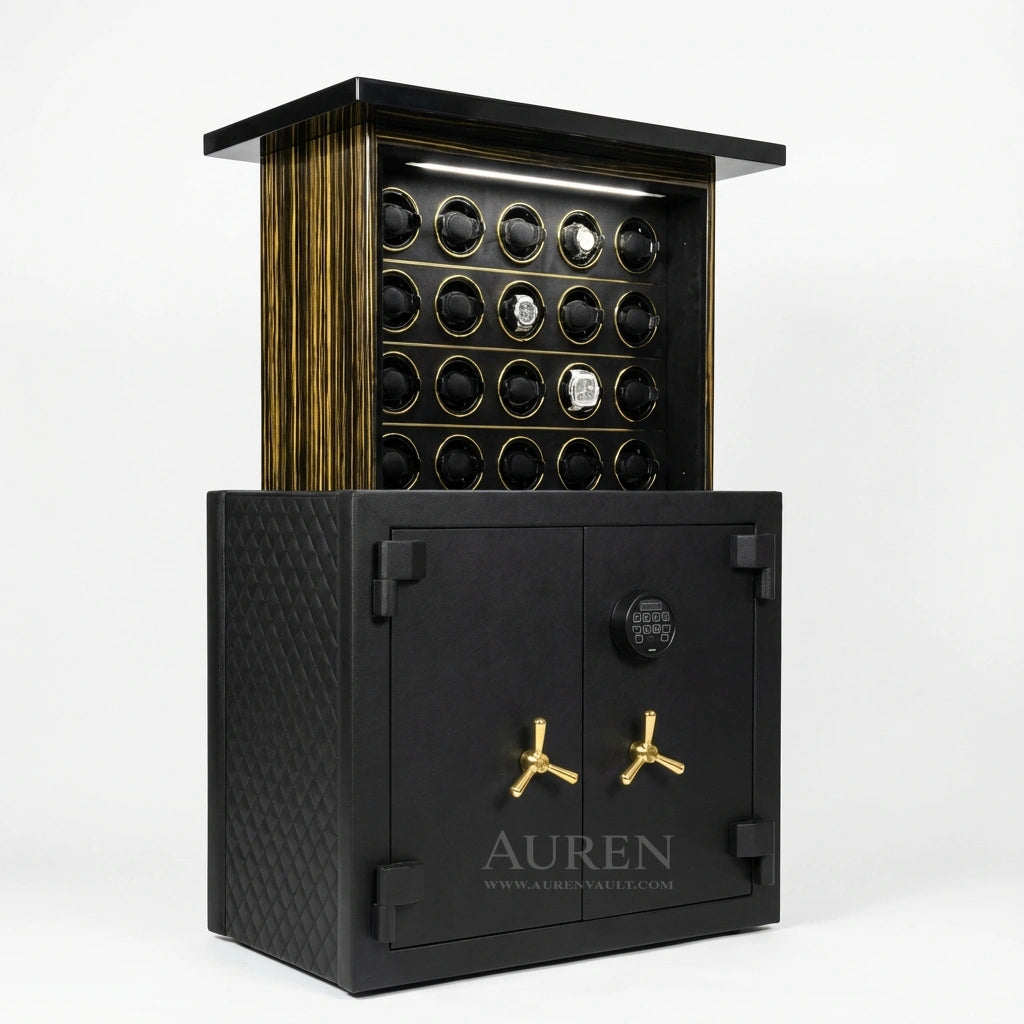
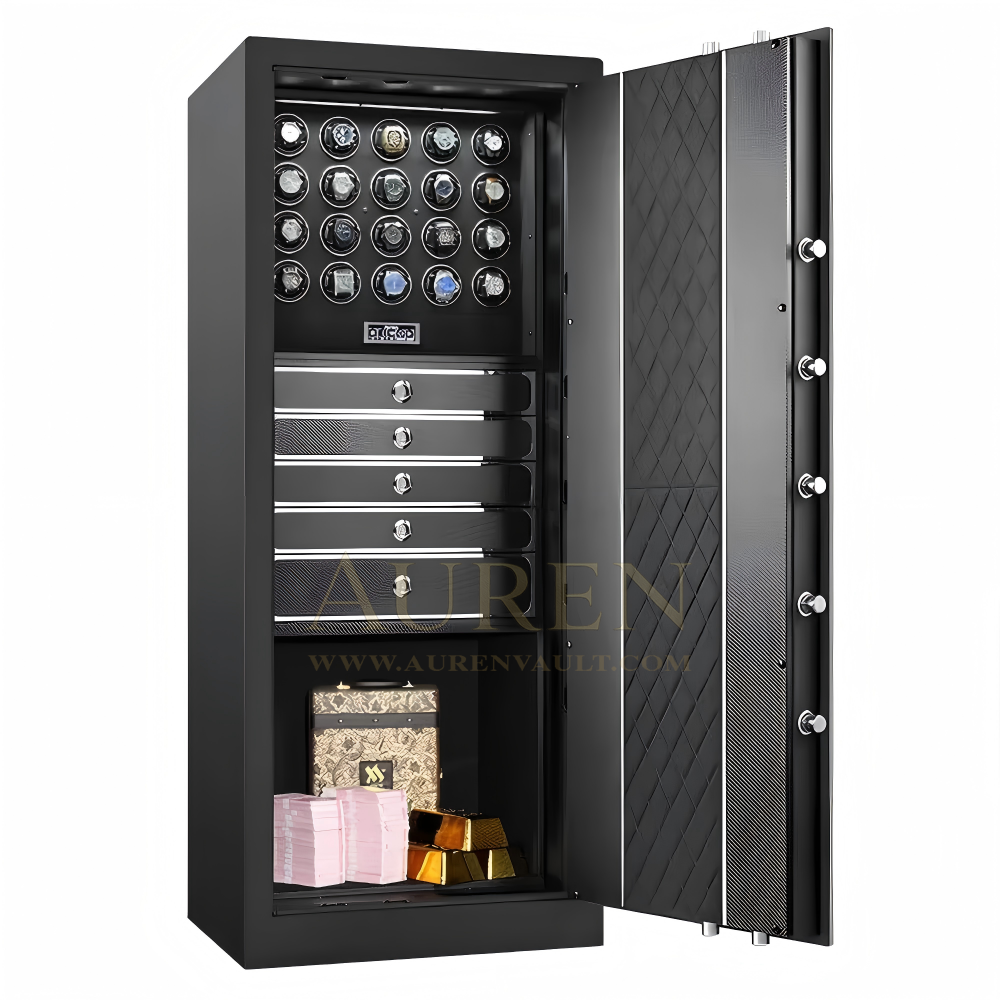
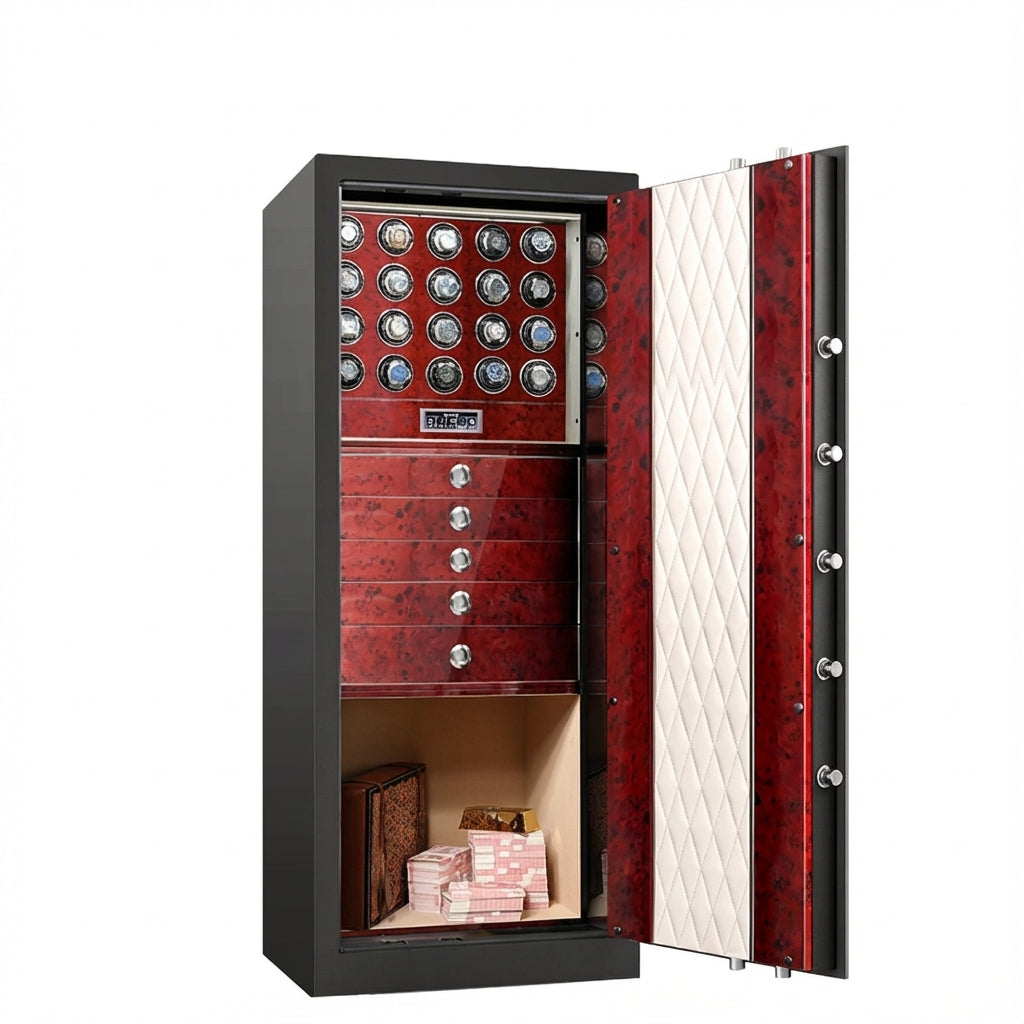
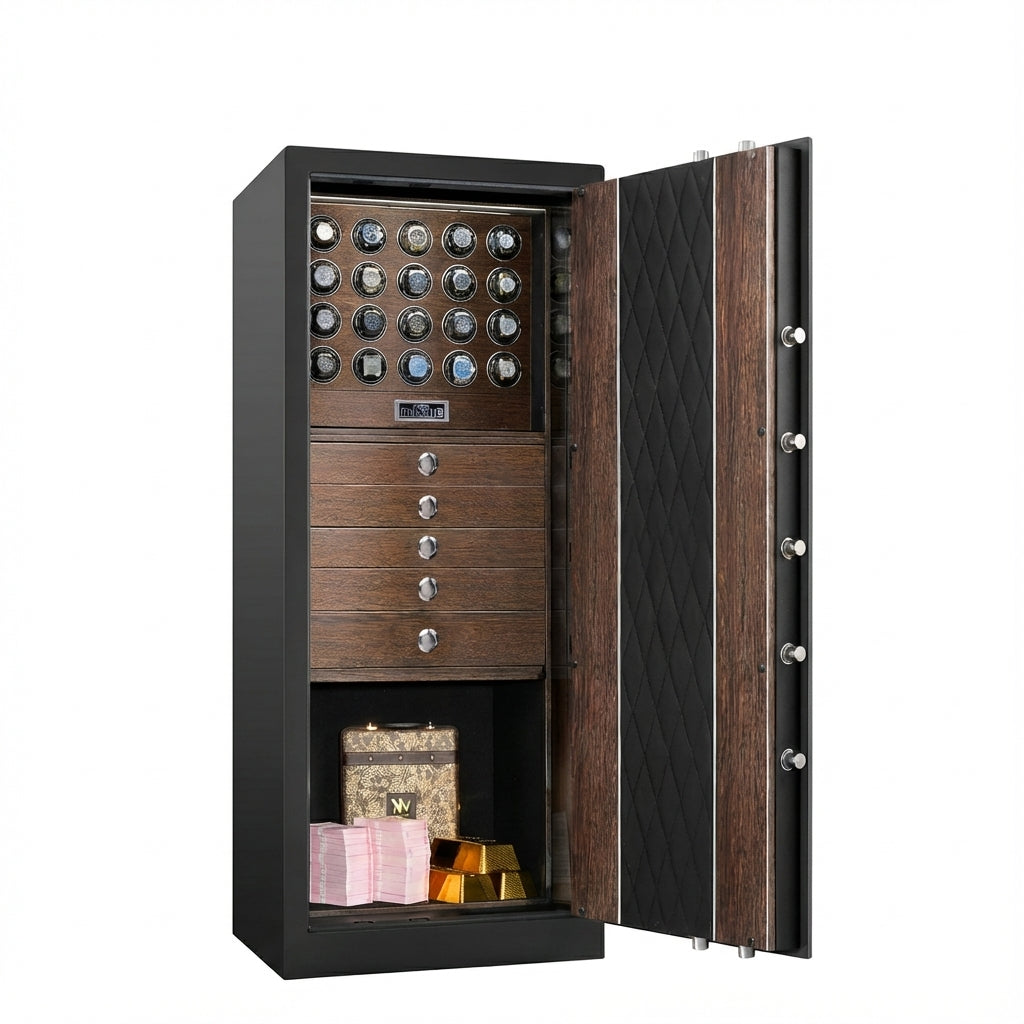
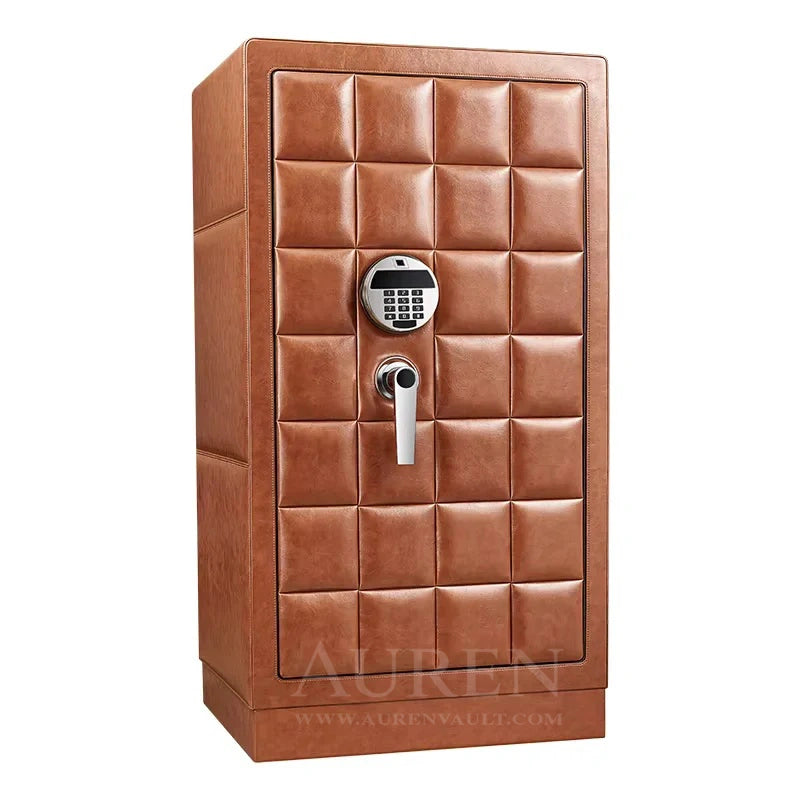
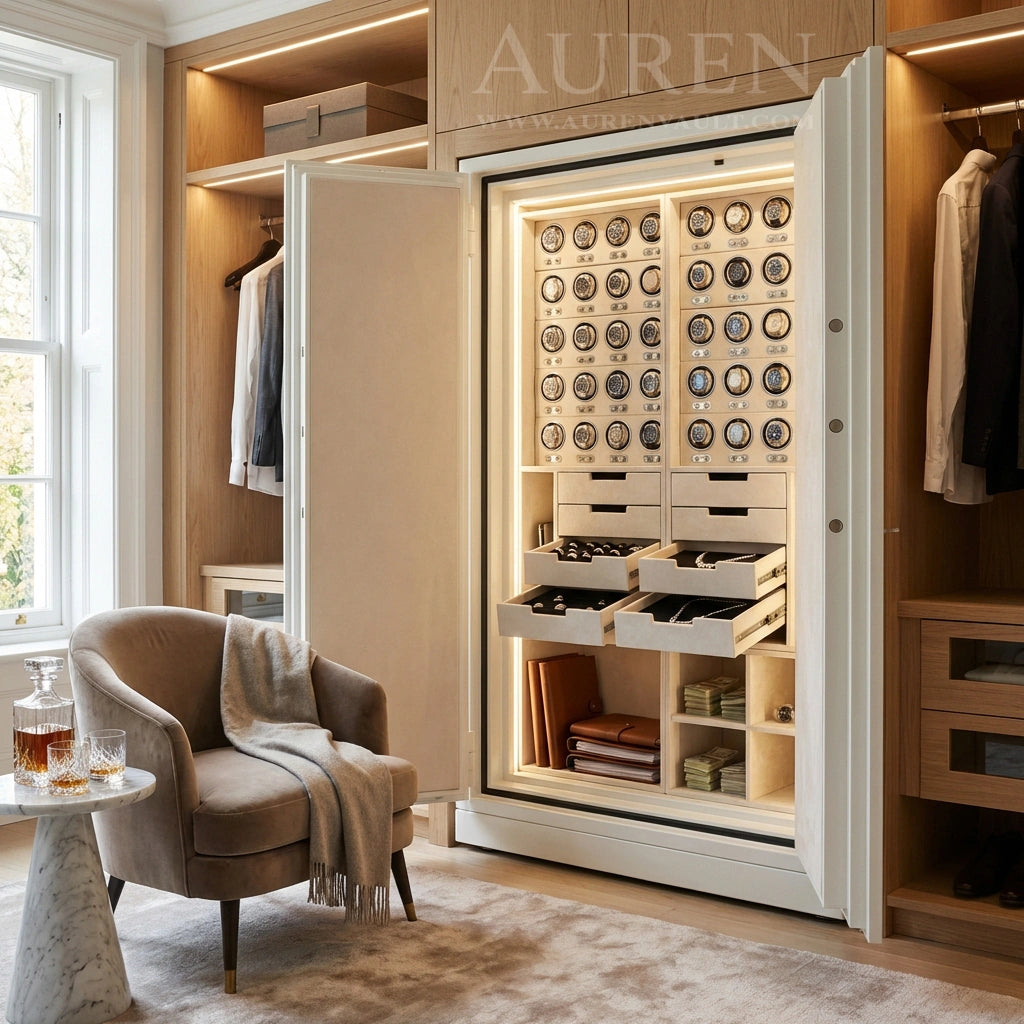
A watch winder safe can combine these requirements within one system.
| Consideration | Standalone watch winder | Watch winder safe |
|---|---|---|
| Automatic winding | Primary purpose | Integrated function |
| Independent programming | Model-dependent | Module-dependent |
| Physical security | Usually limited | Depends on safe construction |
| Passive storage | Often limited | Can include stationary compartments |
| Collection capacity | One or several watches | Compact to large configurations |
| Best suited for | Daily convenience | Valuable mixed collections |
A locking cabinet should not automatically be assumed to provide certified burglary or fire resistance.
Those capabilities depend on the enclosure's documented construction, ratings, and installation.
Collectors considering integrated winding can explore watch winder safes with programmable winding positions.
The watch winder safe guide provides additional context for evaluating these systems.
Planning Around an Actual Louis Vuitton Collection
Consider a collector who owns a Tambour Automatic, Escale Automatic, Tambour Spin Time Air, Escale Twin Zone, Escale Minute Repeater, and Tambour Horizon.
Six watches are owned, but only four require automatic winding positions.
The manually wound minute repeater and electronic connected watch should remain in suitable passive storage or charging arrangements.
The automatic watches may also have different program requirements.
A cabinet with independently controlled winding modules and stationary compartments is therefore more practical than assuming every watch needs rotation.
For larger collections, luxury watch safes provide additional storage options.
The broader watch safe collection can help owners compare different capacities.
When unusual case sizes, complications, or interior requirements make standard arrangements unsuitable, custom watch safe configurations offer another approach.
Should Louis Vuitton Automatic Watches Stay on a Winder Continuously?
No automatic Louis Vuitton watch mechanically requires permanent external winding.
When the power reserve is exhausted, the movement stops normally.
It can be restarted in accordance with the manufacturer's instructions.
For a frequently worn Tambour Automatic, a winder may provide limited additional convenience.
For an Escale Worldtime or Spin Time Air worn intermittently, maintaining operating continuity can reduce repeated adjustments.
The value depends on how the watch is used.
Continuous operation should not be confused with better preservation.
A winder does not replace servicing, protect against every environmental risk, or prevent normal mechanical wear.
For watches stored over longer periods, protection from impacts, excessive humidity, unsuitable temperatures, and unnecessary handling becomes particularly important.
The watch storage guide explains broader principles for protecting mechanical collections.
Frequently Asked Questions About Louis Vuitton Watch Winders
What is the best watch winder for Louis Vuitton watches?
A programmable winder with adjustable TPD, selectable direction, controlled rest cycles, and appropriate watch cushions is the best general choice. The exact settings should match the movement.
How many TPD does a Louis Vuitton automatic need?
There is no single verified TPD program for every Louis Vuitton automatic calibre. The correct setting depends on the movement. General recommendations such as 650–800 TPD should not be treated as official settings for specialized micro-rotor movements.
Does the Louis Vuitton Tambour Automatic need a winder?
No. The LFT023 is self-winding and can receive sufficient energy through regular wear. A compatible winder is optional and useful mainly during extended periods without use.
Can the LFT023 micro-rotor use a conventional watch winder?
Yes, provided the winder's program is compatible with the movement. The micro-rotor architecture does not prohibit external winding, but its exact direction and TPD should be verified.
Is the Louis Vuitton Escale Automatic compatible with watch winders?
Yes. Escale Automatic references using LFT023 can benefit from a compatible winder. A suitable cushion is particularly important for leather-strap versions.
Does the Tambour Spin Time Air need a winder?
Not mechanically, but a compatible winder can be convenient because it helps maintain the automatic ST13.01 movement and reduces repeated resetting of its jumping-hour display.
Can an Escale Worldtime use a watch winder?
Yes. The automatic LFT VO12.01 can benefit from compatible winding. Maintaining the movement can reduce repeated adjustments of its world-time indications.
Does the Escale Twin Zone require more TPD because of its 68-hour reserve?
Not necessarily. Power reserve does not determine TPD. The appropriate program must be based on the LFT VO15.01 movement's winding requirements.
Can a Tambour Twenty Chronograph use a watch winder?
Yes. The LV277 is an automatic chronograph movement. It requires a compatible winding program that should be verified separately from the LFT023.
Does an Escale Minute Repeater need a winder?
No. The LFT SO13.01 is manually wound. Its mainspring must be wound through the designated mechanism according to the watch's instructions.
Can a watch winder charge a Tambour Horizon?
No. The Tambour Horizon is an electronic connected watch and requires its appropriate charging system.
Is a watch winder safe better for Louis Vuitton collectors?
A standalone winder may be sufficient for one automatic watch. A properly specified watch winder safe is more relevant when the owner wants to combine automatic winding with enclosed storage for a valuable collection.
Related Reading
For collectors comparing distinctive movement architectures and luxury watch storage:
-
Best Watch Winder for Cartier: TPD Settings & Buying Guide — Explores automatic, manual, and quartz watches within design-focused luxury collections.
-
Best Watch Winder for Vacheron Constantin Watches — Examines automatic complications, winding requirements, and secure storage.
-
Watch Safes with Built-In Watch Winders: Are They Worth It? — Compares standalone winding and integrated enclosed storage.
Final Thoughts: Choose for the Louis Vuitton Calibre, Not the Collection Name
Louis Vuitton's contemporary watchmaking demonstrates why the correct winder should be selected by movement.
A Tambour Automatic and an Escale Automatic may share the LFT023, while the Spin Time Air, Worldtime, and Twin Zone incorporate different automatic mechanisms.
Manually wound high-watchmaking pieces and electronic watches require entirely different approaches.
For a single frequently worn automatic, a compact programmable winder may be sufficient.
For a growing collection, independent winding controls, suitable cushions, passive storage, and physical security become increasingly important.
At Auren Vault, the emphasis is on bringing precision watch winding, refined presentation, and practical protection together for valuable timepiece collections.
Ultimately, the best watch winder for Louis Vuitton is one that respects the movement, supports the watch securely, and makes ownership more convenient without introducing unnecessary complexity.