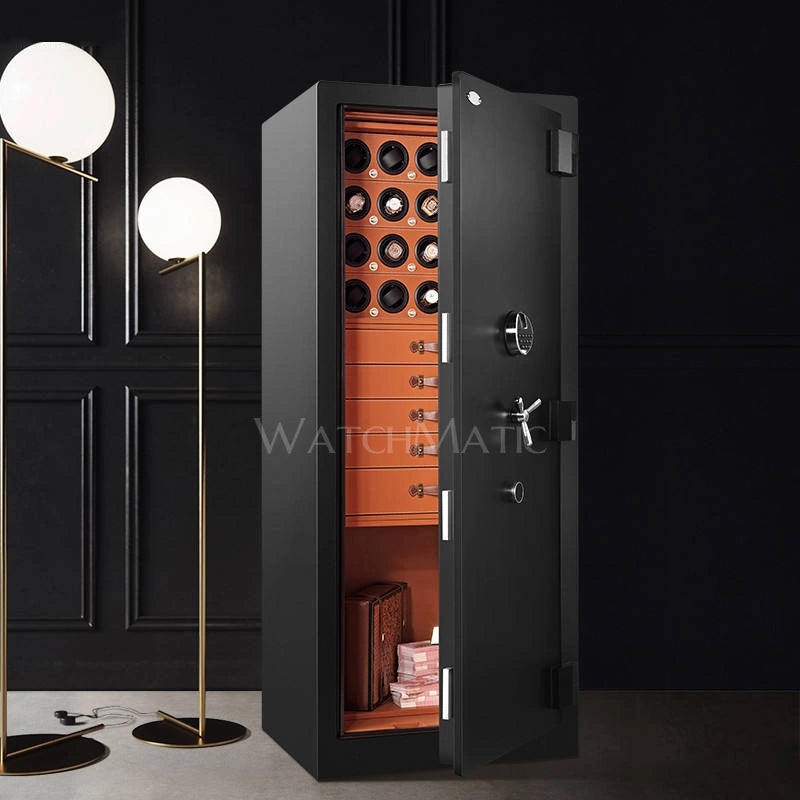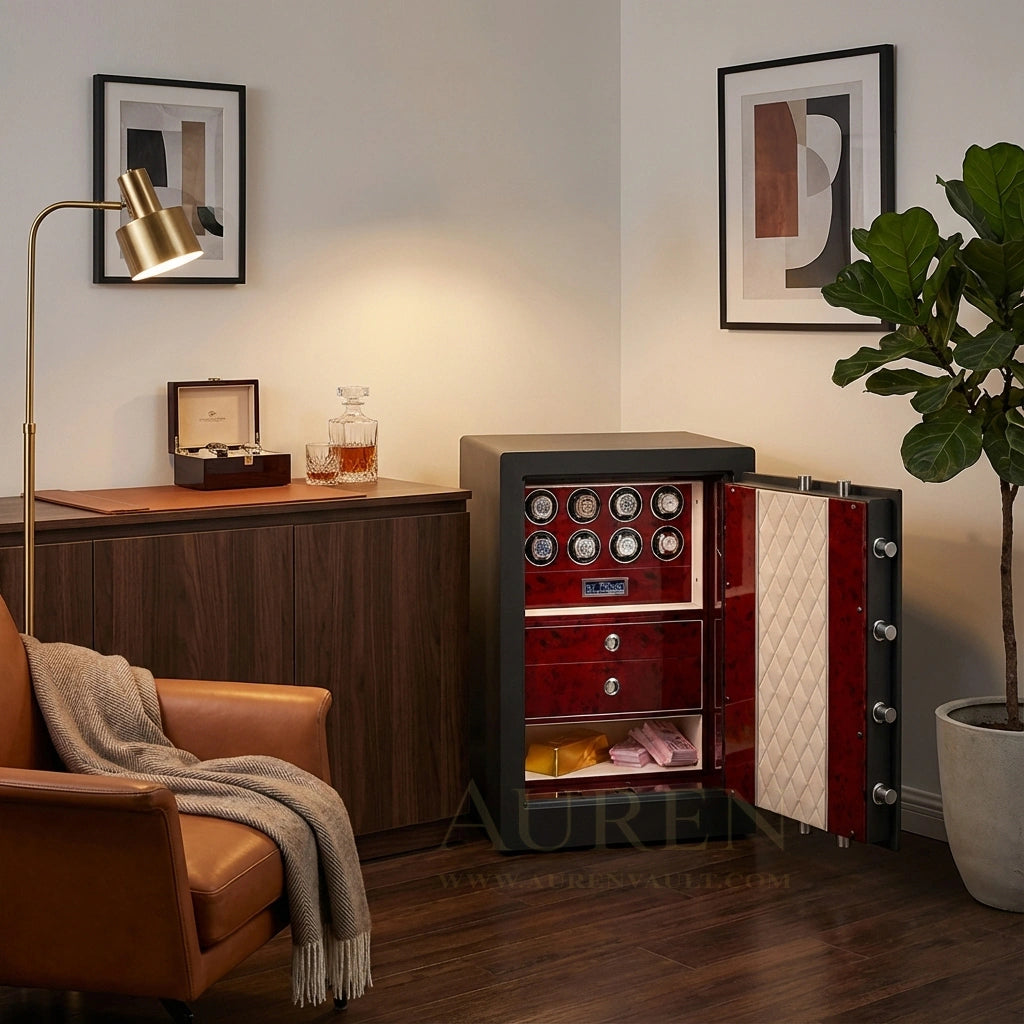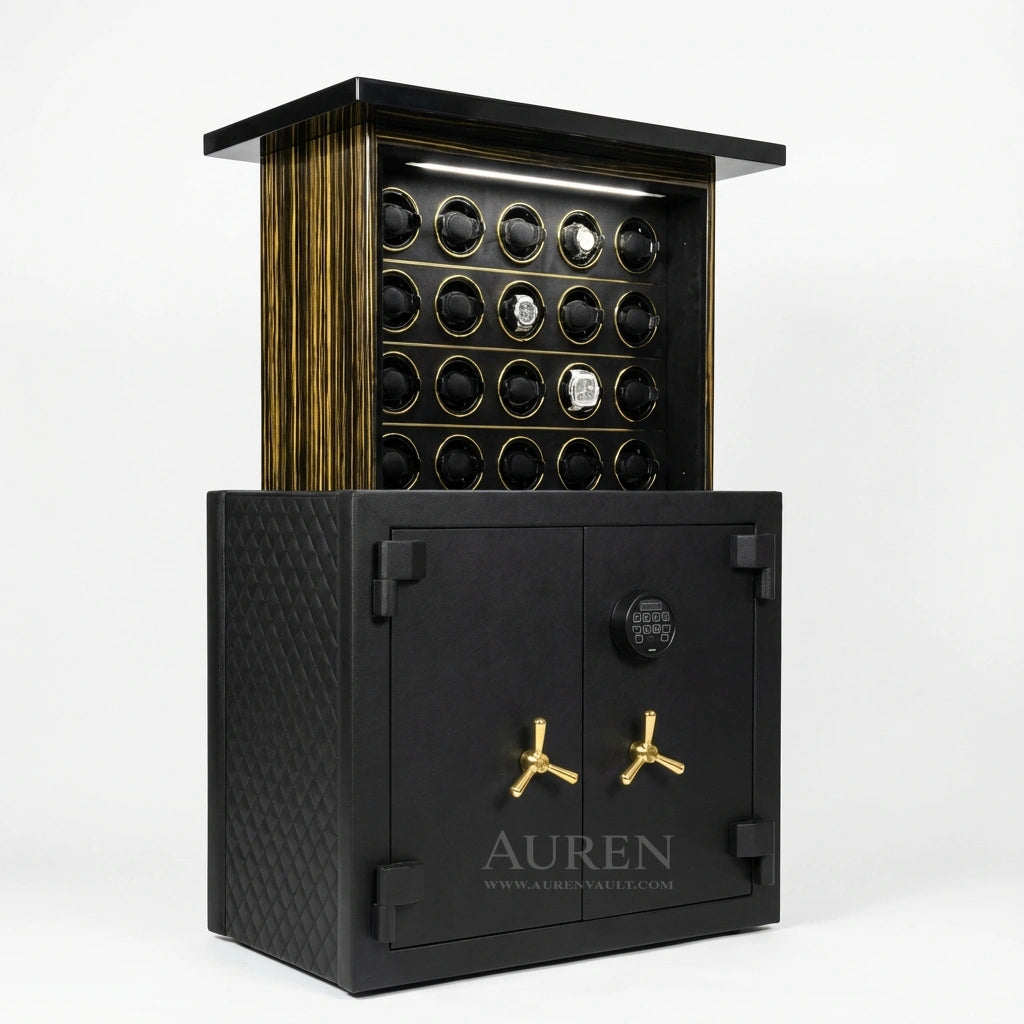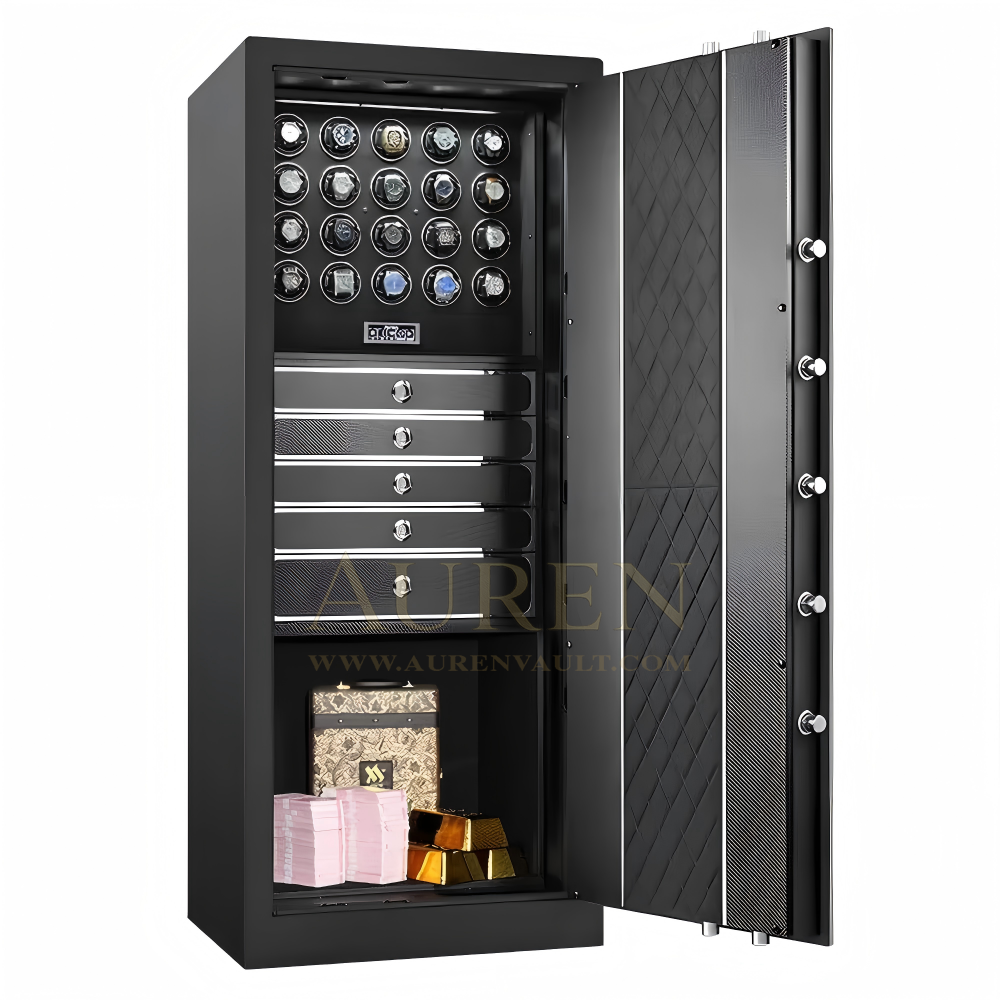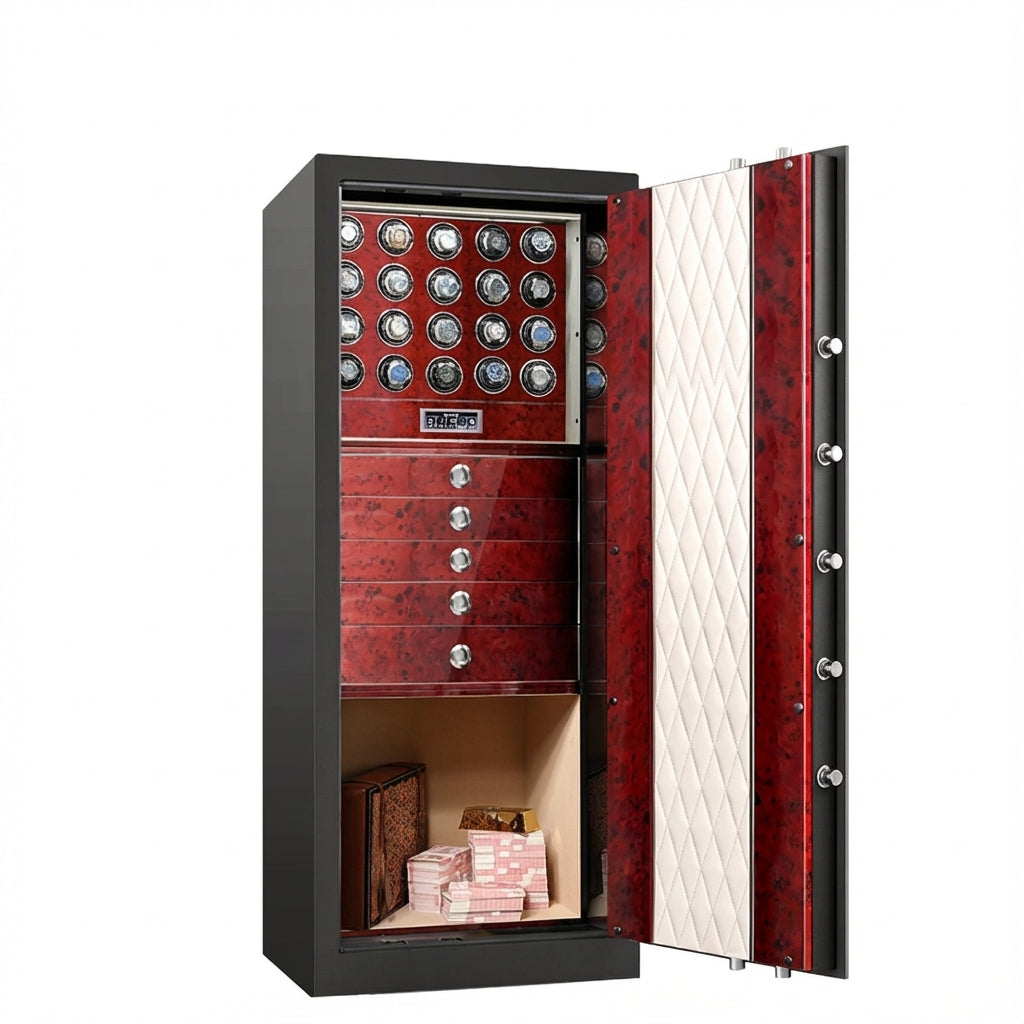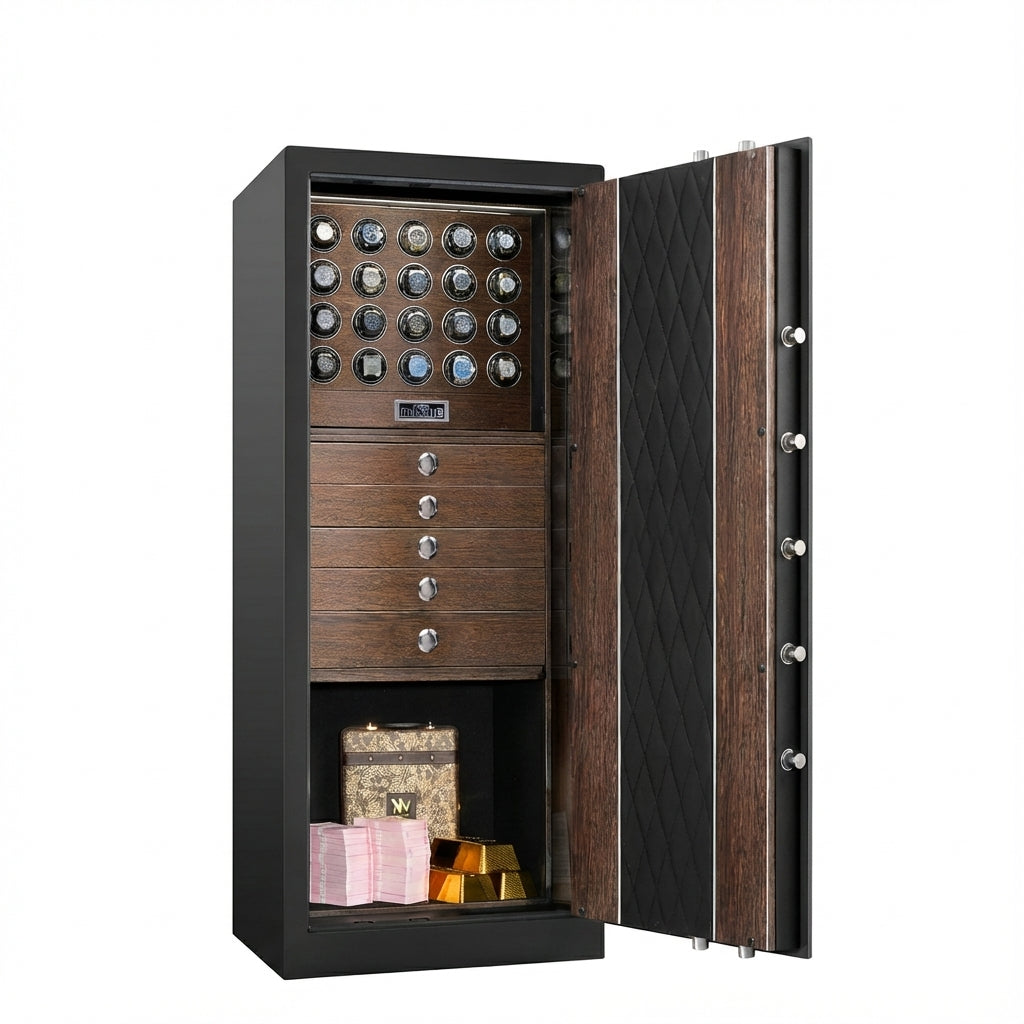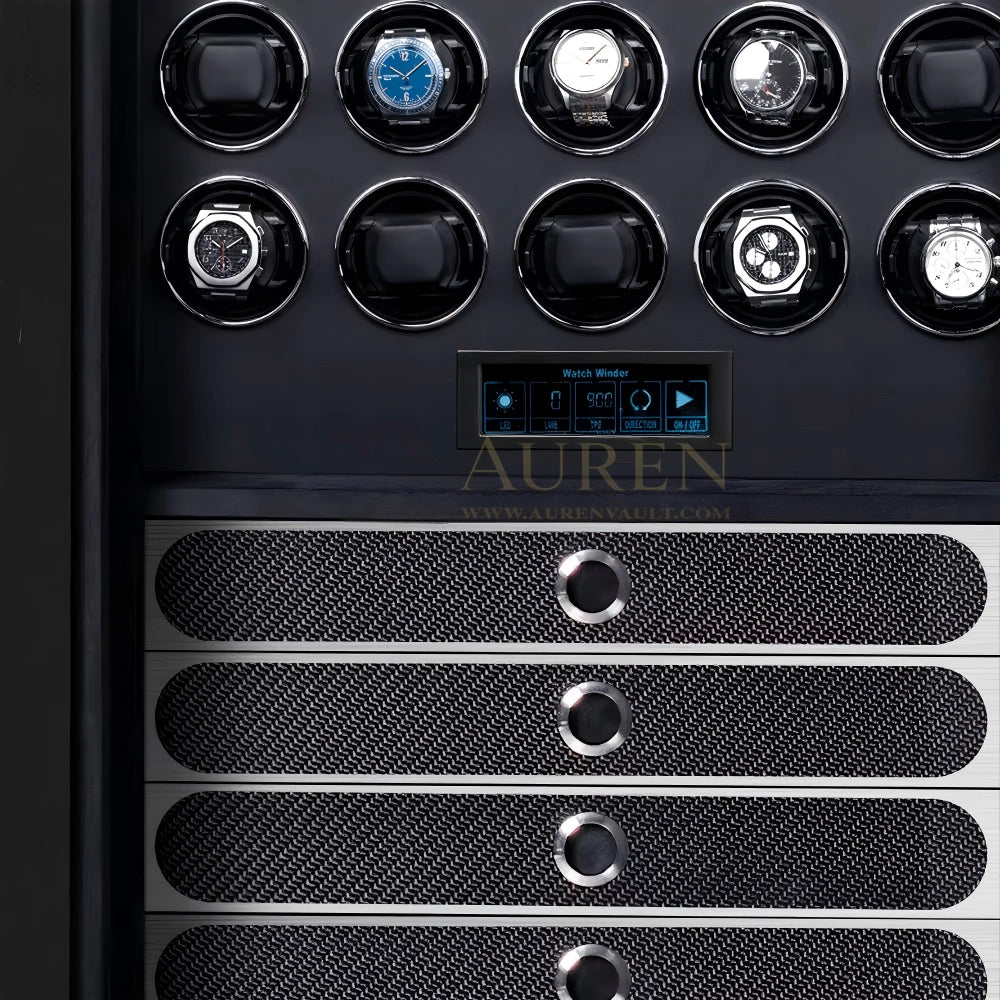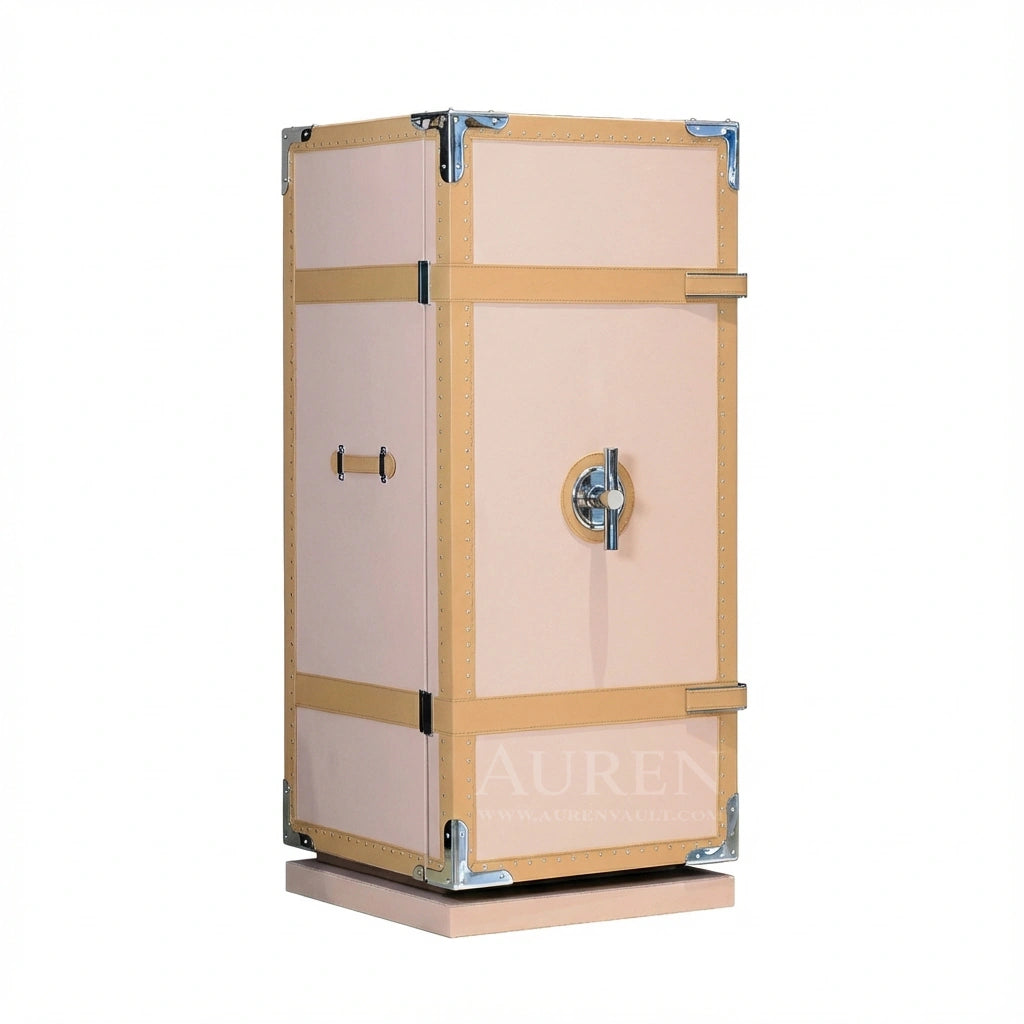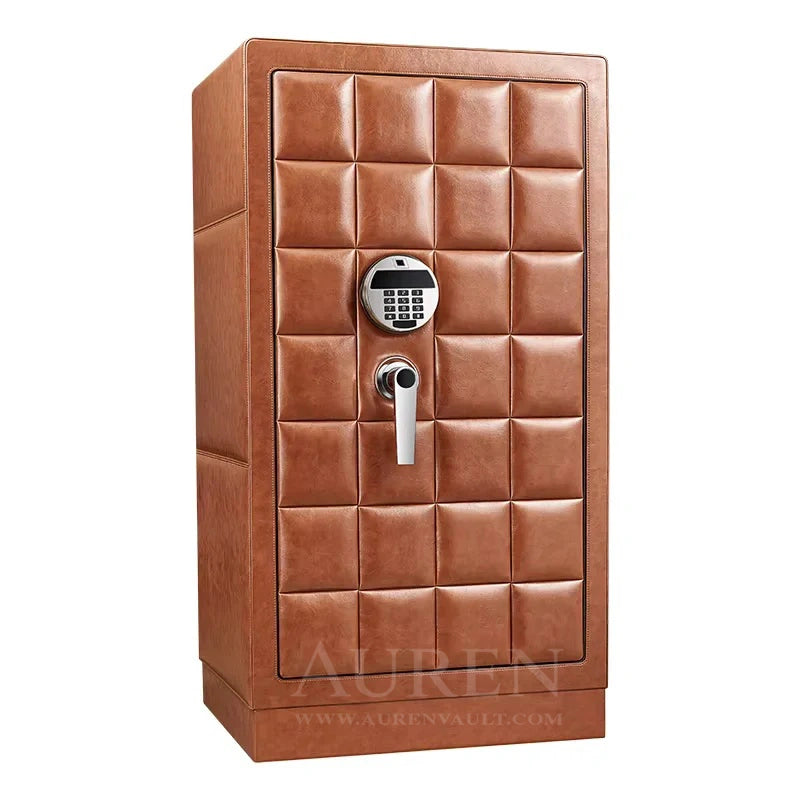

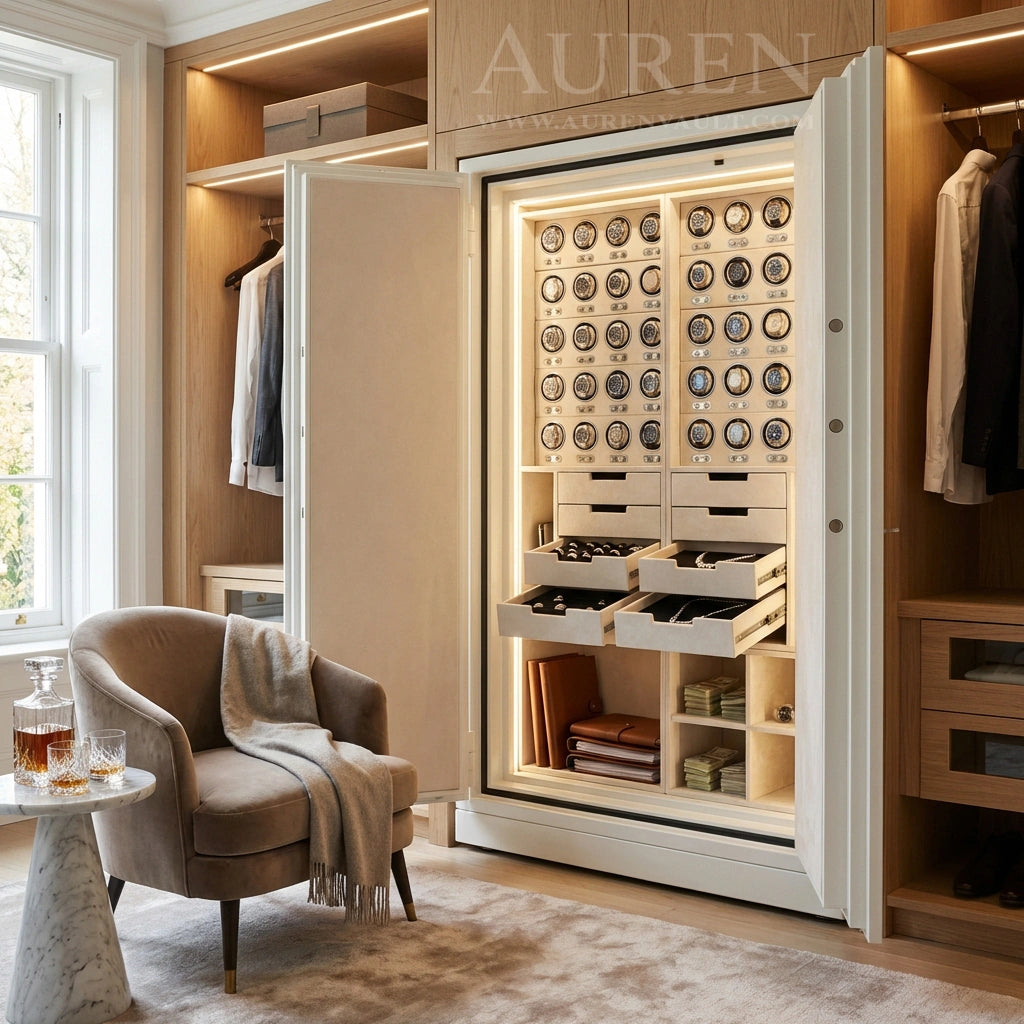

The best watch winder for Carl F. Bucherer watches is a programmable unit that matches the specific movement's winding direction, offers adjustable turns per day (TPD), and supports the watch securely without placing unnecessary pressure on its case or strap.
Many Carl F. Bucherer automatic watches, including the Manero Peripheral, Manero Flyback, Heritage BiCompax Annual, and Patravi TravelTec, can benefit from compatible winders. Independent winding databases frequently list approximately 650 TPD with bidirectional rotation for numerous models. However, this is not a universal manufacturer-approved setting.
The distinction matters particularly for Carl F. Bucherer's manufacture movements. Calibres such as CFB A2050, A2055, and T3000 incorporate peripheral automatic winding technology, while other models use more conventional rotor arrangements.
For collectors who alternate between mechanical watches, a suitable winder can maintain the movement's power reserve and reduce repeated adjustments.
The right choice depends on the exact calibre, winding architecture, complications, and how the collection is stored.
Why Carl F. Bucherer Watches Require a Movement-Specific Winder
Carl F. Bucherer occupies a distinctive position in Swiss mechanical watchmaking.
Founded in Lucerne in 1888, the brand developed a reputation for mechanical complications and an unusual approach to automatic winding. Its most recognizable technical achievement is the peripheral rotor, a winding system that places the oscillating mass around the movement rather than over its central components.
This approach allows the architecture and finishing of the movement to remain more visible through a transparent case back.
It also creates an important consideration for collectors choosing a watch winder.
A Manero Peripheral equipped with calibre CFB A2050 and a Manero Flyback powered by CFB 1970 are both automatic watches, but they use different movement architectures.
A Heritage BiCompax Annual introduces a chronograph and annual calendar, while a Patravi TravelTec combines chronograph functionality with multiple time zones.
Their winding requirements should not be assumed identical simply because they share the same manufacturer's name.
A conventional watch winder rotates the entire watch in programmed cycles. This movement allows the internal automatic rotor to move and replenish energy in the mainspring.
The objective is to maintain sufficient stored energy for continued operation.
A winder does not improve the movement's accuracy, replace servicing, or make a mechanical watch inherently more durable.
For someone who wears the same automatic Carl F. Bucherer every day, regular wrist motion may already supply enough winding.
For a collector who frequently changes between several watches, maintaining the power reserve can offer considerably more convenience.
Which Carl F. Bucherer Watches Can Use a Watch Winder?
Many of Carl F. Bucherer's notable mechanical watches incorporate automatic winding systems.
However, the brand has used different calibres across its collections and production generations.
The following table compares representative movements.
| Carl F. Bucherer watch | Calibre | Movement architecture | Power reserve | Winder compatible? |
|---|---|---|---|---|
| Manero Peripheral | CFB A2050 | Peripheral automatic | 55 hours | Yes |
| Heritage Worldtimer | CFB A2020 | Peripheral automatic | 55 hours | Yes |
| Manero Peripheral Perpetual Calendar | CFB A2055 | Peripheral automatic | 55 hours | Yes |
| Manero Tourbillon Double Peripheral | CFB T3000 | Peripheral automatic | 65 hours | Yes |
| Manero Minute Repeater | CFB MR3000 | Peripheral automatic | 65 hours | Yes |
| Manero Flyback | CFB 1970 | Automatic chronograph | 42 hours | Yes |
| Heritage BiCompax Annual | CFB 1972 | Automatic chronograph and annual calendar | 42 hours | Yes |
| Patravi TravelTec | CFB 1901.1 | Automatic chronograph and multiple time zones | 42 hours | Yes |
| Manero AutoDate | CFB 1965 | Conventional automatic | 42 hours | Yes |
These specifications refer to representative models and documented movement configurations.
Carl F. Bucherer has produced different references and calibre generations, so the watch's exact reference should always be confirmed before selecting a winding program.
Automatic Does Not Mean Identical Winding Requirements
The word automatic describes how a movement receives energy, not the precise winding program it needs.
Two automatic watches may have different rotor constructions, power reserves, gear arrangements, and winding efficiencies.
A movement that winds effectively in both directions may respond differently from one that primarily winds in a single direction.
This becomes particularly relevant when comparing Carl F. Bucherer's peripheral manufacture calibres with conventional automatic chronograph movements.
The appropriate winder must accommodate these differences.
For collectors, the practical rule is simple: identify the calibre before choosing the TPD and rotation direction.
Carl F. Bucherer Watch Winder Settings: TPD and Rotation Direction
Two specifications determine how a watch winder operates.
Turns per day (TPD) describes the number of programmed rotations performed during a 24-hour period.
Winding direction determines whether the winder rotates clockwise, counterclockwise, or alternately in both directions.
These parameters work together.
An automatic movement can receive hundreds of rotations without maintaining sufficient energy if the device operates in an ineffective direction.
Conversely, a correctly configured program may maintain the watch with relatively modest daily movement.
The ideal setting supplies enough energy for consistent operation without unnecessary rotation.
Carl F. Bucherer Winder Settings by Calibre
| CFB calibre | TPD guidance | Rotation direction | Technical consideration |
|---|---|---|---|
| CFB A2050 | Investigate approximately 650 TPD | Bidirectional winding architecture | Peripheral rotor |
| CFB A2020 | Investigate approximately 650 TPD | Bidirectional winding architecture | Manufacture worldtimer |
| CFB A2055 | Investigate approximately 650 TPD | Bidirectional winding architecture | Perpetual calendar |
| CFB T3000 | Confirm calibre-specific TPD | Bidirectional peripheral winding | Floating tourbillon |
| CFB MR3000 | Confirm calibre-specific TPD | Bidirectional peripheral winding | Minute repeater and tourbillon |
| CFB 1970 | Approximately 650 TPD appears in independent references for related models | Verify exact reference | Flyback chronograph |
| CFB 1972 | Approximately 650 TPD is a preliminary reference point | Verify exact reference | Annual calendar and chronograph |
| CFB 1901.1 | Investigate approximately 650 TPD | Verify exact reference | Multi-time-zone chronograph |
| CFB 1965 | Approximately 650 TPD is commonly listed for Manero AutoDate models | Commonly listed as bidirectional; verify | Conventional automatic |
Important: The numerical TPD guidance above comes from general and third-party winding references. It is not an official Carl F. Bucherer chart certifying these settings for every movement.
The bidirectional winding architecture of the peripheral manufacture families is documented by Carl F. Bucherer, but that does not establish one universal TPD requirement for every calibre.
For the most reliable setup, verify the movement and its appropriate winding program before prolonged use.
Is 650 TPD Enough for Carl F. Bucherer?
For many conventional automatic watches, 650 TPD is a commonly published starting point.
Several independent winding databases list this number for numerous Carl F. Bucherer models, often alongside bidirectional rotation.
However, there are exceptions and incomplete entries.
Some references are listed with clockwise winding, while others lack verified settings.
A collector should not interpret the frequency of a published recommendation as proof that it applies to every Carl F. Bucherer movement.
The correct program should be established using the exact calibre and reliable movement-specific guidance.
Once programmed, the watch can be observed over several days to determine whether its operating reserve is being maintained.
If the watch stops repeatedly, review the starting reserve, winding direction, and operation of the device before increasing its rotation count.
The watch TPD guide explains how daily rotations and winding direction interact.
Does a 65-Hour Power Reserve Require More TPD Than a 42-Hour Reserve?
Not necessarily.
Power reserve measures how long a sufficiently wound watch can operate without receiving additional energy.
TPD measures the number of external rotations delivered by a winding device.
The two figures are related to energy management, but they do not describe the same mechanical characteristic.
For example, the CFB A2050 offers approximately 55 hours of power reserve, while the CFB T3000 provides approximately 65 hours.
That difference does not independently prove that the T3000 needs more daily rotations.
Winding efficiency depends on the rotor and its energy-transfer mechanism.
A longer power reserve may make a watch more forgiving when left unworn. It does not automatically justify selecting the highest winder setting.
What Makes Carl F. Bucherer's Peripheral Rotor Different?
The peripheral rotor is one of Carl F. Bucherer's defining innovations.
In a conventional automatic movement, an oscillating mass rotates above much of the movement.
This familiar arrangement efficiently transfers kinetic energy to the mainspring, but the rotor can partially obscure the movement's finishing when viewed through the case back.
Carl F. Bucherer approached this differently.
Its peripheral winding architecture places an annular oscillating mass around the movement's outer edge.
The mass travels around the periphery, supported by a specialized bearing system.
This arrangement allows the mechanical components and finishing to remain more visible.
The brand established an important milestone with the CFB A1000 movement family in 2008 and subsequently developed the CFB A2000 architecture.
Does a Peripheral Rotor Need a Special Watch Winder?
Not necessarily.
A peripheral rotor still receives energy through movement of the watch.
A conventional automatic watch winder can therefore be compatible, provided it supplies the correct rotation program and supports the watch safely.
The rotor's location inside the movement does not require a different physical winding principle.
However, it would be incorrect to assume that every peripheral movement has the same winding efficiency or daily rotation requirement.
Carl F. Bucherer has documented bidirectional winding for its principal peripheral manufacture families.
This makes a bidirectional-capable winder particularly relevant, but the TPD should still be verified for the exact movement.
Why a Programmable Winder Is Preferable
A fixed-program device may offer only one rotation direction and one daily rotation count.
That can be restrictive when the collection contains different automatic movements.
A programmable winder provides greater flexibility through adjustable TPD, selectable direction, and controlled rest periods.
For an owner who possesses both peripheral and conventional automatic Carl F. Bucherer watches, independently programmable modules are particularly useful.
Each movement can receive an appropriate program without requiring every watch to follow the same settings.
This becomes increasingly valuable as the collection expands.
Best Watch Winder for Manero Peripheral: Calibre CFB A2050
The Manero Peripheral is among the clearest examples of Carl F. Bucherer's peripheral winding expertise.
Selected 40.6 mm references use the manufacture CFB A2050 movement.
The movement incorporates a peripheral automatic winding system and offers approximately 55 hours of power reserve.
It is also chronometer-certified in the documented references.
Unlike a conventional automatic movement with a centrally mounted winding mass, the A2050 provides a relatively unobstructed view of its architecture through the sapphire case back.
For collectors who appreciate mechanical finishing, this is part of the watch's appeal.
A watch winder can maintain the movement between wears, allowing the owner to select the watch without repeatedly restarting and adjusting it.
Is Bidirectional Rotation Suitable for the A2050?
The CFB A2000 manufacture family uses a bidirectional peripheral winding architecture.
Because the A2050 belongs to this family, a winder with bidirectional capability is a logical choice.
Nevertheless, the device's programmed TPD must still be suitable.
An independently published setting of approximately 650 TPD can provide a starting point for investigation, but it should not be presented as a factory-certified A2050 program.
The ideal arrangement supplies sufficient winding with suitable rest periods.
For a collector who regularly alternates between a Manero Peripheral and other watches, that can be more practical than manually restarting the movement every time it is selected.
Protecting the Manero's Leather Strap
Many Manero Peripheral references are fitted with refined leather straps.
These straps deserve careful support when mounted on a watch winder.
A rigid cushion that is too large can stretch the leather or force the strap into an unnatural curve.
A cushion that is too small may allow the watch to shift during rotation.
The appropriate holder should secure the case without excessive tension.
Soft, adjustable cushions are particularly useful for dress watches that are worn with closely fitted straps.
The movement program matters, but so does the physical condition of the watch during winding.
Heritage Worldtimer: Why Calibre CFB A2020 Is a Strong Winder Candidate
The Heritage Worldtimer combines a vintage-inspired design with a modern peripheral automatic movement.
Selected references use calibre CFB A2020, which provides approximately 55 hours of power reserve.
The movement incorporates a simplified world-time indication and a bidirectional peripheral winding system.
For an owner who travels frequently or rotates several watches, keeping the movement running can reduce the need to restore its indications after the power reserve is exhausted.
The Convenience of Maintaining World-Time Indications
A conventional three-hand watch is usually straightforward to restart.
A worldtimer introduces additional information that may need to be adjusted.
When the movement stops, the owner must ensure that the time and relevant indications are correctly synchronized.
A compatible winder can maintain operating continuity between wears.
However, it does not automatically detect the owner's location or change the displayed time zone.
The winder supplies energy to the movement. Time-zone management remains the responsibility of the owner.
This distinction is important for collectors choosing a winder primarily because of a watch's complications.
The benefit is fewer interruptions to operation, not automatic correction of every display.
Manero Peripheral Perpetual Calendar: When Continuous Operation Becomes Especially Useful
The Manero Peripheral Perpetual Calendar provides one of the strongest arguments for using a compatible watch winder.
Selected references use the manufacture CFB A2055 movement, with approximately 55 hours of power reserve.
The movement combines peripheral automatic winding with a sophisticated perpetual calendar.
Its indications include the date, day, month, leap-year cycle, and moon phase.
A correctly set perpetual calendar automatically accounts for different month lengths and leap years within its supported calendar cycle.
Under normal continuous operation, the calendar is designed to require no routine calendar correction until the year 2100.
This complexity makes repeated resetting less convenient than it is for a simple automatic date watch.
Why a Winder Can Be Particularly Valuable for a Perpetual Calendar
Consider a collector who wears the Manero Peripheral Perpetual Calendar several times each month.
If the watch is left stationary long enough to exhaust its reserve, the movement stops.
Restoring its indications may require multiple adjustments using the watch's dedicated correctors.
These adjustments must be made in accordance with the movement's instructions.
Operating calendar correctors at unsuitable times can damage certain mechanisms.
For this reason, a compatible watch winder can provide meaningful convenience by reducing how frequently a correctly set perpetual calendar stops.
It should not be interpreted as a substitute for understanding the calendar or following the watch's operating instructions.
Does the CFB A2055 Need More Rotations Because It Has a Perpetual Calendar?
Not automatically.
The presence of an advanced complication does not establish a higher TPD requirement.
The external winding program must be appropriate for the automatic winding mechanism.
Carl F. Bucherer documents the A2055's bidirectional peripheral winding architecture, but the correct daily rotation count should still be confirmed.
A higher TPD should not be selected simply because the watch is more complicated or valuable.
A reliable program with controlled rest periods is preferable to unnecessary continuous rotation.
For collectors who regularly wear several complicated automatic watches, the benefit of maintaining continuous operation can justify a dedicated winding position.
Manero Tourbillon Double Peripheral: Calibre CFB T3000
The Manero Tourbillon Double Peripheral represents a more technically ambitious application of Carl F. Bucherer's peripheral technology.
Its manufacture CFB T3000 movement combines a peripheral automatic winding system with a peripherally mounted floating tourbillon.
The movement provides approximately 65 hours of power reserve.
The floating tourbillon is supported through an unconventional architecture that creates the visual impression that the mechanism is suspended within the movement.
This is not simply a different case design or decorative complication.
It reflects a fundamentally sophisticated mechanical construction.
Can a Tourbillon Watch Use a Conventional Winder?
Yes, when the tourbillon watch contains an automatic movement and the selected winder is compatible.
The CFB T3000 is self-winding.
Its peripheral automatic winding system can receive energy through appropriately programmed external rotation.
However, a tourbillon should not automatically be assigned a higher TPD because of its complexity.
The number of rotations needed depends on the winding system, not the presence of the rotating escapement assembly.
A programmable winder should therefore be selected according to the movement's confirmed requirements.
For an owner of a high-complication watch, reliable motor control and stable physical support are particularly important.
Why Storage Security Becomes More Relevant
A Manero Tourbillon Double Peripheral represents a substantial mechanical and financial investment.
An exposed tabletop winder may provide convenient access, but it generally offers limited protection against unauthorized handling or theft.
A properly specified secure storage system may be more appropriate when the owner wants to maintain winding while the watch is not being worn.
The decision should consider not only winding compatibility but also the construction and documented protective capabilities of the storage enclosure.
For valuable collections, mechanical convenience and physical security are separate requirements that should be addressed together.
Manero Minute Repeater: The Importance of Appropriate Storage
The Manero Minute Repeater introduces another level of mechanical complexity.
Selected versions use the automatic CFB MR3000 movement, incorporating peripheral technology, a floating tourbillon, and a minute-repeater mechanism.
The documented movement provides approximately 65 hours of power reserve.
Unlike a conventional automatic watch, a minute repeater includes a striking mechanism that produces an audible indication of time.
Its complexity requires careful handling.
Should a Minute Repeater Be Kept on a Winder?
A compatible winder can maintain the automatic movement's energy supply, provided the winding program is suitable.
However, keeping the watch running is not automatically necessary.
The owner should evaluate how frequently the watch is worn, the convenience of maintaining its indications, and the manufacturer's handling instructions.
The winder does not activate the minute repeater.
It should not interfere with the case's activation mechanism or place pressure on external controls.
For particularly valuable high-complication watches, the physical security and stability of the storage position may be as important as the winding program.
A winder should simplify ownership without introducing unnecessary mechanical activity or handling risks.
Manero Flyback: Choosing a Winder for Calibre CFB 1970
The Manero Flyback illustrates a different side of Carl F. Bucherer's automatic watchmaking.
Selected references use calibre CFB 1970, an automatic chronograph movement with approximately 42 hours of power reserve.
Its flyback function allows the chronograph to be reset and restarted through the appropriate control sequence.
This is useful for consecutive timing measurements.
However, chronograph functionality should not be confused with the automatic winding system.
The winder maintains energy in the movement.
It does not operate the chronograph pushers or perform timing measurements.
Does a Flyback Chronograph Need a Higher TPD?
Not simply because it is a chronograph.
The correct rotation program depends on the movement's winding architecture.
A chronograph may include additional mechanical components, but their presence does not independently establish a specific external winding requirement.
For the CFB 1970, independent winding references often suggest conventional automatic settings around 650 TPD for related Manero chronographs.
These figures should be verified for the exact calibre and reference.
A winder with adjustable direction and daily rotation count provides the flexibility needed to accommodate those requirements.
When the Manero Flyback Benefits From Winding
A collector who wears the Manero Flyback only on selected occasions may find a watch winder convenient.
Without regular winding, the watch will eventually stop and require restarting.
A compatible winder can keep the ordinary timekeeping movement running between wears.
However, there is no mechanical requirement for the chronograph to remain active continuously.
For infrequent use, allowing the watch to stop and storing it appropriately can also be reasonable.
The best choice reflects the owner's routine rather than the complexity of the dial alone.
Heritage BiCompax Annual: A Practical Case for Automatic Winding
The Heritage BiCompax Annual combines a chronograph with an annual calendar.
Selected references use the automatic CFB 1972 movement, offering approximately 42 hours of power reserve.
The annual calendar is more sophisticated than a conventional date display.
It accounts for months with different lengths but generally requires an adjustment at the transition from February to March.
When the watch stops during normal use, its calendar indications may need to be synchronized again.
This creates a stronger practical argument for using a compatible winder.
Why Calendar Continuity Matters
For a simple automatic watch, resetting the time and date may take very little effort.
The Heritage BiCompax Annual includes additional indications, including an annual calendar and large date.
A collector who wears it only occasionally may prefer to avoid repeating the full setting procedure.
Maintaining the movement through a suitable winding program can reduce that inconvenience.
However, the winder does not eliminate the annual calendar's inherent adjustment requirements.
Nor does it automatically correct a calendar that was set incorrectly.
The owner must still follow the watch's operating instructions, especially when using calendar correctors.
For this type of watch, the value of a winder lies in preserving an already correct setting.
Patravi TravelTec: A Winder for Collectors Who Travel
The Patravi TravelTec is among Carl F. Bucherer's most distinctive travel-oriented watches.
Selected references use the automatic CFB 1901.1 movement, with approximately 42 hours of power reserve.
The watch combines chronograph functionality with the ability to display three time zones.
Its substantial case dimensions also distinguish it from the more restrained Manero collection.
For example, documented Patravi TravelTec references measure approximately 46.6 mm in diameter, with some versions being even larger.
This creates two separate winder considerations: movement compatibility and sufficient physical clearance.
Why TravelTec Owners May Appreciate Continuous Operation
A multi-time-zone watch can require more attention when being restarted than a simple automatic.
Once the power reserve is exhausted, the owner may need to restore the time indications and ensure that the additional time zones are synchronized correctly.
A compatible watch winder can help maintain the watch's energy between periods of use.
That is especially useful for someone who rotates between several travel watches or frequently changes their daily timepiece.
However, the winder cannot automatically update the displays when the owner moves between geographic regions.
Manual time-zone adjustments remain necessary.
Large Cases Need Larger Winding Compartments
The Patravi TravelTec's dimensions make physical compatibility particularly important.
A winding compartment that accommodates a 38 mm Manero AutoDate may not provide sufficient clearance for a substantially larger TravelTec.
The case, crown, and pushers should remain clear of the enclosure throughout a full rotation.
The watch should also be mounted securely enough that its weight does not cause it to shift on the cushion.
A robust holder does not need to compress the strap excessively.
It should distribute support evenly while accommodating the watch's size and weight.
For larger sports and travel watches, these physical requirements can be just as important as the electronic winding program.
What to Look for in a Premium Carl F. Bucherer Watch Winder
The best winding system should be evaluated through its mechanical compatibility, physical support, and long-term reliability.
Decorative finishes may contribute to presentation, but they should not determine the purchase before the essential technical requirements are satisfied.
Independent TPD and Direction Control
A suitable winder should provide adjustable daily rotation settings and clockwise, counterclockwise, and bidirectional modes.
For collectors who own several Carl F. Bucherer movements, independent programming is particularly useful.
A CFB A2050 peripheral automatic and a CFB 1970 chronograph should not be forced to use identical settings unless those settings have been verified for both.
Individual module control allows each watch to operate according to its movement.
This also provides flexibility when new watches are added to the collection.
Controlled Rest Periods
A watch winder does not need to rotate continuously.
Quality devices distribute their programmed rotations across operating cycles separated by rest periods.
This approach is more appropriate than maintaining uninterrupted movement.
The objective is to provide sufficient winding while avoiding unnecessary activity.
A winder should execute its programmed routine consistently rather than relying on excessively high TPD settings to compensate for unreliable operation.
Quiet and Reliable Motors
Motor noise becomes important when a winder is placed in a bedroom, dressing room, or private office.
Several winding modules operating simultaneously can produce noticeable sound if the system is poorly designed.
Quiet motors, stable rotating assemblies, and appropriate rest periods contribute to a more discreet ownership experience.
For valuable watches, consistency and reliability should take priority over visual effects or decorative lighting.
Cushions for Different Case and Strap Sizes
Carl F. Bucherer watches vary considerably in their dimensions.
A Manero AutoDate may have a relatively compact 38 mm case, while a Patravi TravelTec can exceed 46 mm.
Their straps and bracelets also differ.
A suitable winder should accommodate these variations without forcing every watch around the same rigid support.
Soft, adjustable cushions are particularly useful for leather straps.
Stable holders with adequate compartment clearance are essential for larger watches.
The watch should remain secure throughout rotation without unnecessary pressure on its crown, pushers, clasp, or strap.
Standalone Watch Winder or Watch Winder Safe for Carl F. Bucherer?
A standalone winder and a watch winder safe can both maintain automatic mechanical movements.
Their primary difference is the storage environment.
A standalone unit is generally intended for convenience and presentation.
It may sit on a dresser, shelf, or desk, keeping one or several automatic watches ready for use.
A watch winder safe combines winding functionality with enclosed storage and a locking system.
For valuable or complicated watches, that additional consideration may be significant.
| Consideration | Standalone watch winder | Watch winder safe |
|---|---|---|
| Automatic winding | Primary function | Integrated function |
| Independent programming | Depends on model | Depends on installed modules |
| Physical security | Usually limited | Depends on safe construction |
| Passive storage | Often limited | Can include dedicated compartments |
| Collection capacity | Typically one to several watches | Compact to large configurations |
| Best suited for | Daily winding convenience | Combined winding and protective storage |
A lockable cabinet should not automatically be considered certified for burglary resistance or fire protection.
Those capabilities depend on the actual construction, locking mechanisms, installation, and documented test results.
For a collector who wants automatic winding within a more secure storage environment, watch winder safes with integrated winding systems provide a relevant option.
The watch winder safe guide also explains how to evaluate winding capacity alongside storage and security requirements.
Building a Storage System Around a Carl F. Bucherer Collection
An efficient collection-storage configuration should reflect the watches that the owner actually wears.
Consider a collector who owns a Manero Peripheral, Heritage Worldtimer, Manero Flyback, Heritage BiCompax Annual, and Patravi TravelTec.
All five are automatic watches, but their movements and physical dimensions differ.
A multi-watch system with independently programmable positions provides greater flexibility than one fixed program for the entire collection.
The TravelTec may require a larger compartment, while the Manero watches may need softer support for leather straps.
The owner should also consider which watches genuinely benefit from continuous winding.
A regularly worn Manero Peripheral may not require a permanent winding position.
A complicated annual-calendar watch worn intermittently may provide a stronger reason to maintain continuous operation.
This distinction helps prevent the collection from being planned solely around total watch count.
Planning for a Larger Collection
Collectors with substantial watch portfolios often need a combination of active winding positions and stationary storage.
Some automatic watches may be kept running regularly.
Other watches may remain unworn for extended periods.
Accessories, spare straps, and documentation may require additional space.
The complete watch safe collection provides options for considering different storage capacities and layouts.
For collectors managing larger numbers of valuable watches, luxury watch safes may offer a more integrated way to organize their collection.
The objective is not to fill every available space with a rotating module.
It is to allocate winding capacity where it provides practical value.
When Custom Watch Storage Makes More Sense
Standard watch cabinets cannot always accommodate unusual case sizes, complicated watches, and different strap configurations equally well.
A Carl F. Bucherer collector may require larger winding compartments for Patravi watches alongside more compact positions for Manero models.
The collection may also include other brands with different winding requirements or watches that do not need automatic rotation.
A tailored arrangement can accommodate these needs through different winding capacities, stationary compartments, and accessory storage.
Collectors with specialized requirements can explore custom watch safe configurations designed around collection size, interior layout, and installation considerations.
A thoughtfully planned storage system should make watches easier to access, organize, and protect.
How to Set Up a Watch Winder for Carl F. Bucherer
Once a suitable device has been selected, the setup process should begin with the exact watch reference.
Identify the Calibre
Confirm whether the movement is CFB A2050, A2020, A2055, T3000, 1970, 1972, or another calibre.
Do not rely on a collection name such as Manero or Patravi alone.
Different references can contain different movements.
The original documentation and movement specifications are more reliable than a generic collection-level winding recommendation.
Start the Watch Properly
If the watch has stopped, follow the movement's instructions for restarting it.
Many automatic movements can be manually wound through the crown before being placed on a winder.
A watch winder is generally intended to maintain the power reserve rather than rapidly restore a completely depleted movement.
For complicated watches, follow the manufacturer's instructions before adjusting calendar or time-zone indications.
Select the Appropriate Program
Choose the confirmed winding direction and TPD for the specific movement.
Where official external-winder settings are unavailable, seek reliable calibre-specific guidance.
Do not assume that every Carl F. Bucherer watch should use 650 TPD simply because this number appears frequently in third-party databases.
A programmable winder should allow the necessary settings without requiring excessive rotation.
Secure the Watch
Position the watch on the cushion so that it remains stable without excessive strap or bracelet tension.
Check that the case and its controls have sufficient clearance.
Large watches such as the Patravi TravelTec may require greater compartment dimensions than conventional dress watches.
The holder should support the watch throughout rotation without allowing it to shift.
Observe the Watch Over Several Days
Once programmed, allow the winder to complete its normal cycles.
Check whether the watch continues running reliably.
If it stops, assess the initial power reserve, rotation direction, daily rotation count, and winder operation.
Persistent problems may require professional inspection.
Increasing the TPD should not be the automatic response to every stoppage.
Should Carl F. Bucherer Automatic Watches Stay on a Winder Continuously?
There is no general requirement for an automatic Carl F. Bucherer watch to remain running at all times.
When a mechanical automatic exhausts its power reserve, the movement stops normally.
It can be restarted according to its operating instructions.
For a simple Manero AutoDate, occasional resetting may be relatively straightforward.
For a Manero Peripheral Perpetual Calendar, restoring the complete calendar is considerably more involved.
This distinction changes the practical value of a winder.
Collectors who want complicated watches to remain ready for use may find continuous operation worthwhile.
For watches worn only rarely, stationary storage can also be reasonable.
A winder is a convenience device, not a replacement for regular maintenance or appropriate storage conditions.
When watches remain unused for extended periods, protection from excessive humidity, accidental impacts, unsuitable temperatures, and unnecessary handling becomes especially important.
The watch storage guide addresses these broader principles for protecting mechanical watch collections.
Common Mistakes When Choosing a Carl F. Bucherer Winder
One frequent mistake is assuming that every Carl F. Bucherer automatic uses the same rotor architecture.
The peripheral manufacture movements differ from many conventional automatic chronographs.
Another mistake is treating a commonly published 650 TPD recommendation as a certified setting for every calibre.
Independent references can provide useful preliminary guidance, but the exact movement must still be identified.
Collectors should also avoid selecting the highest TPD program simply because a watch is complicated or expensive.
A tourbillon or perpetual calendar does not automatically establish a greater external winding requirement.
Physical fit is another underestimated issue.
A large Patravi TravelTec and a compact Manero AutoDate should not be expected to fit identical rigid holders comfortably.
Finally, a watch winder should not be mistaken for a maintenance device.
If a properly started automatic watch repeatedly loses power despite a suitable program, the cause may require mechanical inspection.
Additional rotations cannot correct every problem.
Frequently Asked Questions About Carl F. Bucherer Watch Winders
What is the best watch winder for Carl F. Bucherer watches?
The best option is a programmable winder with adjustable TPD, selectable rotation direction, controlled rest periods, and a cushion suited to the watch's case and strap. Independent winding modules are useful when storing several different calibres.
How many TPD does a Carl F. Bucherer automatic need?
Approximately 650 TPD is commonly published for many Carl F. Bucherer automatic models. However, it is not a universal manufacturer-approved setting. The correct TPD and rotation direction should be verified for the specific movement.
Does the Manero Peripheral need a watch winder?
No. A Manero Peripheral can receive sufficient winding through regular wear. A compatible winder is optional and useful when the watch remains unworn long enough to exhaust its power reserve.
Is the CFB A2050 a bidirectional movement?
Yes. The CFB A2050 belongs to Carl F. Bucherer's A2000 peripheral movement family, which uses bidirectional automatic winding. The appropriate TPD still needs to be confirmed.
Does a peripheral rotor require a special watch winder?
Not necessarily. A peripheral rotor still receives energy from movement of the watch. A conventional programmable winder can be suitable when its rotation direction, daily cycles, and physical holder are compatible.
What TPD should I use for the CFB T3000?
The CFB T3000 uses a bidirectional peripheral automatic winding system, but a universally verified external-winder TPD is not established here. Confirm the appropriate program for the exact reference rather than choosing a high rotation count based on its tourbillon complication.
Can the Manero Tourbillon Double Peripheral use a winder?
Yes. Its CFB T3000 movement is automatic and can benefit from a compatible winder. Reliable programming and secure support are particularly important for such a valuable complicated watch.
Is a watch winder recommended for the Manero Peripheral Perpetual Calendar?
A compatible winder can be especially convenient because it helps keep the movement running and reduces how often the perpetual calendar needs to be reset. It is not mechanically mandatory, and the correct winding program must still be verified.
Can a Carl F. Bucherer Manero Flyback use a watch winder?
Yes. References equipped with the automatic CFB 1970 movement can use a compatible winder. The device maintains the movement's power reserve but does not operate the chronograph functions.
Is a watch winder useful for the Heritage BiCompax Annual?
Yes. Maintaining the automatic CFB 1972 movement can reduce repeated adjustments of its annual-calendar indications. The watch still requires correct calendar handling, including any scheduled annual adjustment.
Does the Patravi TravelTec need a larger watch winder?
Its substantial case size means that sufficient compartment clearance is important. A suitable winder should accommodate the case, crown, pushers, and strap while securing the watch during rotation.
Can a watch winder overwind a Carl F. Bucherer automatic?
Modern automatic movements generally incorporate mechanisms that limit excessive mainspring tension. Nevertheless, unnecessarily high TPD programs should be avoided. A correct winding program with appropriate rest periods is preferable.
Should I keep my Carl F. Bucherer on a winder every night?
That depends on the movement and wearing routine. A frequently worn automatic may not need external winding. A complicated watch used intermittently may benefit more from remaining operational between wears.
Is a watch winder safe better than a standalone winder?
A standalone winder may be sufficient for everyday convenience. A properly specified watch winder safe becomes more relevant when the collector also needs enclosed storage and physical protection for valuable watches.
Related Reading
Collectors researching movement-specific winding requirements and secure storage may also find these guides useful:
-
Best Watch Winder for Vacheron Constantin Watches — Explores winding requirements, automatic complications, and storage considerations for high-end mechanical timepieces.
-
Best Watch Winder for Jaeger-LeCoultre: TPD & Care Guide — Examines automatic movements, sophisticated calendar displays, and the importance of movement-specific winding programs.
-
Watch Safes with Built-In Watch Winders: Are They Worth It? — Explains the practical advantages and limitations of combining automatic winding with enclosed watch storage.
Final Thoughts: Choose the Winder Around Carl F. Bucherer's Engineering
Carl F. Bucherer's mechanical identity is closely associated with innovation in automatic winding.
Its peripheral rotor technology distinguishes movements such as CFB A2050, A2020, A2055, and T3000 from more conventional automatic architectures.
However, the presence of a peripheral rotor does not eliminate the need for movement-specific winding settings.
A Manero Peripheral, Heritage BiCompax Annual, and Patravi TravelTec may all benefit from automatic winding, but their mechanical characteristics and physical dimensions deserve separate consideration.
For a single frequently worn automatic watch, a compact programmable winder may provide sufficient convenience.
For collectors managing high-complication watches or larger collections, independent winding controls, suitable watch supports, and secure storage become more important.
At Auren Vault, the focus is on combining refined watch storage, integrated winding technology, and practical protection for valuable timepiece collections.
Ultimately, the best watch winder for Carl F. Bucherer is not determined by the highest rotation count or the most elaborate enclosure.
It is the system that respects the movement's engineering, maintains appropriate power, and provides a storage environment suited to the watch's long-term ownership.