


The best watch winder for Bovet watches is a precisely programmable unit that matches the movement's automatic winding requirements, provides secure support for its distinctive case design, and operates through controlled winding and rest cycles.
However, Bovet requires a different approach from many other luxury watchmakers. A substantial portion of its haute horlogerie collection uses manually wound movements, including the 19Thirty, Récital 12, Récital 22 Grand Récital, and Récital 28 Prowess 1. These watches cannot be wound through conventional automatic rotation.
Automatic Bovet references do exist. The Fleurier Miss Audrey uses a self-winding movement, while the Récital 30 incorporates an automatic world-time movement with approximately 62 hours of power reserve.
There is no single verified Bovet TPD setting suitable for every automatic reference. The correct program must be established by movement.
For collectors, the more important decision is often how to combine appropriate winding positions with protected passive storage for exceptional manually wound timepieces.
The Bovet Difference: Not Every Mechanical Watch Needs a Winder
Bovet is a distinctive name in independent Swiss haute horlogerie.
The Maison's history dates to 1822, and its contemporary timepieces are recognized for elaborate movement architecture, hand-finished components, miniature painting, intricate complications, and unconventional case designs.
Unlike many manufacturers whose collections consist primarily of automatic watches, Bovet places considerable emphasis on manually wound movements.
Some of its most technically ambitious watches offer power reserves extending over several days or even weeks.
These extended reserves can create confusion when choosing a watch winder.
A watch capable of running for ten days does not necessarily contain an automatic winding rotor.
In fact, many of Bovet's long-reserve manufacture movements are manually wound.
Their energy must be replenished through the designated crown or winding mechanism.
A conventional rotating watch winder cannot perform that function.
Automatic Bovet watches operate differently.
They contain a self-winding mechanism that uses movement of an oscillating weight to replenish the mainspring's energy.
These watches can benefit from a compatible external winder when they remain unworn for extended periods.
The distinction is fundamental.
The appropriate storage solution depends on the actual movement, not the watch's complexity, value, or power reserve.
Which Bovet Watches Can Use an Automatic Watch Winder?
Bovet's collection contains automatic and manually wound timepieces with very different mechanical characteristics.
| Bovet watch | Movement type | Power reserve | Conventional winder suitable? |
|---|---|---|---|
| Fleurier Miss Audrey | Automatic | 42 hours in documented references | Yes |
| Récital 30 | Automatic | 62 hours | Yes |
| Fleurier 19Thirty | Manual winding | 7 days | No |
| Récital 12 | Manual winding | 7 days | No |
| Récital 22 Grand Récital | Manual winding | 9 days | No |
| Récital 28 Prowess 1 | Manual winding | 10 days | No |
| Récital 32 | Manual winding | 10 days | No |
| Other Bovet manufacture complications | Reference-dependent | Varies | Confirm movement first |
These examples illustrate the importance of movement identification.
The Récital 30 is automatic, but the Récital 12 and Récital 22 are manually wound.
The fact that all three belong to the Récital family does not establish identical winding requirements.
For a collector, the first question should always be whether the movement contains a self-winding rotor.
Why Power Reserve Can Be Misleading
Bovet is particularly accomplished at creating mechanical movements with long power reserves.
However, power reserve and winding method are independent characteristics.
A Récital 12 with a seven-day reserve cannot be wound by a conventional rotating winder because it is manually wound.
A Miss Audrey with a much shorter reserve can benefit from a winder because it is automatic.
The length of the reserve does not determine compatibility.
The presence or absence of an automatic winding mechanism does.
This is one of the most important principles for collectors considering Bovet storage.
Bovet Watch Winder Settings: TPD and Rotation Direction
For automatic Bovet watches, the two essential winder settings are turns per day and rotation direction.
Turns per day (TPD) describes the number of rotations performed by the device over a programmed 24-hour period.
Rotation direction determines whether those rotations occur clockwise, counterclockwise, or alternately in both directions.
A correctly configured program should provide enough motion to maintain the mainspring's energy without unnecessary rotation.
However, automatic movements do not all wind with equal efficiency or respond to the same direction.
A generic program suitable for one movement may not be appropriate for another.
Bovet Winder Settings by Watch Type
| Bovet watch | TPD guidance | Direction guidance |
|---|---|---|
| Miss Audrey Automatic | Verify the exact automatic movement's requirements | Confirm for the reference |
| Récital 30 | Obtain calibre-specific winding guidance | Confirm the automatic winding architecture |
| 19Thirty | Not applicable | Manual winding only |
| Récital 12 | Not applicable | Manual winding only |
| Récital 22 Grand Récital | Not applicable | Manual winding only |
| Récital 28 Prowess 1 | Not applicable | Manual winding only |
| Récital 32 | Not applicable | Manual winding only |
A comprehensive manufacturer-certified TPD chart for all Bovet automatic references is not established here.
For that reason, assigning approximately 650 or 800 TPD to every Bovet automatic would be insufficiently precise.
The correct program should be confirmed through the specific movement's documentation or qualified manufacturer guidance.
Is 650 TPD Suitable for Bovet Watches?
Approximately 650 TPD is commonly discussed for many conventional Swiss automatic movements.
However, Bovet's automatic watches should not automatically be assigned that setting.
A movement's winding efficiency depends on its rotor architecture and the transmission of energy to the mainspring.
The correct direction is equally important.
A winder performing hundreds of rotations in an ineffective direction may fail to maintain the watch's power reserve.
The best approach is to identify the exact automatic movement and select a program appropriate to its documented requirements.
The watch TPD guide provides additional background on understanding these parameters.
Why Higher TPD Is Not Automatically Better
A watch winder is designed to maintain sufficient stored energy.
It does not need to rotate the watch continuously.
Once a suitable program provides adequate winding, additional rotations may offer little practical benefit.
For a valuable haute horlogerie timepiece, unnecessary mechanical activity should not be considered desirable simply because the watch is expensive.
The more appropriate objective is a precise, reliable program with suitable rest periods.
A quality winder should execute its scheduled movement consistently while holding the watch securely.
Best Watch Winder for Bovet Miss Audrey
The Miss Audrey is one of Bovet's distinctive automatic watches.
Part of the Fleurier collection, it combines refined decorative craftsmanship with a versatile convertible case design.
The watch has been offered with guilloché dials, diamond-set cases, miniature decorative treatments, and other elaborate finishing techniques.
Documented Miss Audrey references use a self-winding mechanical movement with approximately 42 hours of power reserve.
That makes them suitable candidates for compatible watch winders.
Why the Miss Audrey Can Benefit From a Winder
A 42-hour reserve is relatively modest compared with many of Bovet's manually wound manufacture movements.
Consider an owner who wears the Miss Audrey during special occasions while choosing other watches for everyday use.
If the watch remains stationary for several days, its movement will normally stop.
A compatible winder can maintain the reserve between wears.
This reduces the need to restart the watch and reset its time and date indications.
However, the device is not mechanically mandatory.
An owner who is comfortable restarting the watch can store it without continuous winding.
The Miss Audrey's Amadeo Case Requires Special Consideration
The Miss Audrey incorporates Bovet's Amadeo convertible case system.
This allows the timepiece to be transformed between different wearing and display configurations, including wristwatch, pendant, and desk-clock arrangements.
That versatility is part of the watch's identity.
It also means a conventional watch winder holder should not automatically be assumed suitable.
A standard cushion is designed primarily for a watch secured around a strap or bracelet.
A watch configured as a pendant or desk clock may not be suitable for mounting on that holder.
The correct approach is to use a securely attached wristwatch configuration only when the holder is compatible with the watch's construction.
The convertible mechanism and case should not be subjected to unnecessary pressure.
Small Cases and Decorative Surfaces
The Miss Audrey has a relatively compact case, approximately 36 mm in documented references.
Many versions incorporate diamonds, decorative bows, and carefully finished dial and case elements.
A large rigid cushion may be inappropriate.
The holder should secure the watch without stretching its strap or creating pressure around the case.
Adequate compartment clearance is also essential.
The watch should not move against surrounding surfaces during rotation.
For a highly decorative timepiece, gentle physical support is at least as important as the electronic winding program.
Bovet Récital 30: An Automatic Worldtimer Worth Keeping Running
The Récital 30 represents a different aspect of Bovet's mechanical expertise.
It incorporates an elaborate world-time system within a contemporary case.
The movement is automatic and provides approximately 62 hours of power reserve.
Unlike many other Récital complications, the Récital 30 can therefore benefit from compatible external winding.
Its world-time mechanism is particularly interesting for collectors who frequently travel or own several complicated watches.
The Récital 30 World-Time Mechanism
The Récital 30 uses a sophisticated system incorporating rollers to display time-zone information.
Its mechanism accounts for different world-time arrangements and seasonal time changes through a carefully designed display system.
The watch incorporates 26 rollers, including those associated with cities and time-period information.
The complexity of the display creates a practical reason to maintain operating continuity.
When a complicated automatic watch stops, restoring all its indications can require more attention than resetting an ordinary three-hand movement.
A compatible winder can reduce the frequency of these adjustments.
However, the device does not automatically update the time-zone configuration when the owner travels.
It supplies energy to the movement.
Setting the world-time indications remains a separate operation.
Why a Winder May Be Particularly Useful for the Récital 30
Consider an owner who wears the Récital 30 during international travel but rotates among other watches at home.
Without additional winding, its 62-hour reserve will eventually be exhausted.
The owner may then need to restart the movement and restore the relevant indications.
A suitable winder can preserve operating continuity between wears.
This can be especially convenient when the watch is used intermittently.
However, keeping the watch running is not inherently necessary for its mechanical preservation.
The practical value lies in reducing repeated adjustments.
Does the World-Time Complication Require More TPD?
Not automatically.
The presence of numerous rollers and a complicated display does not establish a higher external rotation requirement.
The appropriate TPD depends on the movement's automatic winding mechanism.
The correct direction must also be verified.
A generic setting based only on the number of complications is not technically reliable.
For a Récital 30, the owner should obtain calibre-specific guidance before using an external winder for extended periods.
Case Size and Stable Support
The Récital 30 uses a titanium case measuring approximately 42 mm in diameter.
Its sophisticated display and case geometry require appropriate physical clearance.
The winding compartment should provide enough space for the crown, pushers, and surrounding case surfaces.
The watch should remain stable during rotation without excessive strap pressure.
For such a mechanically complicated timepiece, reliable programming and secure support should take priority over decorative features.
Bovet 19Thirty: Why a Seven-Day Watch Does Not Need a Winder
The 19Thirty is an important example of Bovet's approach to manually wound watchmaking.
Its movement provides approximately seven days of power reserve from a single mainspring barrel.
The watch is distinguished by its refined proportions, visible movement architecture, and decorative finishing.
However, the 19Thirty is manually wound.
It does not receive energy through a conventional automatic rotor.
A watch winder therefore cannot replenish the mainspring.
Seven Days of Reserve Changes the Storage Decision
A sufficiently wound 19Thirty can continue operating for approximately one week without additional winding.
For an owner who wears the watch regularly, that reserve already provides considerable flexibility.
A conventional winder offers no additional mechanical benefit.
The watch should instead be wound through its designated crown according to Bovet's instructions.
When it is not being worn, the more relevant consideration is how to protect the case, strap, and movement from unnecessary handling and unsuitable environmental conditions.
What Storage Is Appropriate for a 19Thirty?
A protected stationary position is generally more appropriate than a rotating module.
The holder should support the case and strap without excessive pressure.
For a watch with a carefully finished movement and precious-metal components, stable storage and controlled access may be important.
The watch does not need to remain physically rotating to maintain its power reserve.
Its reserve is replenished through manual winding.
This distinction should guide the design of any collection-storage system.
Bovet Récital 12: A Manual-Winding Watch Despite Its Contemporary Design
The Récital 12 introduces a more contemporary and wearable interpretation of Bovet's manufacture watchmaking.
Its titanium case and integrated bracelet give it a sports-oriented character.
However, the movement is manually wound.
It provides approximately seven days, or 168 hours, of power reserve.
This is important because the watch's contemporary bracelet design might lead some owners to assume it uses an automatic movement.
It does not.
Why the Récital 12 Cannot Benefit From a Conventional Winder
A conventional watch winder rotates the entire watch to generate motion in an automatic rotor.
The Récital 12 lacks that conventional self-winding mechanism.
Its mainspring must be wound manually through the designated control.
Placing the watch inside a rotating module does not perform the required winding action.
For collectors who own the Récital 12 alongside an automatic Miss Audrey, the two watches should be stored differently.
The Miss Audrey can potentially use an active winding position.
The Récital 12 should remain in protected passive storage.
Why Bracelet Fit Still Matters in Passive Storage
Although the Récital 12 does not need a winder, its bracelet should still be supported appropriately.
A rigid oversized watch holder can place unnecessary pressure on a closely adjusted bracelet.
A suitable stationary support should accommodate the normal bracelet circumference without stretching it.
This is another reason to plan storage around the individual watch rather than assuming all holders are interchangeable.
Bovet's Grand Complications: Why Most Need Manual Winding
Bovet produces some of the most elaborate complications in contemporary independent watchmaking.
These watches often incorporate multiple displays, long power reserves, and sophisticated mechanisms.
However, many are manually wound.
A particularly complicated mechanical watch does not automatically need a watch winder.
In several cases, the correct choice is the opposite: high-quality passive storage.
Récital 22 Grand Récital
The Récital 22 Grand Récital combines several remarkable complications.
Its movement incorporates a flying tourbillon, perpetual calendar, astronomical indications, and a distinctive representation of celestial motion.
Bovet specifies approximately nine days, or 216 hours, of power reserve.
The movement is manually wound.
A conventional rotating watch winder cannot replenish its energy.
For a collector, the appropriate approach is to follow the watch's winding and setting instructions and provide a protected storage environment.
Because the indications are complicated, they should not be adjusted casually or without understanding the movement's operating procedure.
Récital 28 Prowess 1
The Récital 28 Prowess 1 is another example.
Its elaborate world-time and perpetual-calendar system addresses complex time-zone and seasonal-time arrangements.
The movement offers approximately ten days, or 240 hours, of power reserve.
It is manually wound.
Despite its sophisticated world-time mechanism, a conventional winder provides no mechanical winding benefit.
The owner should instead use the designated winding system and follow the manufacturer's instructions when adjusting the complications.
Récital 32
The Récital 32 introduces a GMT complication alongside a flying tourbillon.
Bovet specifies approximately ten days of power reserve for documented references.
The movement is manually wound.
It therefore belongs in passive storage rather than an automatic winding module.
This illustrates a broader principle: a watch with an extended reserve and multiple complications may still be completely unsuitable for conventional automatic winding.
Why Complicated Manual Watches Need Careful Storage
A high-complication movement can be vulnerable to incorrect adjustments.
A collector should follow the original instructions for winding, setting, and operating the mechanism.
A watch winder cannot replace those procedures.
For long-term storage, secure support and suitable environmental conditions are important.
When the watch is eventually worn, the owner can restart and set it according to the manufacturer's guidance.
The presence of a complicated calendar or tourbillon does not justify unnecessary rotation.
Understanding Bovet's Specialized Manual Winding Technology
Bovet has developed specialized winding systems for its manually wound manufacture movements.
One example is the Maison's patented spherical winding architecture.
This mechanism is designed to improve the efficiency and smoothness with which energy is transferred through the crown-operated winding system.
It is particularly relevant to movements with unusually long power reserves.
However, the term winding system should not be confused with an automatic watch-winder mechanism.
The spherical winding system is associated with manual winding efficiency.
It does not mean that an external rotating watch winder can supply the same energy.
This distinction is especially important for collectors comparing specifications.
A movement can incorporate highly advanced winding technology while still requiring manual operation.
The correct storage strategy must reflect that architecture.
What Makes a Watch Winder Suitable for an Automatic Bovet?
For an automatic Miss Audrey or Récital 30, the winder should meet several requirements.
Movement-Specific Programming
Adjustable TPD and selectable rotation direction are essential.
The owner should be able to program the exact setting appropriate to the movement.
A generic claim that the winder suits every Swiss automatic is not sufficient for a valuable haute horlogerie piece.
Secure Physical Support
Bovet cases can incorporate distinctive bows, lugs, convertible systems, and decorative features.
The holder should secure the watch without placing pressure on these components.
A cushion suitable for a conventional round watch may not accommodate every Bovet design.
Controlled Rest Periods
A quality winder should distribute its programmed rotations across operating and resting intervals.
Continuous uninterrupted rotation is unnecessary.
The objective is adequate power maintenance without excessive activity.
Stable, Quiet Operation
A winder should provide reliable motor operation with minimal vibration and noise.
For valuable watches, consistent programming and secure physical retention matter more than visual effects.
The ability to service or replace winding modules may also be useful for long-term ownership.
Standalone Winder or Watch Winder Safe for Bovet?
The answer depends heavily on the composition of the collection.
A single automatic Miss Audrey may benefit from a compact programmable winder.
However, a collection containing several manually wound Bovet complications requires a different approach.
The number of active winding positions may be much smaller than the total number of watches.
| Collection type | Recommended storage approach |
|---|---|
| One Miss Audrey Automatic | Compatible adjustable winder, if desired |
| One Récital 30 | Verified program and stable holder |
| 19Thirty or Récital 12 | Protected passive storage |
| Récital 22 or Récital 28 | Secure passive storage with careful handling |
| Mixed automatic and manual collection | Active winding plus stationary compartments |
| Large high-value Bovet collection | Consider appropriately specified secure storage |
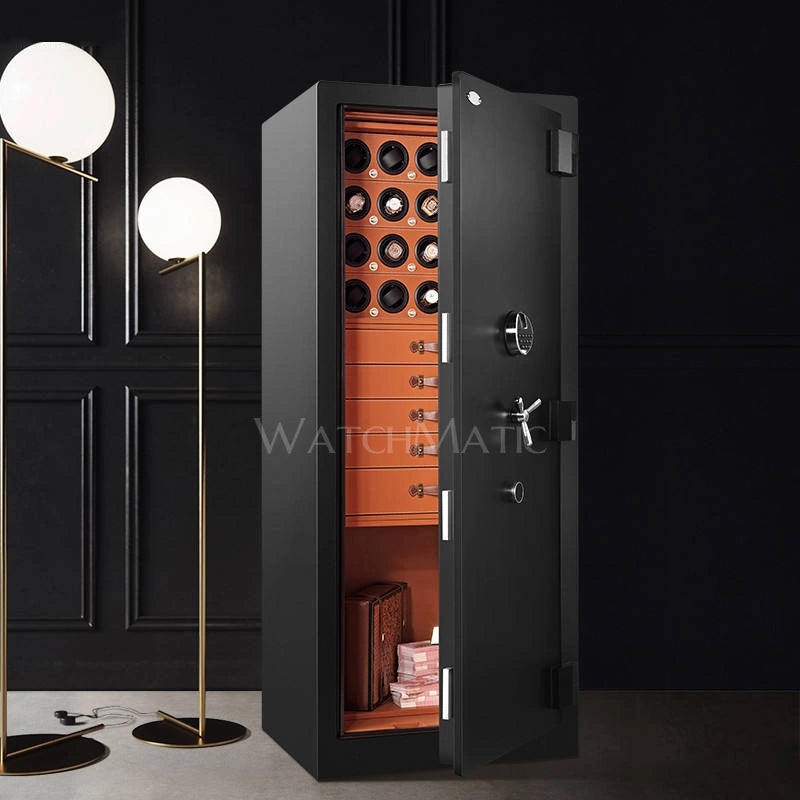
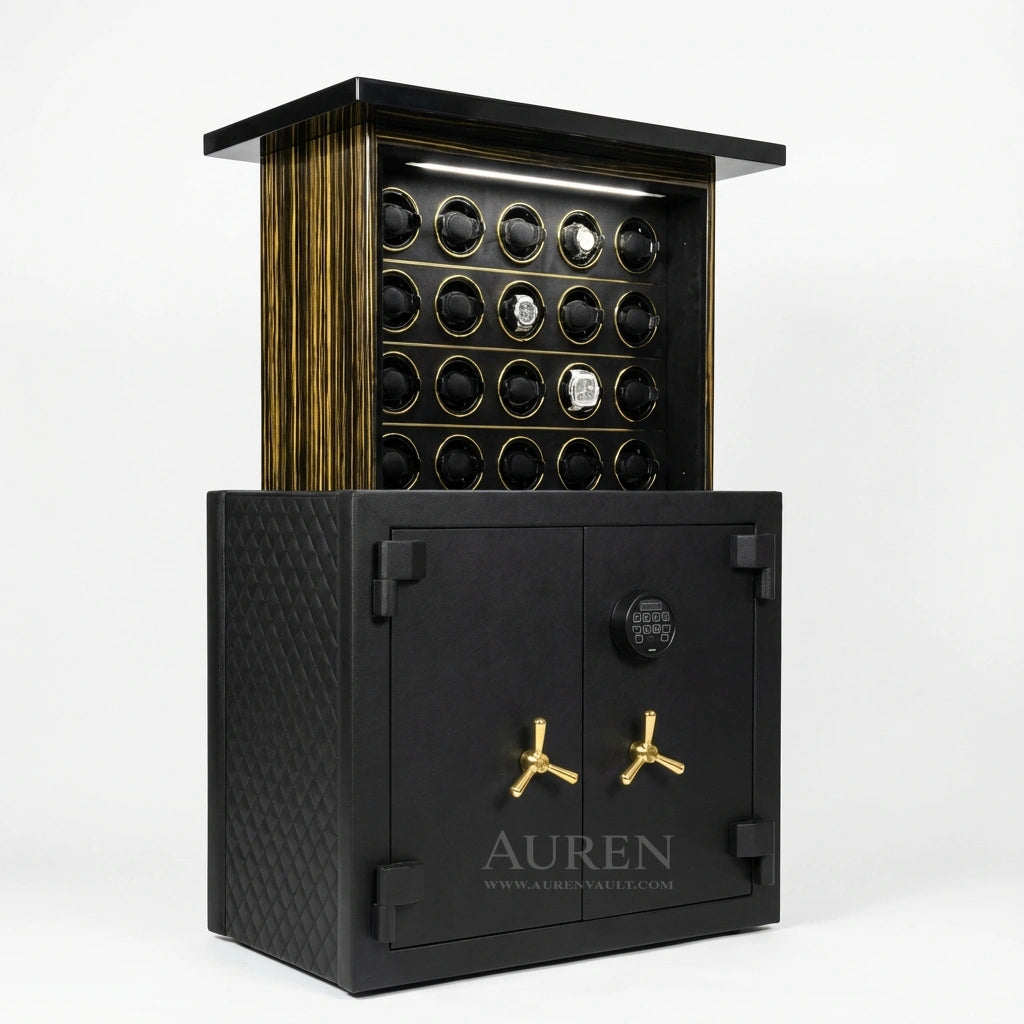
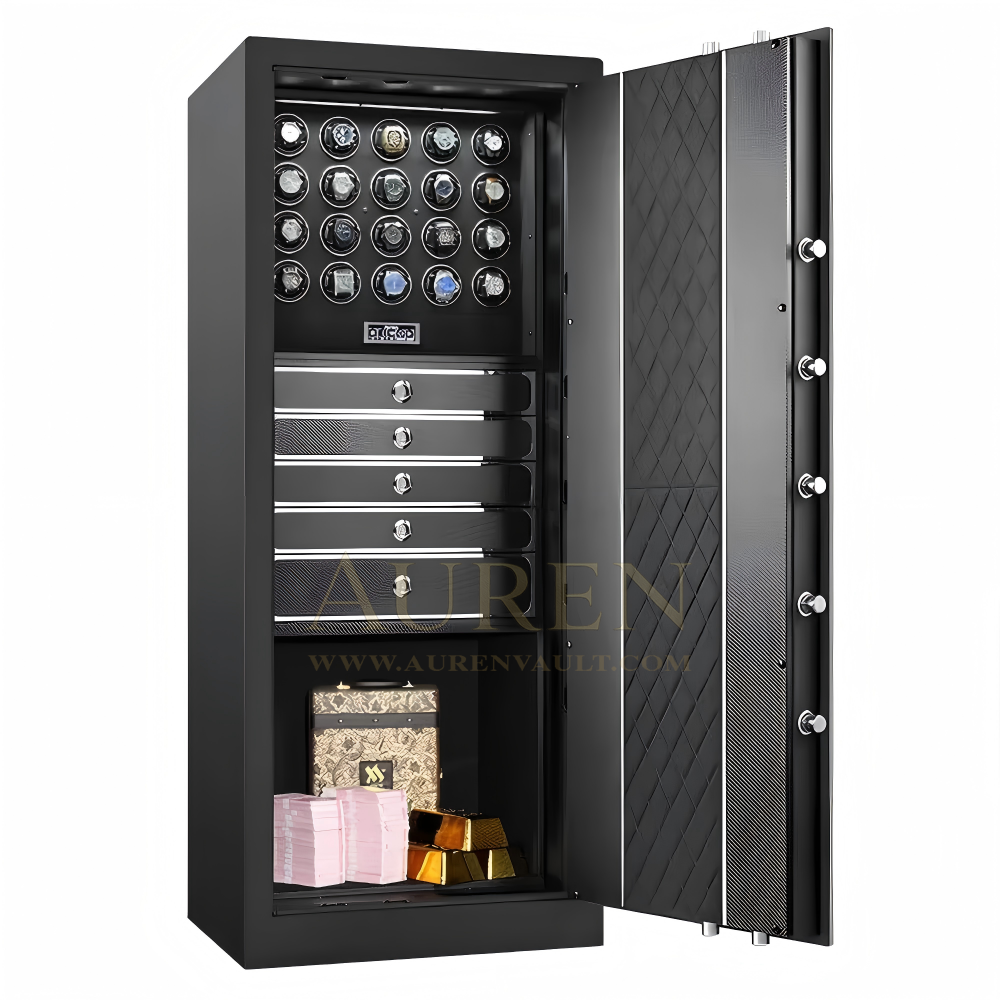
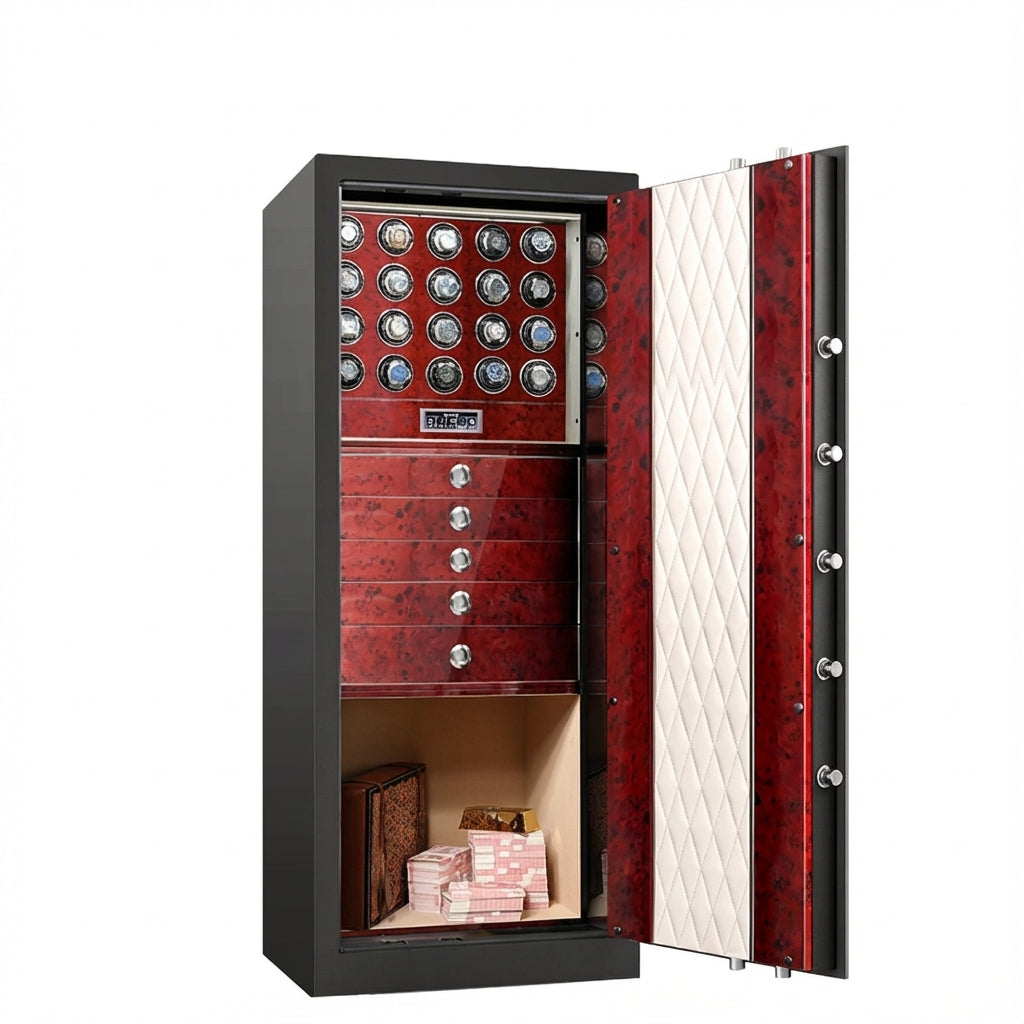
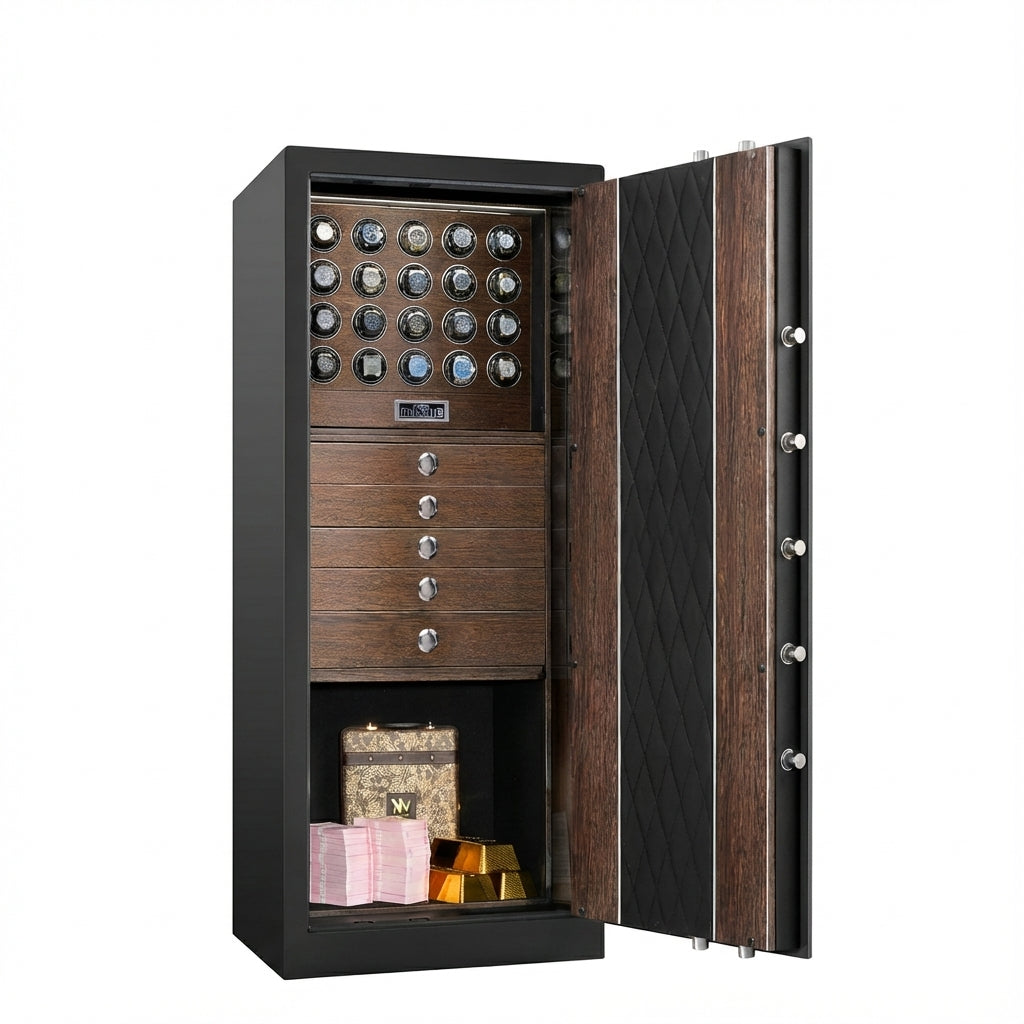
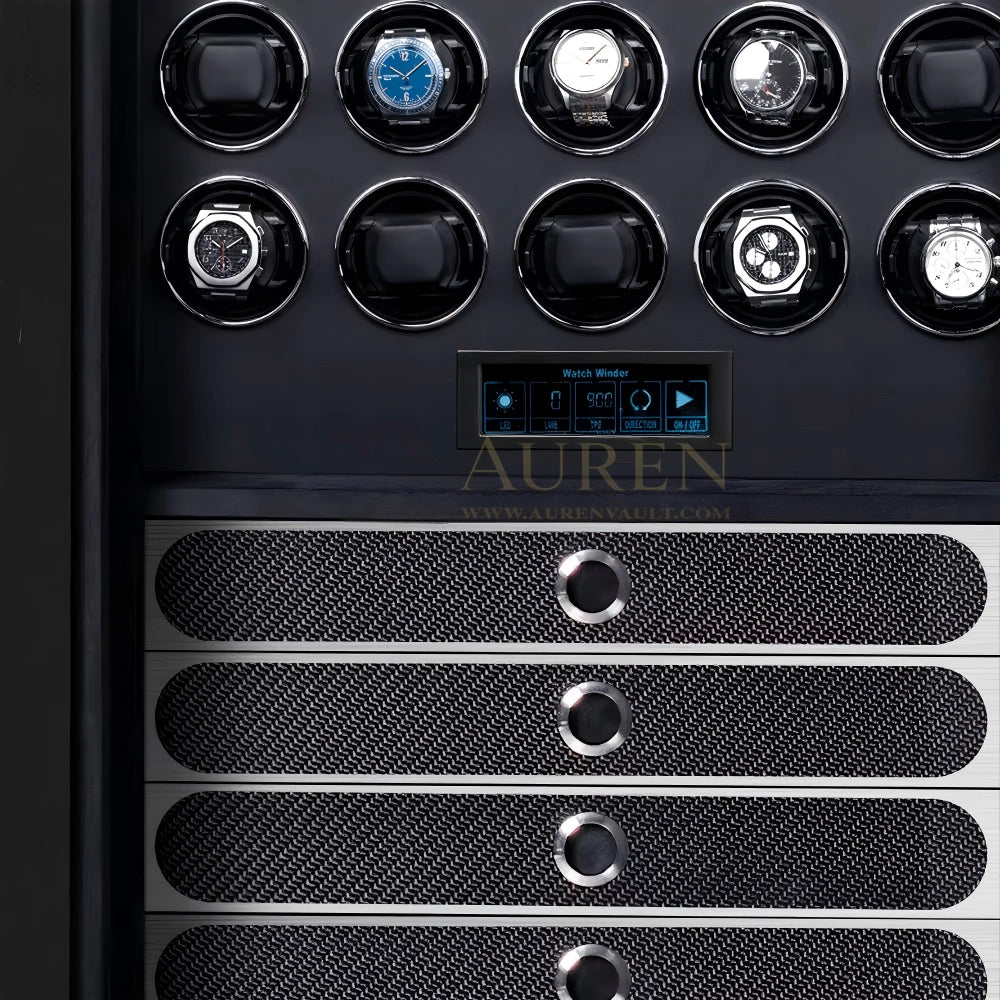
A watch winder safe may offer a practical way to combine these requirements.
It can accommodate automatic winding modules alongside protected stationary storage positions.
However, the protective capabilities of the enclosure must be evaluated independently.
A locking cabinet is not automatically certified for burglary resistance or fire protection.
Collectors can explore watch winder safes for integrated storage configurations.
The watch winder safe guide provides a broader explanation of the relationship between winding capacity and security.
Planning Storage Around a Serious Bovet Collection
Consider a collection containing a Miss Audrey, Récital 30, 19Thirty, Récital 12, Récital 22 Grand Récital, and Récital 28 Prowess 1.
Six watches are owned.
Only two are automatic.
The remaining four are manually wound and do not need rotating modules.
A cabinet containing six active winders would therefore allocate space inefficiently.
A more suitable configuration could provide two independently programmable winding positions and four protected passive compartments.
The manually wound watches would remain accessible without unnecessary rotation.
The automatic watches could be maintained according to their confirmed movement requirements.
Why Custom Storage Can Be Particularly Appropriate
Bovet watches have distinctive cases and complications.
A Miss Audrey with an Amadeo convertible case may require different support from a Récital 30.
A large Récital 28 may need more compartment clearance than a compact 19Thirty.
Their straps, case materials, and display mechanisms also vary.
A standardized watch holder may not accommodate every watch equally well.
For valuable collections, the internal layout deserves careful consideration.
The complete watch safe collection provides options for evaluating different capacities.
For larger portfolios, luxury watch safes may provide expanded organization and storage.
Where standard layouts are unsuitable, custom watch safe configurations can help address unusual case dimensions, passive storage requirements, and the balance between active and stationary positions.
The objective is to design storage around the watches rather than force each watch into a standard rotating holder.
How to Set Up a Watch Winder for an Automatic Bovet
Begin by identifying the exact watch and its movement.
Confirm that the movement is automatic.
For a Miss Audrey or Récital 30, obtain the appropriate winding requirements before selecting the program.
Do not assume that the watch requires 650 or 800 TPD merely because those numbers are common among other Swiss automatics.
If the watch has stopped, restart it according to Bovet's instructions.
A winder should generally maintain an existing reserve rather than be treated as a rapid replacement for the correct starting procedure.
Next, select the verified rotation direction and TPD.
Mount the watch securely using a suitable configuration.
For an Amadeo convertible case, ensure that the mounting arrangement is appropriate for the actual watch configuration.
Check that the case, bow, crown, and other components have sufficient clearance.
Allow the device to operate through its normal cycles.
Observe whether the watch maintains its reserve.
If problems occur, review the program and mechanical condition before increasing rotations.
For valuable complicated watches, professional assistance may be appropriate.
Should Bovet Watches Remain Wound All the Time?
There is no general requirement for every Bovet watch to remain running continuously.
For automatic references, a winder can provide convenience when the watch is not worn regularly.
For manually wound references, the decision is different.
The watch must be wound through its designated mechanism, and a conventional external winder provides no benefit.
Bovet's extended power reserves already give many manually wound models substantial flexibility between winding sessions.
For long-term storage, the priorities include careful handling, stable support, suitable environmental conditions, and appropriate security.
Continuous operation should not be confused with preservation.
Even an automatic watch does not require uninterrupted rotation.
The watch storage guide provides broader information about protecting mechanical collections.
Frequently Asked Questions About Bovet Watch Winders
What is the best watch winder for Bovet watches?
A precisely programmable winder with adjustable TPD, selectable direction, rest cycles, and suitable physical support is appropriate for automatic Bovet references. Many manually wound Bovet watches do not need a conventional winder at all.
Do all Bovet watches need a watch winder?
No. Many Bovet manufacture watches are manually wound. Only references with an automatic winding mechanism can benefit from a conventional rotating watch winder.
How many TPD does a Bovet automatic need?
There is no single verified TPD setting for every Bovet automatic. The correct program must be determined for the specific movement.
Can the Bovet Miss Audrey use a watch winder?
Yes. Documented Miss Audrey references use a self-winding movement with approximately 42 hours of power reserve. The winder must be compatible with the movement and the watch's distinctive case design.
Does the Bovet Amadeo case need a special watch winder?
A convertible Amadeo case requires careful physical support. A conventional winder may be suitable when the watch is correctly configured and securely mounted, but compatibility should not be assumed for pendant or desk-clock arrangements.
Is the Bovet Récital 30 automatic?
Yes. The Récital 30 uses an automatic movement with approximately 62 hours of power reserve. It can benefit from a compatible watch winder.
Does the Bovet Récital 12 need a winder?
No. The Récital 12 is manually wound and provides approximately seven days of power reserve. A conventional watch winder does not replenish its mainspring.
Can a Bovet 19Thirty be placed on a watch winder?
It can physically be placed in a suitable holder, but rotation does not wind its manual movement. Protected passive storage is more appropriate.
Does the Récital 22 Grand Récital need automatic winding?
No. The Récital 22 is manually wound and offers approximately nine days of reserve.
Does the Récital 28 Prowess 1 benefit from a winder?
No. Its complex mechanical movement is manually wound. Its ten-day reserve does not make it compatible with automatic winding.
Does a ten-day power reserve require higher TPD?
No. Power reserve does not determine winding method or external rotations. A manually wound ten-day movement cannot receive energy from a conventional rotating winder.
Can a watch winder overwind an automatic Bovet?
Automatic movements generally use mechanisms to limit excessive mainspring tension, but appropriate rotation programs remain important. Unnecessary winding activity should be avoided.
Is a watch winder safe worthwhile for Bovet collectors?
It can be appropriate for collectors who want to combine automatic winding with enclosed storage. For collections dominated by manually wound complications, high-quality passive storage may be more important than the number of winding modules.
Related Reading
Collectors interested in exceptional mechanical complications and appropriate storage may also find these articles useful:
-
Best Watch Winder for Vacheron Constantin Watches — Explores movement-specific winding and the storage of complicated mechanical watches.
-
Best Watch Winder for Jaeger-LeCoultre: TPD & Care Guide — Explains automatic and manually wound movement differences, particularly for calendar complications.
-
Watch Safes with Built-In Watch Winders: Are They Worth It? — Discusses the advantages of combining active winding and enclosed storage.
Final Thoughts: The Best Bovet Storage Strategy Is Not Always a Watch Winder
Bovet demonstrates why a serious collector should never assume that mechanical complexity requires automatic winding.
The Miss Audrey and Récital 30 can benefit from compatible winders because they use self-winding movements.
Many of the Maison's most sophisticated complications, including the 19Thirty, Récital 12, Récital 22, and Récital 28, are manually wound.
For those watches, the correct approach is careful manual winding and suitable passive storage.
A collector with both movement types may benefit from an integrated system combining a small number of precisely programmed winding positions with protected stationary compartments.
At Auren Vault, the focus is on creating refined storage arrangements that respect the different mechanical requirements within valuable watch collections.
Ultimately, the best solution for Bovet is not determined by the number of winding modules or the highest available TPD.
It is the system that respects each movement's engineering, accommodates the watch's distinctive construction, and provides appropriate protection throughout ownership.