

Blancpain automatic watches do not share one universal turns-per-day (TPD) or winding-direction setting. Independent winding databases recommend substantially different programs for several established calibres, making movement-specific verification particularly important.
For example, some third-party references recommend approximately 950–960 TPD clockwise for the Fifty Fathoms Calibre 1315, while others suggest 650–800 TPD with bidirectional rotation. Calibres 1150 and 1151 also appear with different directional recommendations across independent sources.
These figures should not be treated as official Blancpain winding instructions.
Power reserves vary considerably. The Fifty Fathoms Calibre 1315 provides approximately 120 hours, the Villeret Calibre 1151 offers 100 hours, and the complete-calendar Calibre 6654.4 provides approximately 72 hours.
A compatible winder can maintain the energy of these automatic movements, particularly when a watch remains unworn for extended periods. However, manually wound Blancpain calibres such as 11A4B and 1333SQ cannot benefit from conventional external rotation.
The correct approach is to identify the exact movement, verify its external winding requirements, and select a program that maintains adequate reserve without unnecessary activity.
Why Blancpain Watch Winder Settings Require Verification
Blancpain's contemporary watchmaking is associated with two particularly different traditions.
The Fifty Fathoms collection emphasizes technical diving-watch construction.
The Villeret collection represents classical mechanical watchmaking, including ultra-thin movements and sophisticated calendar complications.
These watches can contain very different automatic winding systems.
A Fifty Fathoms using Calibre 1315 has approximately five days of reserve.
A Villeret Complete Calendar with Calibre 6654.4 has approximately three days.
The first may remain running throughout several days of non-use without external winding.
The second may stop sooner, requiring the owner to restore its calendar and moonphase indications.
This creates different practical reasons for using a winder.
However, the amount of external rotation required should still be determined by the winding architecture.
A longer reserve does not automatically mean fewer TPD, and a complicated calendar does not automatically require more.
The first task is to establish the exact calibre and its external winding program.
Blancpain Watch Winder Settings by Calibre
Independent reference databases provide useful information about Blancpain movements, but their recommendations are not always consistent.
The discrepancy is particularly significant for Calibre 1315.
One established historical table lists approximately 960 TPD clockwise.
Other contemporary guides suggest approximately 650–800 TPD bidirectional.
These are different recommendations, not interchangeable descriptions of one confirmed factory program.
Blancpain TPD and Rotation Direction Chart
| Calibre | Representative watch | Power reserve | Independent TPD reference | External direction |
|---|---|---|---|---|
| 1315 | Fifty Fathoms Automatique / Bathyscaphe | 120 hours | 650–800 or 950–960 | Conflicting: both / clockwise |
| 1150 | Selected Bathyscaphe 38 mm | 100 hours | Approx. 650 | Sources differ |
| 1151 | Villeret Ultraplate | 100 hours | Approx. 650–820 | Sources differ |
| 6654.4 | Villeret Complete Calendar | 72 hours | Around 650 in selected model listings | Verify exact variant |
| F388B | Air Command Flyback Chronograph | 50 hours | No consistently verified setting | Verify |
| 1185 | Historical automatic chronographs | Reference-dependent | Approx. 800–950 | Clockwise in historical tables |
| 11A4B | Villeret Ultraplate 6605 | 100 hours | Not applicable | Manual winding |
| 1333SQ | Villeret Squelette 8 Jours | 192 hours | Not applicable | Manual winding |
Movement classifications and reserves refer to representative Blancpain references. Numeric TPD settings originate from independent databases. Conflicting recommendations should be confirmed rather than averaged.
The table illustrates why a fixed-speed watch winder is not ideal for a diverse Blancpain collection.
Different movements may require different directions and rotation counts.
The availability of independently adjustable TPD, clockwise, counterclockwise, and bidirectional programs is more useful than a large number of unspecified presets.
The watch TPD guide explains how external rotation settings relate to effective winding.
Fifty Fathoms: Why Calibre 1315 Is the Main TPD Question
Calibre 1315 is one of Blancpain's best-known modern automatic movements.
It is used in numerous Fifty Fathoms and Bathyscaphe references.
The movement provides approximately 120 hours of reserve through a multi-barrel construction.
This gives the owner five days of autonomy when the movement begins with sufficient stored energy.
It also changes the practical value of a watch winder.
For an owner who wears a Fifty Fathoms regularly, the five-day reserve may cover most short periods between wears.
A watch worn on Friday may still be running on Tuesday, depending on its initial reserve.
For someone who rotates watches over ten days or more, a winder may provide greater convenience.
Why the Calibre 1315 TPD Figures Conflict
The most significant issue is the disagreement between independent recommendations.
Some established databases list approximately 950–960 TPD clockwise.
Other sources suggest 650–800 TPD bidirectional.
These programs differ both in daily rotation count and direction.
It would be misleading to choose one without acknowledging the disagreement.
A collector should confirm the program for the exact calibre and external device through Blancpain, an authorized service representative, or reliable movement-specific documentation.
Why Higher TPD Is Not Automatically Better
A watch winder should replace enough energy to compensate for the movement's consumption.
It does not need to keep the rotor moving continuously.
Once a verified program maintains an adequate running reserve, additional rotations may provide little benefit.
If a Fifty Fathoms stops despite an apparently suitable program, the owner should investigate direction, effective rotation count, initial reserve, and device operation.
Increasing TPD alone is not necessarily the correct solution.
The Dive Bezel Does Not Indicate Winding Direction
The Fifty Fathoms uses a unidirectional rotating bezel for elapsed-time measurement.
This has no direct relationship to the automatic movement's external winding direction.
A unidirectional dive bezel does not mean that the watch winder must rotate clockwise or counterclockwise.
The two mechanisms serve completely different purposes.
This distinction is important when interpreting technical specifications for diving watches.
Bathyscaphe: Calibre 1315 Versus Calibre 1150
The Bathyscaphe collection includes different case sizes and movement generations.
Selected larger references use Calibre 1315.
Certain 38 mm versions use Calibre 1150, which provides approximately 100 hours of reserve.
Although both are automatic, their winding programs should be established separately.
Bathyscaphe With Calibre 1150
The Calibre 1150 provides approximately four days of autonomy.
Independent winding databases commonly publish settings around 650 TPD, but they do not consistently agree on external direction.
Some references recommend counterclockwise rotation, while others provide a bidirectional program.
The exact movement and winder should therefore be verified before prolonged use.
The shorter reserve compared with Calibre 1315 does not automatically establish that the 1150 needs more rotations.
Reserve duration and rotor winding efficiency remain distinct specifications.
Why Bathyscaphe Dimensions Matter
A larger Bathyscaphe may have a substantial case and a relatively thick strap.
A smaller 38 mm model may require a more compact cushion.
The correct winder should accommodate both electronic and physical requirements.
A watch that fits inside a compartment should also remain stable throughout rotation.
The crown, bezel, case, and strap should have adequate clearance and should not contact surrounding surfaces.
Villeret Ultraplate: Calibre 1151 and Its Four-Day Reserve
The Villeret Ultraplate demonstrates Blancpain's classical dress-watch approach.
Representative automatic references use Calibre 1151, providing approximately 100 hours of reserve.
This autonomy is substantial for a relatively slim watch.
An owner who wears the Villeret several times a week may have little reason to use a winder.
For occasional wear, a compatible device can maintain its reserve between appearances.
However, the correct program remains movement-specific.
Independent databases provide inconsistent recommendations for Calibre 1151, including figures near 650–820 TPD and differing external directions.
A verified setting is preferable to automatically adopting one of these values.
Why Slim Watches Need Different Holders
Villeret watches are often fitted with refined leather straps.
A large rigid winder cushion can stretch these straps unnecessarily.
A smaller compressible holder provides more suitable support.
The watch should remain stable without excessive pressure on the polished case, strap, or clasp.
For an ultra-thin watch, adequate clearance and gentle contact materials are particularly important.
Villeret Complete Calendar: Calibre 6654.4
The Villeret Quantième Complet uses automatic Calibre 6654.4 in representative references.
Blancpain specifies approximately 72 hours of reserve.
The movement includes day, date, month, and moonphase indications.
This creates a different ownership experience from a simple automatic watch.
If the movement stops, the owner may need to restore several calendar displays.
These adjustments must follow the manufacturer's instructions.
A compatible winder can help keep the movement operating and reduce repeated setting.
Does a Complete Calendar Need More TPD?
Not automatically.
The complication uses energy from the movement's mainspring but does not independently establish its winding direction or external rotation requirement.
The correct program depends on Calibre 6654.4.
Some historical references provide settings around 650 TPD for related complete-calendar models, but this should not be treated as a universal instruction for every 6654.4 configuration.
Under-Lug Correctors and Calendar Care
Certain Villeret calendar watches incorporate Blancpain's under-lug correctors.
These allow the owner to adjust calendar indications without conventional recessed case-side correctors.
However, the convenience of the adjustment mechanism does not remove the importance of following the correct procedure.
A watch winder should maintain the movement's energy, not substitute for proper calendar setting.
For collectors with several complete-calendar watches, this distinction becomes particularly useful.
Air Command: Why Chronograph Frequency Does Not Establish TPD
The Air Command Flyback Chronograph uses automatic Calibre F388B in representative references.
It operates at 5 Hz and provides approximately 50 hours of reserve.
This is considerably shorter than the five-day reserve of Calibre 1315.
A collector who rotates watches over several days may therefore find a winder more convenient for the Air Command.
However, its chronograph complication and high-frequency regulation do not automatically require more TPD.
Frequency measures the operation of the regulating system.
TPD measures the external winding motion.
A reliable external program must be established according to the actual automatic winding mechanism.
The chronograph's crown and pushers also require sufficient physical clearance during rotation.
Blancpain Watches That Do Not Need a Winder
The Villeret collection includes manually wound watches.
The Villeret Ultraplate 6605 uses Calibre 11A4B, with approximately 100 hours of reserve.
The Villeret Squelette 8 Jours uses manual Calibre 1333SQ, providing approximately eight days of reserve.
Neither movement contains the conventional automatic winding system required for a rotating winder to replenish its mainspring.
These watches must be wound through their crowns.
A long reserve does not mean a movement is automatic.
For collectors, this affects how active winding capacity should be allocated.
An eight-watch collection containing three manually wound pieces does not need eight active rotors.
Passive compartments may provide a better arrangement for the manual watches.
How to Configure a Blancpain Watch Winder
Begin by identifying the exact watch reference and calibre.
Do not select a program using only the collection name.
If the watch is automatic and has stopped, follow Blancpain's instructions for restarting it manually.
The winder should then maintain the established reserve through controlled motion.
Choose the external direction and TPD supported by reliable movement-specific guidance.
For movements with conflicting published settings, seek clarification before prolonged operation.
Mount the watch securely and check clearance throughout a complete rotation.
Then monitor whether the watch maintains adequate energy over several days.
If it stops, investigate the initial reserve, program, device performance, and mechanical condition.
A winder is a maintenance convenience, not a replacement for servicing.
How Much Winding Does a Blancpain Actually Need?
A winder should replenish enough energy to maintain the movement's operating state.
It does not necessarily need to hold the mainspring at maximum reserve at all times.
Modern automatic movements generally incorporate mechanisms that prevent ordinary automatic winding from increasing mainspring tension indefinitely.
Nevertheless, unnecessarily high external rotation provides no clear advantage.
The most appropriate program is one that maintains sufficient reserve through reliable operating and rest cycles.
For Blancpain, where independent settings can conflict substantially, the effectiveness of the actual device matters more than selecting the highest published number.
Storage for a Mixed Blancpain Collection
Consider a collector with a Fifty Fathoms Calibre 1315, Bathyscaphe Calibre 1150, Villeret Complete Calendar, Air Command, and two manually wound Villeret watches.
Four are automatic.
Two are manually wound.
A configuration containing four independently programmable winding positions and two passive compartments would provide an appropriate starting arrangement.
The owner could reduce active winding further if some watches are worn regularly.
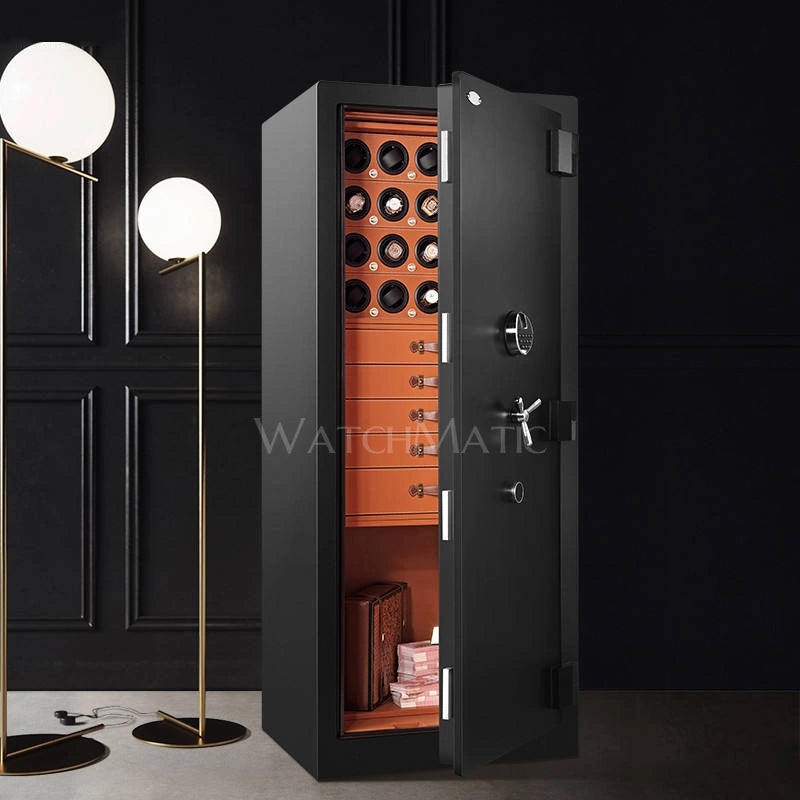
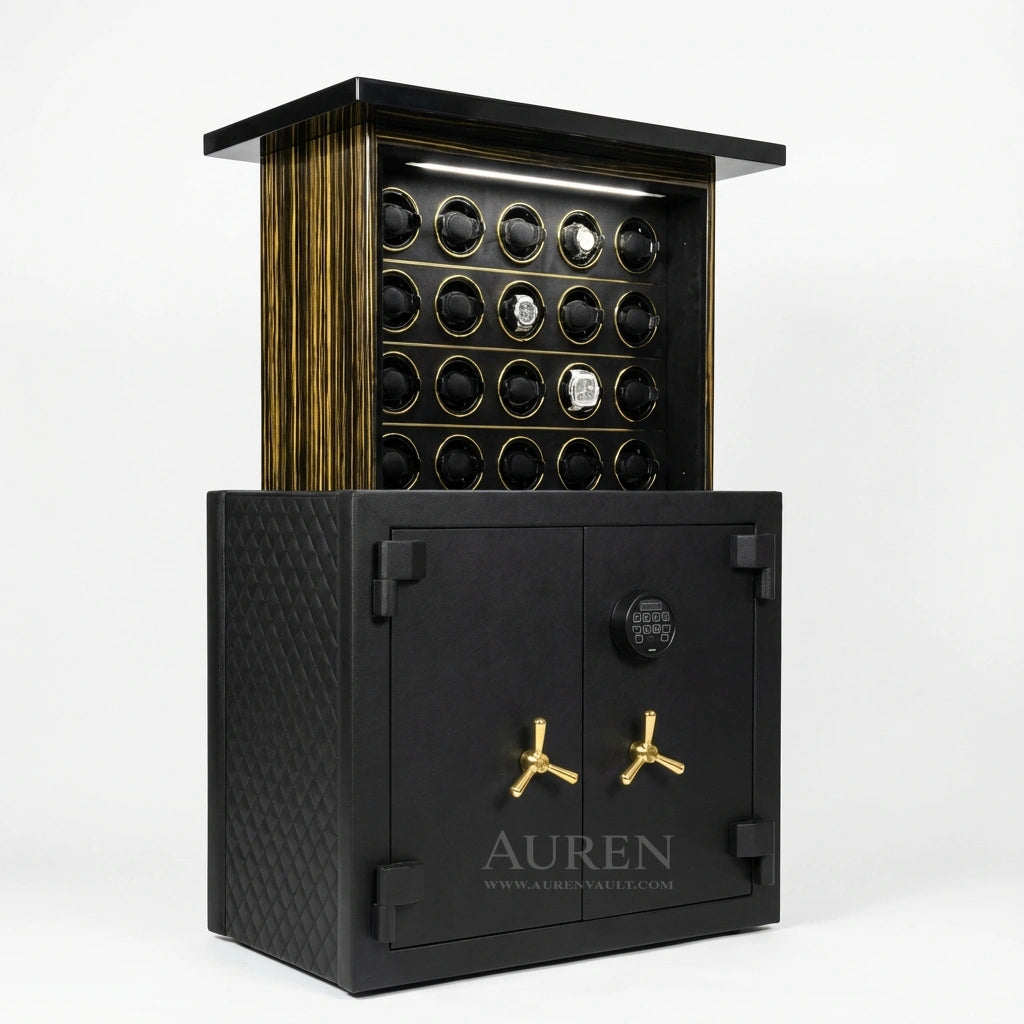
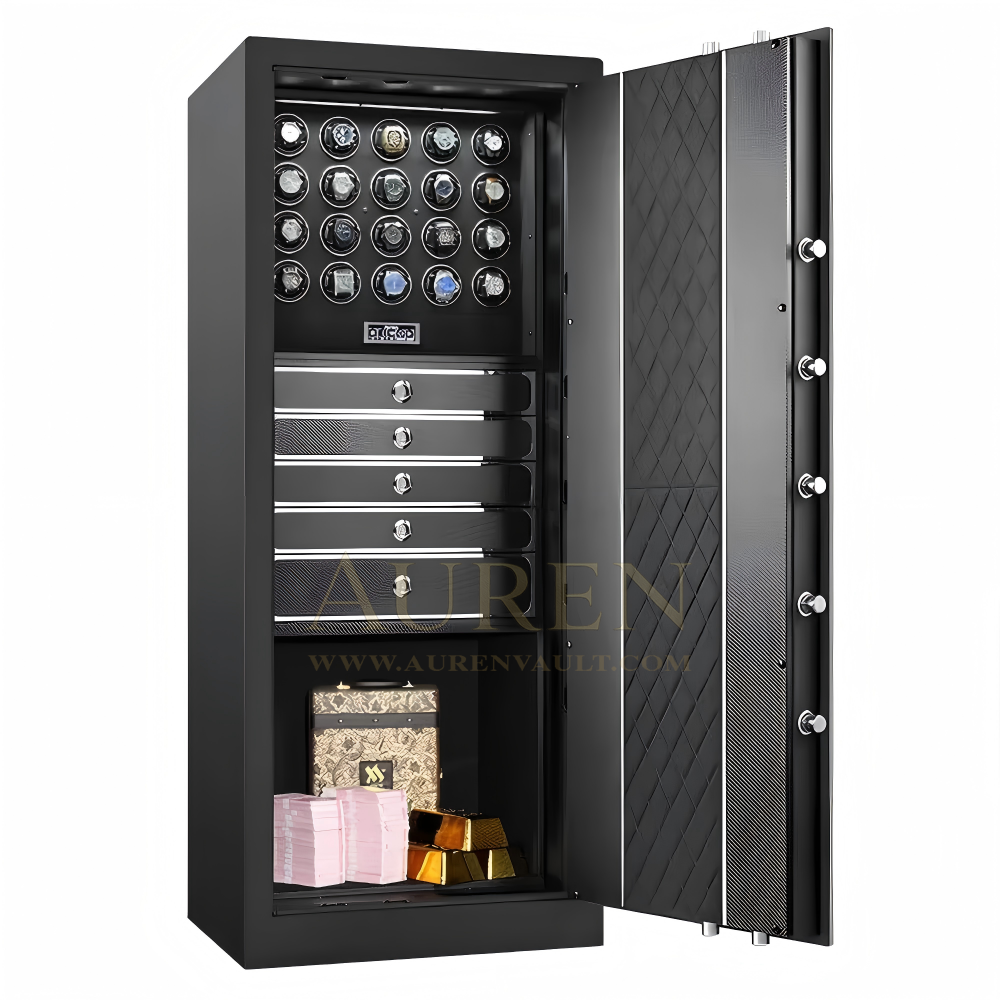
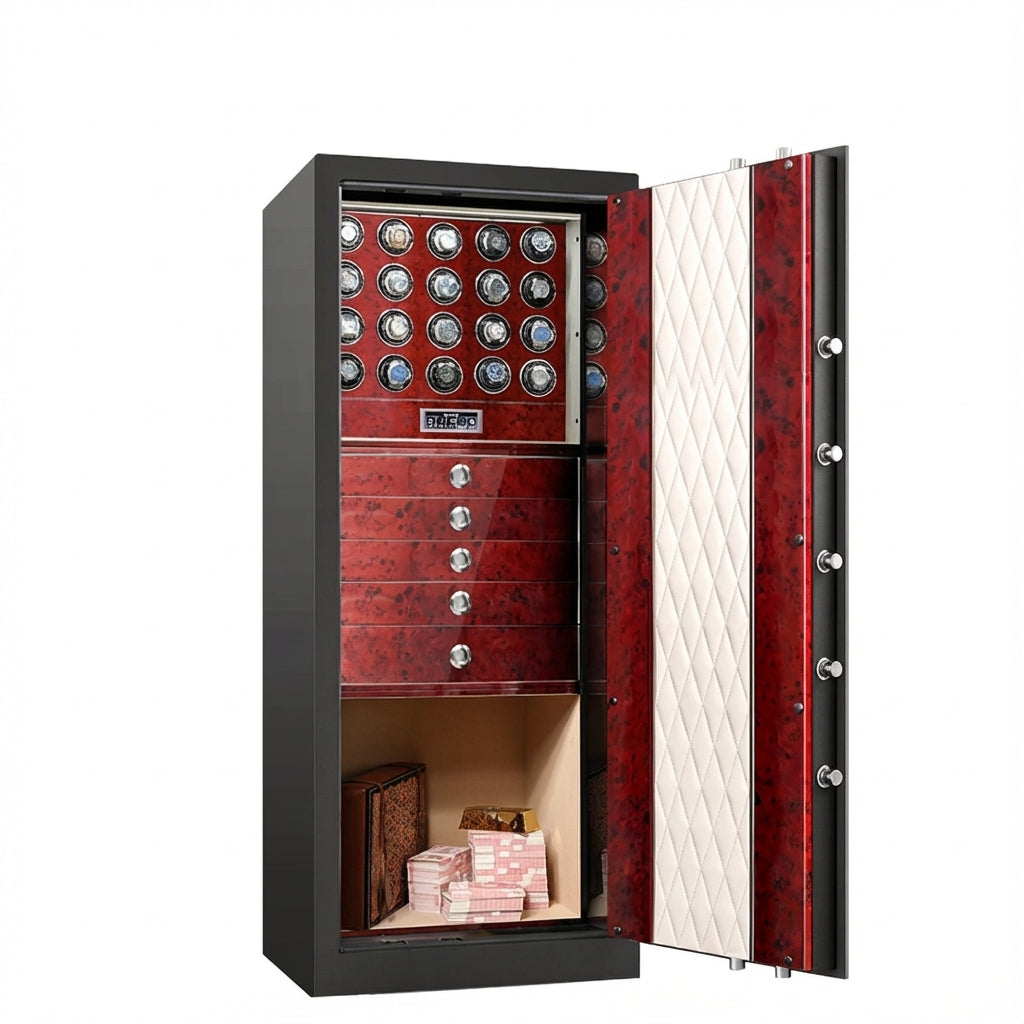
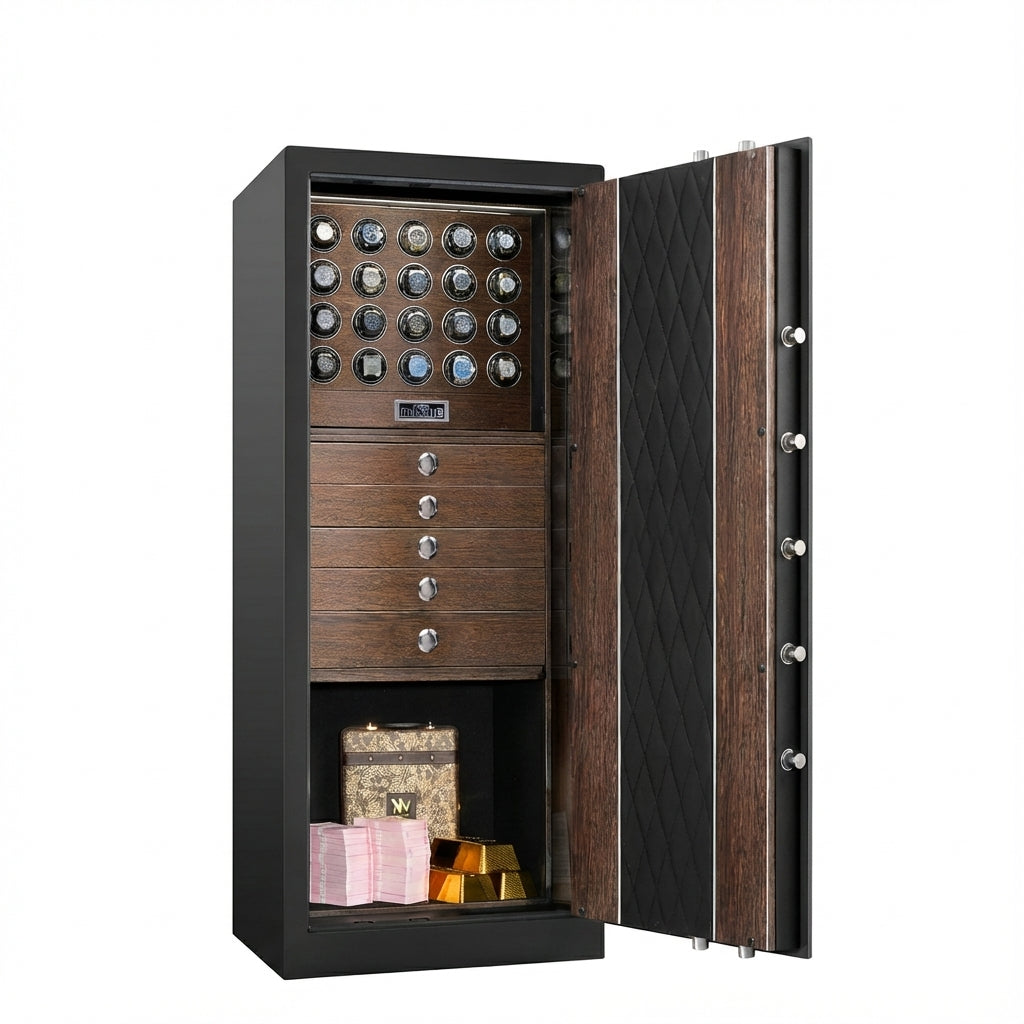
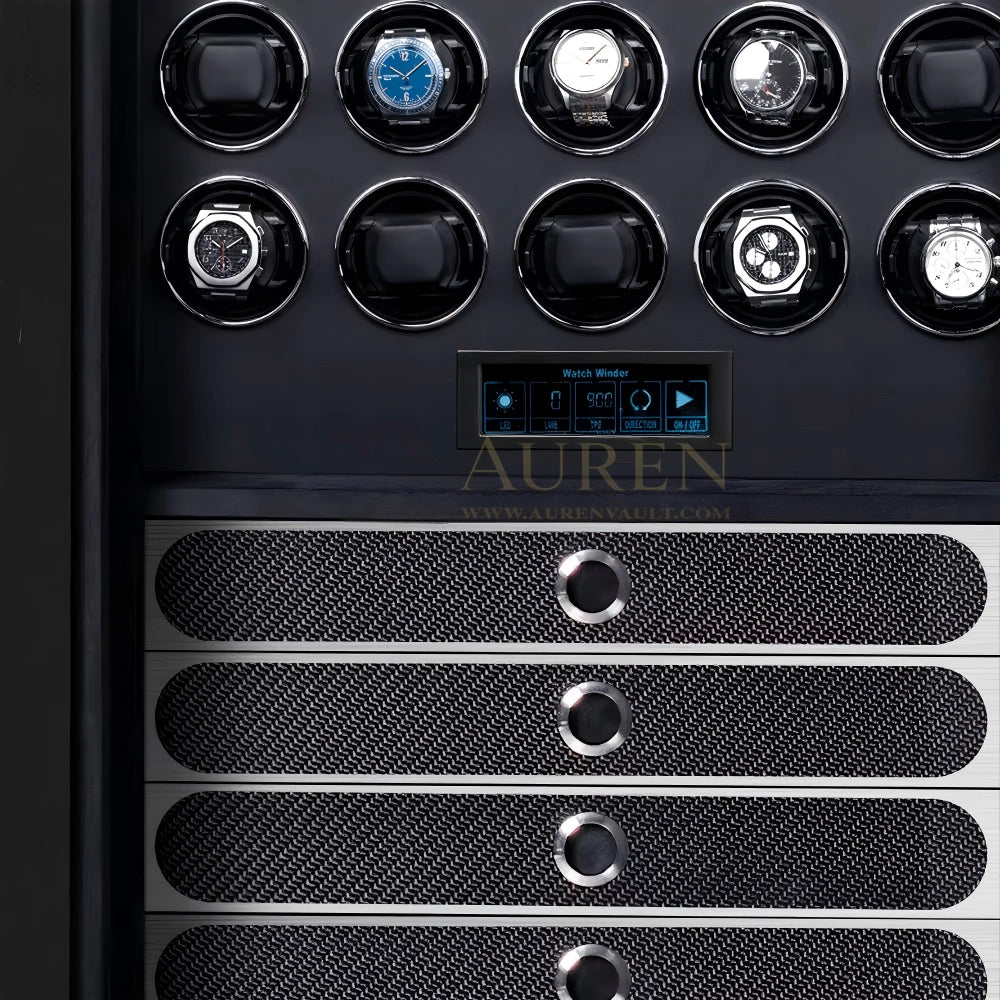
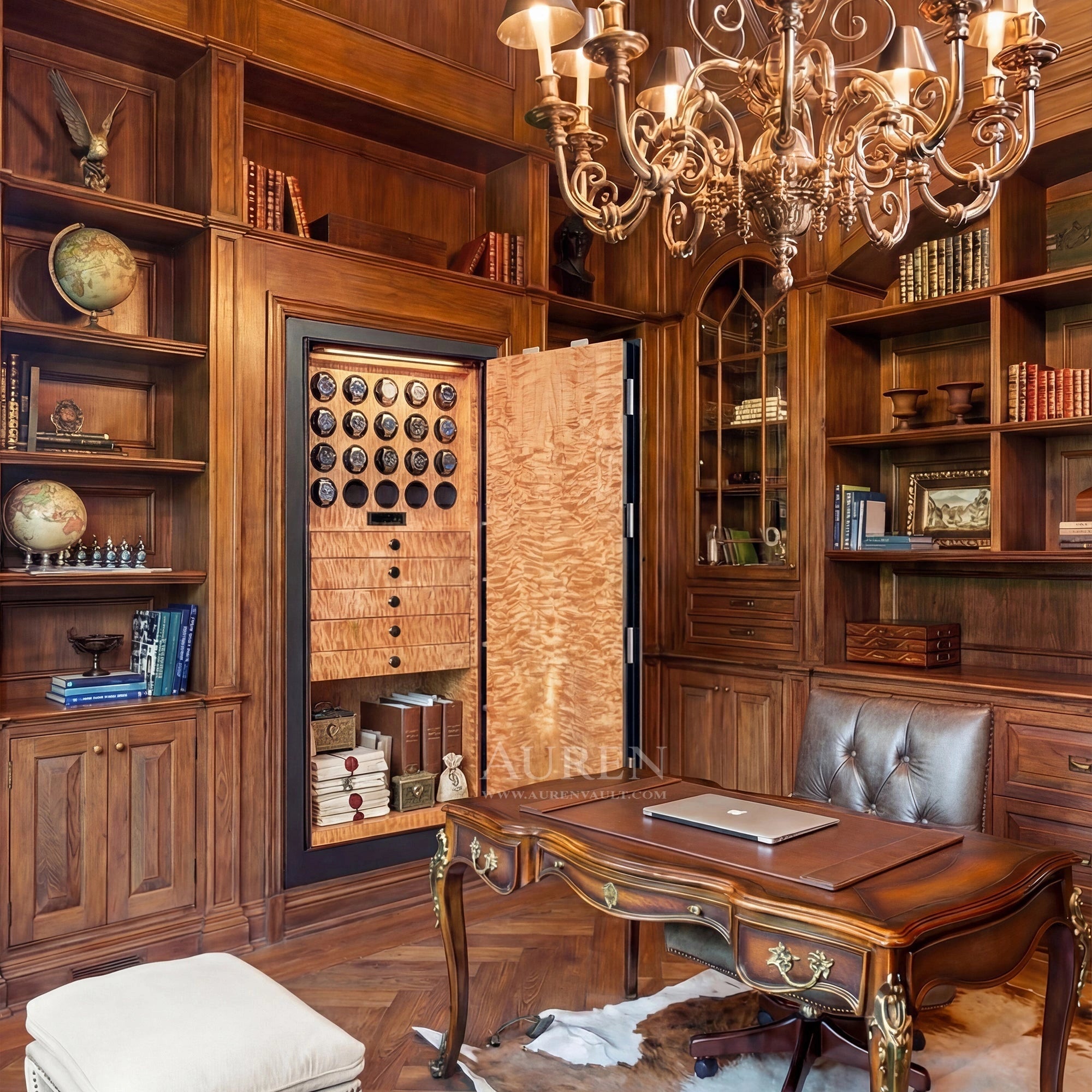
For combined winding and enclosed protection, watch winder safes offer configurations that may accommodate both automatic and passive storage.
The watch winder safe guide explains how to evaluate winding capacity and protection separately.
A locking cabinet should not be assumed to provide certified burglary or fire resistance without product-specific documentation.
Long-Term Storage and Environmental Care
Blancpain watches may combine substantial diving cases, refined dress-watch finishes, leather straps, and complicated calendar mechanisms.
These require appropriate physical support and stable environmental conditions.
High humidity, condensation, and large temperature fluctuations can create unfavorable storage conditions.
An enclosed safe does not automatically provide humidity control.
For extended periods of non-use, passive storage may be reasonable when consistent with Blancpain's guidance.
The watch storage guide provides broader considerations for protecting mechanical watches.
Frequently Asked Questions About Blancpain TPD
What is the recommended TPD for Blancpain watches?
There is no universal setting. Independent sources disagree on several calibres, including Calibre 1315. Confirm the exact movement and external device before choosing a program.
What is the correct TPD for Fifty Fathoms Calibre 1315?
Some independent databases list approximately 950–960 TPD clockwise, while others recommend 650–800 TPD bidirectional. Neither should be treated as a universal manufacturer-issued instruction.
Does a five-day Fifty Fathoms need a winder?
No. Its approximately 120-hour reserve can support several days without additional winding. A winder becomes more convenient when it remains unworn beyond that period.
What direction does Blancpain Calibre 1150 require?
Independent references differ. Some recommend counterclockwise rotation, while others suggest bidirectional operation. Movement-specific verification is advisable.
Can a Villeret Complete Calendar use a winder?
Yes. Representative Calibre 6654.4 references are automatic. A compatible winder can reduce the need to reset calendar and moonphase displays.
Does a Blancpain chronograph need more TPD?
Not automatically. The chronograph complication does not independently establish the external winding requirement.
Can manually wound Blancpain watches use a winder?
No. Manual calibres such as 11A4B and 1333SQ must receive energy through their crowns.
Does 100 hours of power reserve mean fewer TPD?
Not necessarily. Power reserve and automatic winding efficiency are separate characteristics.
Can a Blancpain be overwound on a watch winder?
Modern automatic movements generally manage excess mainspring tension during winding. However, unnecessary external rotation remains undesirable.
Is a watch winder safe suitable for Blancpain?
It can be appropriate for collectors who want enclosed storage and individually programmable winding modules. Compatibility, physical fit, and documented protective specifications should all be evaluated.
Related Reading: Blancpain Winding and Watch Storage
For a broader discussion of equipment selection, Best Watch Winder for Blancpain Watches examines movement compatibility and physical storage requirements.
Collectors comparing integrated storage can also explore Watch Safes with Built-In Watch Winders: Are They Worth It?.
For environmental preservation, Why Humidity Can Damage Luxury Watches addresses the risks associated with moisture and storage conditions.
Final Perspective: Blancpain TPD Requires More Than a Single Number
Blancpain demonstrates why independent winding databases should be interpreted carefully.
The Fifty Fathoms 1315, Bathyscaphe 1150, Villeret 1151, and complete-calendar 6654.4 have different technical and ownership considerations.
For several movements, published external settings are inconsistent.
The appropriate response is not to select the highest number, but to confirm the exact calibre and effective program.
For mixed collections, independent rotor controls and passive compartments can provide greater flexibility.
Auren Vault offers watch storage and integrated winding configurations designed around varying collection requirements.
The correct Blancpain TPD setting is ultimately the one supported by the movement's actual winding characteristics and the external device's operation.